
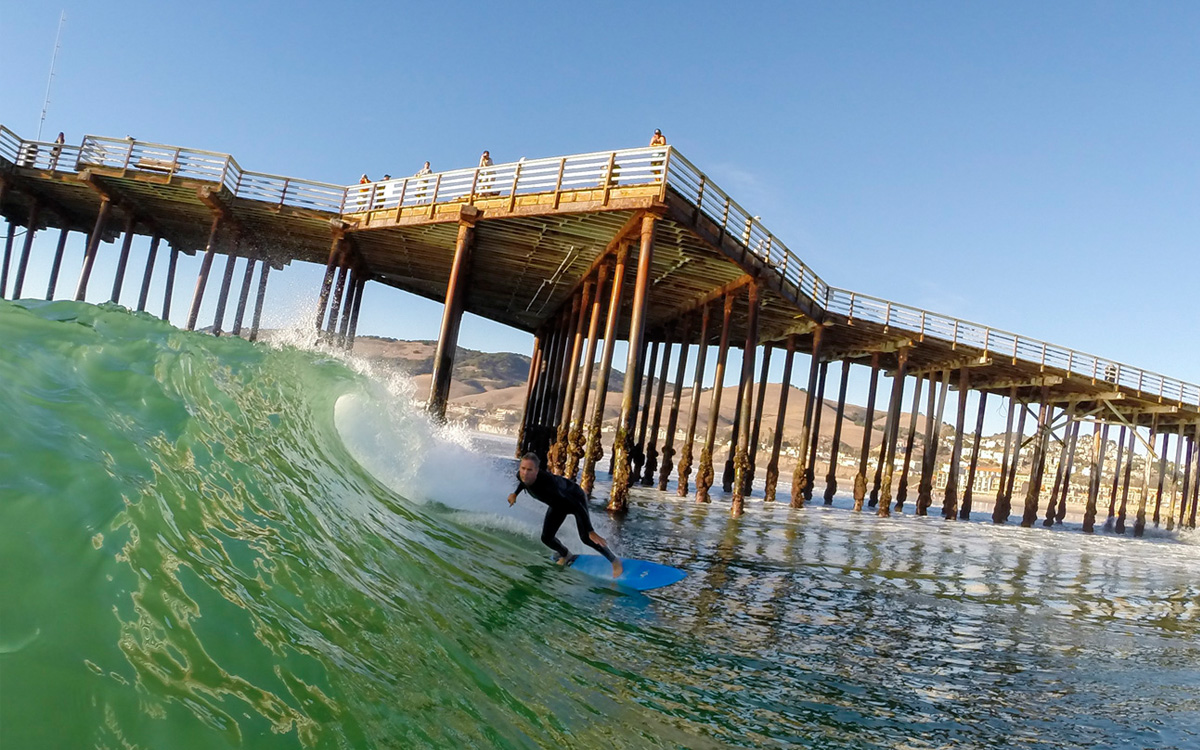
Pismo Beach Open Director Andy McKay knows the Pismo Pier gets good. Good enough for an event. Photo: Jonathon Reis/PismoBeachOpen.com

Of the ranks of surfers on the World Championship Tour, fewer than you might think have these three letters next to their name: USA. To be exact, excluding Hawaii, just three men (out of 36) and three women (out of 18) hail from the United States.
Compare that, for example, to Australia or Brazil. The letters “AUS” accompany 13 names on the men’s tour and eight — nearly half — on the women’s. For its part, Brazil has nine men on the CT. Sure, Australia has a rich heritage of competitive surfing. But when you consider that California’s population alone outnumbers the entire Australian nation by more than 15 million, you have to wonder: Where are all the Americans?
Of all the possible answers, this one’s worth considering: Very few Qualifying Series events take place in the mainland U.S. Meaning that young Californians, Floridians and North Carolinians have to shell out for airfare and schlep to Hawaii, Japan, or farther away, to net the five results that count toward their QS ranking.
This year’s QS is made up of 52 events. Only six of those are in the mainland U.S., just one more than will be held on Oahu, an island the same size as Santa Cruz County.
“It’s criminal that there are only a few events here,” says Andy McKay, a former competitive surfer who now owns Surfside Donuts in Pismo Beach. Last year, McKay’s nephew Austin Neumann competed in QS events in Florida and Israel to get five results. “I thought, why aren’t there more events in California?”
On a trip to Costa Rica, McKay met Brian Robbins, the WSL’s tour director, who told him how QS events come to be: Event organizers create events, get funding and assume the financial risk, and the WSL can choose to sanction it as a QS if it wants. McKay decided to go for it, and has planned a brand new QS event, the Pismo Beach Open, a 1,000-point contest. If McKay gets enough money to run the event, it’ll be held Nov. 17 to 19 by the iconic pier.
A 1,000-point event like the Pismo Beach Open requires about $35,000 in sponsorship costs. A 3,000-point event can cost $150,000, and a 10,000-point event runs about $500,000. “They bring the judges and the scoring system and you do everything else,” McKay says, including renting scaffolding, feeding and housing judges and more.
Getting that kind of funding is easier in Australia, where competitive surfing is more of a national pastime, than the U.S., says Brian Robbins, the WSL tour manager. “Australia is fortunate to be the beneficiary of some government funding, and surfing is a bigger sport than in the U.S. There’s more visibility,” he says.
For contest promoters, the higher the level of competition, the better the prospect of earning a good return on the investment, Robbins says. So making a business out of low-level QS events isn’t as easy a prospect as with an event like the Vans U.S. Open of Surfing or the Triple Crown, for example.
For his part, McKay believes holding more QS events would mean more young Californians would compete on the QS, and eventually the CT. “Looking at California surfers alone, I can’t help but think that’s true,” he says.
The WSL would like to see more low-level events in California, too. “I’d love to see a couple more, just on the basis that there’s a lot of surfers in California, and every time we put on an event, it’s full,” says Robbins.
But would holding more events in North America lead to more American CT surfers? “Maybe, maybe not,” says Robbins. He thinks that more low-level events like QS 1,000s would probably net more American youngsters on the CT.
With so much talent worldwide, though, that’s obviously no guarantee that would put more Americans on the big stage of the CT. For the time being, patriotic surf fans may just have to root for Kelly Slater, Kolohe Andino, Kanoa Igarashi, and Nat Young.
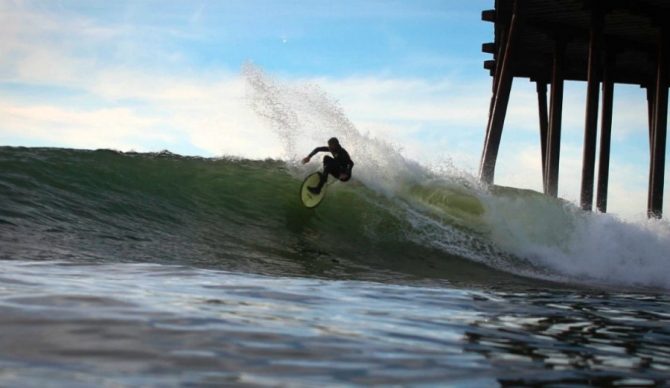
With conditions like this, a contest at Pismo Beach could be very contestable indeed. Photo: Wahl Surfboards

