
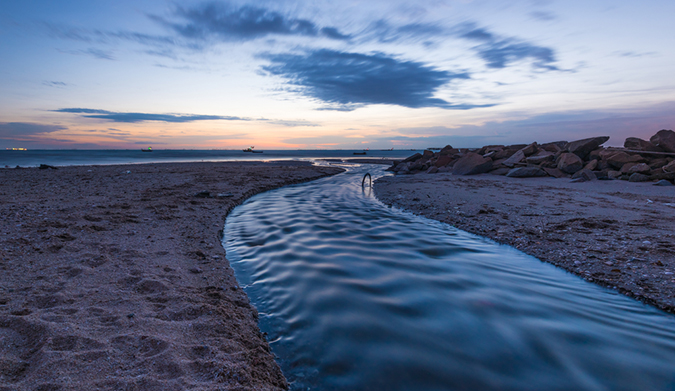
The accepted rule of thumb is to stay out of the water for three days after it rains. But is this nothing more than just an arbitrary number? Photo: Shutterstock

More lax than my father’s strict rule to “never go into the ocean”, some surfers abide by the guideline to not surf three days after rainfall. Earlier this week in Los Angeles many surfers stayed home and avoided the beach after a freak monsoon –
but why exactly?
According to Surfline’s Chad Nelson, “The coastal waters are polluted with urban runoff and sewage from leaking water logged sewer pipes. In most places, and especially in Southern California, ocean water quality after a rain is dangerous.” Nelson goes on to state that after a rainfall the waters, especially around storm drains, are a soup of pathogens that can cause illness and, in the extreme case of Chris O’Connell, an infection that almost sent him to that big A-frame in the sky.
The rain also causes chemical runoff such as oil and toxic substances that ends up in the water and the waves. Heal the Bay, a group aimed at the preservation of the Santa Monica Bay and Southern California waters, states that “…fertilizers, herbicides and other pollutants are washed into the system by rain…” I am not a doctor but I will roll the dice and say these chemicals are probably not great for your sinuses.
But the solution is easy, right? Just stay out of the water for the standard three days and watch the Republican Debate? Wrong. Amanda Griesbach, a scientist at Heal the Bay, stated in a 2014 Los Angeles Times article that surfers and swimmers should “…err on the side of caution, [and] stay out of the water for five days after rainfall.” The waiting period between dropping rain and dropping in seems to be getting longer and longer. Perhaps the extended waiting period will act as a catalyst for more environmental awareness and preservation in the surfing community.
So sit tight, but if you can’t wait to be doused in toxins, just go roll around on the 405.

