
Photo: Shutterstock

The Atlantic Meridional Overturning Circulation is like a conveyor belt of ocean currents. Oceanographers know it as currents that carry sun-warmed water from the tropics through colder regions. As the water moves into those cooler regions it gets a bit colder itself, eventually getting to Greenland where it becomes its most cold and dense, sinking deep into the depths of the ocean and inevitably reversing its path back to those warmer, shallower parts of the same ocean in which it all started. As the AMOC slows down or speeds up, scientist often learn a lot about climate change across the globe.
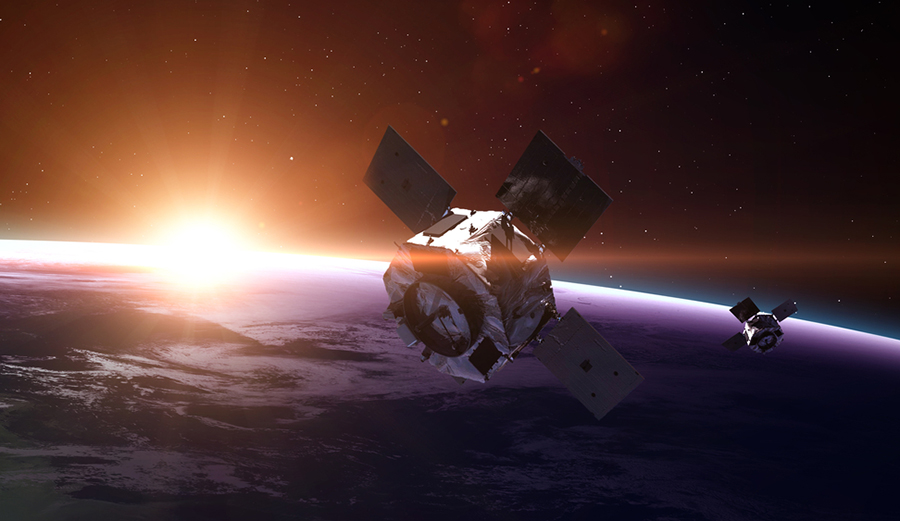
Scientists at NASA have found a way to track these currents with satellites as a way to track and even predict climate changes from space. Over the past decade the trend in their measurements has shown the AMOC slowing down, which in turn moves less water and nutrients. Data from the Gravity Recovery and Climate Experiment (GRACE) mission do everything from measure tiny changes in Earth’s gravitational field to the mass of water on the planet’s surface. Now, scientists are figuring out how to take that data and track changes in air pressure at the Earth’s surface and changes in pressure at the bottom of the ocean, which helps them understand the flow of water underneath the surface. Essentially, they can now track much of the same measurements given to them through buoy networks in the ocean itself, but are now capable of doing this from space.
“We’ve wanted to observe this phenomenon with GRACE since we launched 13 years ago, but it took us this long to figure out how to squeeze the information out of the data stream,” said Michael Watkins, director of the Center for Space Research at the University of Texas at Austin, former GRACE project scientist.

