
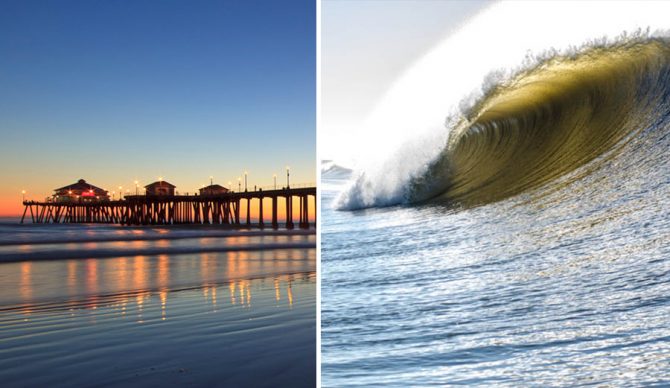
HB, left, NY, right. Worlds apart and yet, surfing is surfing.

Growing up in coastal Southern California is a privilege. And having the means to surf consistently is an added bonus. The weather is temperate year-round, and surfing runs so deep in the culture of the place that even the non-surfing populous embraces it. Hell, I grew up in Huntington Beach. And whether the derivation of the nickname Surf City was just a clever marketing ploy or an honest-to-God suggestion by the City’s surfing denizens we’ll never know. The fact the town embraced it, though, is case in point.
In 2014, I packed up my things and drove with my wife across the country to do a stint in New York. We moved back to SoCal after two years. That short time hunting for waves back east, especially in the winter months, changed the way I now see some of the ubiquities of a Southern California surfing life. Here are just five of those things:
1. Hoods are just for style points
One thing I’ve never been able to understand, even before I ventured back east, is the desire to wear a hooded full suit in Southern California without booties. I mean, in my experience the order in which extremities get colder as temps drop has always been feet, then head, then hands. Surfers in New York have a love/hate relationship with winter. As a result, they tend to wait until the last minute to don a hood, which becomes a lifeline from November until about March or April. By spring, everyone’s doing all they can to avoid a hood – sometimes that includes wearing gloves and booties without covering the head. Back in SoCal, though, the hood seems to be more fashion sense than function. If you’re not cold enough to suffocate your tootsies, are your ears really that cold?
2. We’re a wave spoiled bunch
In New York, I went through a transformation. I’d paddle out on days when the waves were barely rideable, just to get in the water. Funny thing was, a lot of people were doing the same. New York can get some incredible waves, but that requires serious patience. California, on the other hand, boasts more days of rideable surf. Since returning to California, I find myself reverting to old habits – e.g. checking the waves and not paddling out on days I would have been totally psyched on in New York.
3. Respect the beach break
From North Jersey to Long Island, you can count the number of structured breaks on one hand. And even then, they’re not at the same level as say, Rincon, Lowers, or even Swami’s. That leaves almost exclusively beach breaks to explore. Beach breaks demand your full attention to even begin to understand how and why they work. Sandbars come and go, they’re sensitive to the tide, swell direction, and the wind. Carrying that newfound respect for beach breaks is helpful in California if only to encourage you to check a lesser-known beach break during a big swell before heading to the overcrowded magnets. Who knows? You might score.
4. A surfing life need not lack balance
Every surfer I met in New York seemed to have an idea of how to balance a surfing life with professional pursuits. The City has that kind of gravitational pull. When the waves are flat, get shit done. That was a common sentiment. But when it’s pumping, skip out on work. Do whatever you can to get in the water, because you don’t know when it’ll be good again. It’s not that California surfers don’t understand that. It’s just different. Some surf every day before work, for example, like going to the gym or something. In New York, surfing seven days a week ain’t an option.
5. Surfing is so SoCal
Growing up, I grew accustomed to driving past surf shops, knowing that major surf brands were headquartered close by, and seeing billboards advertising anything from coffee to cologne with images of surfing. Some liquor stores in Huntington Beach even sell surf wax! It’s so pervasive that if you don’t know any different you become blind to it. In coastal Long Island, though, surfing remains less central to the character of coastal towns. Long Beach (New York, not California, they say), for example, has a few surf shops, but beyond that, it has the feel of a working-class town that just so happens to be by the coast.

