
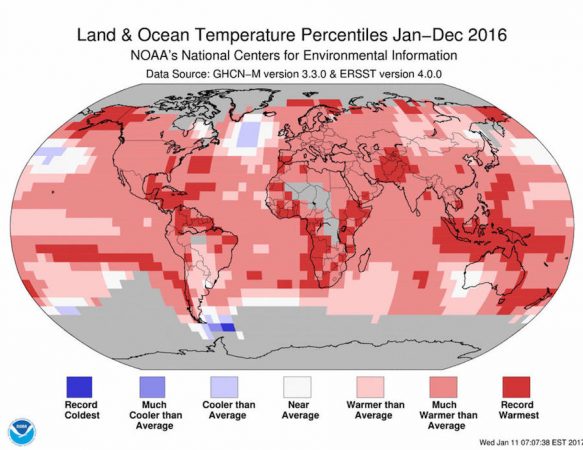
2016 was the hottest year on record, scientists say. Source: NOAA

Two thousand sixteen won’t quit. By early December the internet had collectively come to a consensus – maybe for the first time ever – that 2016 was a year to forget. With the number of notable celebrity deaths, a presidential election in the states with two of the most disliked candidates in history, police shootings, terror attacks, natural disasters, etc., etc. it’s safe to say the new year was celebrated with particular enthusiasm as it marked the end of 2016.
But like a dark cloud that won’t go away, scientists have extracted even more foreboding news: 2016 was the warmest year on record, the third consecutive year of record-breaking temperatures, reports the New York Times.
The news, released Wednesday by two U.S. government agencies (including the NOAA’s National Centers for Environmental Information, NCEI and NASA) and one British government agency, was particularly inauspicious as it coincided with the confirmation hearing of president-elect Trump’s pick to head the Environmental Protection Agency, Oklahoma Attorney General Scott Pruitt, who has sued the agency thirteen times.
“With the contribution of eight consecutive high monthly temperature records set from January to August, and the remainder of the months ranking among their five warmest, 2016 became the warmest year in NOAA’s 137-year series,” said the NOAA in their report. “This marks the fifth time in the 21st century a new record high annual temperature has been set (along with 2005, 2010, 2014, and 2015) and also marks the 40th consecutive year (since 1977) that the annual temperature has been above the 20th century average.”
Record-setting global temperatures were also confirmed by the Berkeley Earth Surface Temperature project, a non-profit California group that gathers Earth-surface-temperature data and are independent of any government. The project does not claim 2016 is the third consecutive year of record temperatures, though (they found 2010 to be hotter than 2014). Still, in their “Summary of Findings” they argue warming is a direct result of greenhouse gas emissions related to human activity.
The implied impacts of a warming planet, based on the NOAA report, are an increasing frequency of significant weather and climate events, as evidenced by the graphic below.
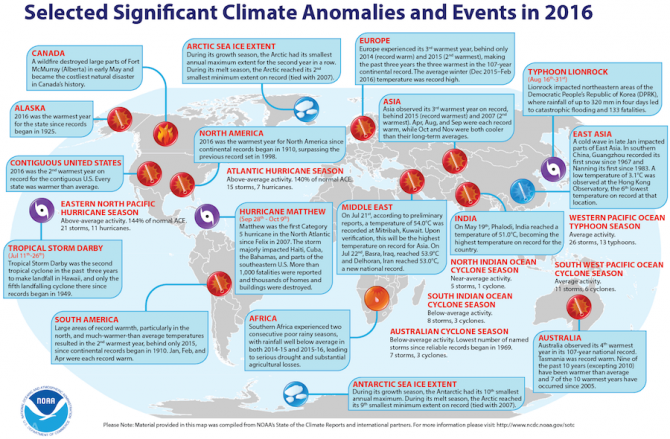
Source: NOAA
The NOAA report also establishes record global temperatures with drought in some parts of the world, and record rainfall in others.
According to scientists, the concern is not simply that temperatures were up in 2016, rather that it’s the mark of a significant trend. “A single warm year is something of a curiosity,” Deke Arndt, chief of global climate monitoring for the NOAA, told the Times. “It’s really the trend, and the fact that we’re punching at the ceiling every year now, that is the real indicator that we’re undergoing big changes.”
Scientists are particularly concerned about the potential to curb the effects of climate change, especially given the U.S. is the second largest emiter of carbon-dioxide in the world and president-elect Trump has both tweeted that climate change is a hoax and expressed his desire to pull out of the Paris climate agreement negotiated by nearly 200 countries in 2015.
“2016 is a wake-up call in many ways,” Jonathan Overpeck, a climate scientist at the University of Arizona, told the Washington Post. “Climate change is real, it is caused by humans, and it is serious.”

