
Is it even real?

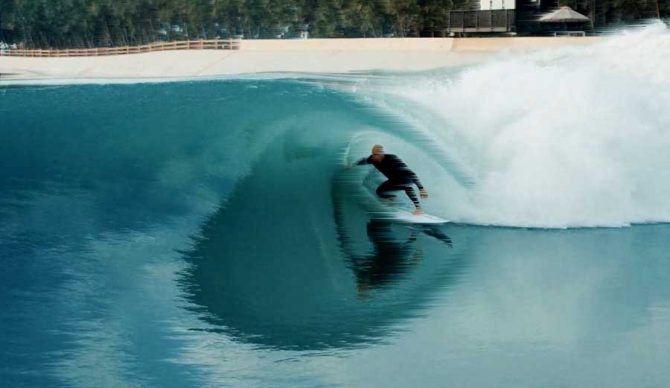
It’s dawn in California’s Central Valley, 110 miles from the Pacific, and the light is casting a purple glow through the auroral mist. There are dewdrops on the leaves, and a single duck’s silhouette is cutting a thin line across an otherwise sheet-glass pond. The pond is long and thin and circumscribed by tall, slender trees whose tops bow at the hint of wind. A switch flips in a control room somewhere out of view and suddenly the hum of a machine and the sound of flowing water punctuate the still air. Out of the fog, a breaking wave emerges, and on that wave a rider coasts. The wave is maybe chest-to-shoulder high, clean, and barrelling endlessly. A surfer dances lithely on its face. With a kick-stall and a crouch, the surfer tucks underneath the throwing lip for one second, two, three, four…ten, eleven, twelve…for some unholy stretch of time he assumes that awesome vantage point, which before the advent of surfing was Poseidon’s alone. The surfer emerges from the barrel not because it closes, but because he gets bored. He could have stayed longer. There is no triumphant spray. It’s dreamlike in its odd perfection.
The flow state of the surf-trance is broken when the surfer lets his surroundings set in: At the end of the wave, beyond the netted fence, a massive hydrofoil slides methodically along the pond’s far edge. It looks like a train running alongside the wave’s shoulder. It’s the size of a barge and its mechanical guts are covered by a shell the primary-blue color of a tarp. There’s literally a netted fence and a grotesque blue train at the end of the wave. The train heaves into port. The pond’s floor is surprisingly slick, and it’s not until he reaches its edge that the surfer sees the sandy bank for the tan, plastic tarp that it actually is. The hydrofoil is the energy source of his land-locked dreamwave. The dreamwave isn’t a dream at all: It’s surfing’s brave new world of the artificial wave. And it’s a grotesquerie.
Consider this an allegory for the insidious human costs of technological progress. In the near future, another lone surfer will ride a glassy wave one foggy morning in Central California, but when the fog clears, there will be no big blue train generating the wave, nor plastic tarp lining the pool. The wave will exist in a pristine ocean crashing upon a sandy beach. It will be perfect. Only it won’t be real. It will exist in some virtual reality indistinguishable from the natural world. And we’ll have to make a choice: Is this still surfing? And is this a world in which we want to live?
On December 18, 2015, the Kelly Slater Wave Company announced its presence to the world in a three-minute and 38-second hype video sharing Kelly’s first encounter with the artificial wave whose creation he helped fund. The video opens—not unlike the story above—to a foggy, purple dawn in Lemoore, California at Kelly’s Surf Ranch. Unlike the surfer in the opening allegory, though, Kelly isn’t mystified by the wave. He greets his creation with raised arms as if summoning it from the depths, and laughs—no, cackles—with something like rapture. Kelly’s wave is nearly head-high, glassy, fast, and barrelling. He rides it with the virtuosity of an eleven-time surfing champion. On the surface, it all seems so fun and so cool, and I defy any surfer to claim their first reaction to the footage was anything other than “I must surf that.”
Another promo video for Kelly’s Surf Ranch features Josh Kerr riding the artificial wave. He gets barrelled effortlessly, gouges sharp turns, and throws the stylish airs that have become his signature. After the session, he’s asked about the wave. He’s laughing and smiling, but the words he chooses belie a graver understanding of what’s at stake when men play god, and I suggest that they’re not accidental: “It’s not right,” he says. “It’s not right.”
In that first video and almost all footage of the Surf Ranch that has followed, the camera is nearly always angled so that the surfer moves toward it, hiding the wave’s ugly mechanical energy source behind the lens. From this perspective, what the viewer sees is a glassy wave that could be anywhere; their imagination fills in the natural world where the image ends. I submit that this is deliberate. KSWC’s marketers and videographers know full well that to sustain the illusion of the “perfect” wave, they have to hide the ugly superstructure on which it depends. And for the most part, they do their job. But in the odd clip from the opposite angle that somehow makes the final cut, you can catch a glimpse of the monstrosity with its tarp-blue skin—that sad attempt at camouflaging its robot innards. Zoom out further, and you can see the flimsy, tan tarp that lines the rectangular pool in which this “perfect” wave is conjured. Further still, and you can see the big blue train’s track and the control room from which its orders are processed. Zoom out one last time, and you can see clearly that this isn’t surfing at all, but a bad imitation.
Much has been made of the potential wave pools hold for surfing’s progression and just as much has been said of what will be lost. It’s true that infinite, repeatable sections will afford surfers unprecedented access to repetitions, which should allow for technical innovation in the form of new and more polished maneuvers. But it remains to be seen how well these choreographed maneuvers will translate to the natural world. In that organic world, in the span of the crest and crash of an organic ocean pulse, the surfer experiences a micro-life and a micro-death, encoding an understanding of life’s momentariness and impermanence into their DNA. Surfing is a perpetual chase and the perfect wave is the object of that chase—the ever-receding horizon that propels the surfer’s pursuit. To remove an enormous amount of the work required to find that perfection is to strip surfing of its rarefied essence; it is to render it insipid and unnatural.
How comfortable are we with the idea of existing in an artificial world, especially if that world is tantalizingly perfect? Wave pools are clearly inferior to the real thing now, but someday they won’t be, and what then? Then we’ll really have a difficult choice to make regarding what’s authentic, what isn’t, and the kind of world in which we want to live.

