
Mountain

Somehow I found myself last in the pack – sucking wind and stopping for water both because I needed it and I was happy to have an excuse to stop moving my legs. To say it was a beautiful day on the back side of Mammoth Mountain would be an understatement. Blue skies, forty degree weather, and panoramic vistas of the Eastern Sierra Nevada, the Minarets peeking past trees in one corner, were welcome distractions from the task at hand – my first major uphill.
The allure of riding backcountry snow is clear. Put in a little work and you can find untouched powder stashes without the crowds or the lift ticket prices of major resorts. And honestly, the backcountry appeals to me personally more than any other aspect of the sport. I grew up in Huntington Beach, Calif., where I had to sit, wait, fight and generally overly-froth with 100 of my closest friends every time there were waves. And to ride snow? Hours of urban wilderness separated me from the mountains, as we had to weave through detours and tightly-packed freeway, only to sit in tightly-packed lift lines. Even when California’s front range resorts like Mt. High and Big Bear enthusiastically reported only a few inches of fresh over man-made cement. And I’m not alone in these sentiments. Just look at what a powder day at Snowbird looks like:
Recently, no matter where you look, the story’s the same. The ski and snowboard industries are hurting. A 2016 article in Quartz highlights US snowboard industry sales in decline from 2007 to 2013. And according to the BBC, across the US and Europe, the ski industry has remained stagnant in recent years. Despite the bleak outlook, though, one subsection of both industries has exploded in the last decade – backcountry riding.
I was ready for a new challenge. A new freakin’ adventure where I could see more country. It sounds like lots of skiers and riders are looking for the same thing. According to Forest Service research, cites the Winter Wildlands Alliance, “The number of participants in undeveloped skiing… is projected to increase by 55 percent – 106 percent by 2060.” And, “During the 2012-2013 season 7 percent of all alpine skiers, 11 percent of snowboarders, and 20 percent of cross-country skiers ventured into the backcountry, and sales of backcountry ski and snowboard equipment increase substantially each year.”
Given the popularity of the backcountry, it’s no wonder ski resorts have jumped on board for a piece of the action. But in the case of most of them, backcountry guide services are contracted out to local guide outfits – in other words, certified guides are technically not in the employ of the resort.

Expert guide Tim leads Mammoth Backcountry Ski Schoolers on the skin track. Photo: Miles Weaver
Mammoth Mountain is different, says Davey McCoy who is the director of the resort’s newly-founded Backcountry Ski School. “This is really the first time that I know of where a resort has bridged the gap between itself and local guide services,” he told me. What McCoy means is at all resorts he’s aware of, a visitor interested in venturing into the backcountry hires a guide (either independently or through the resort) and can tour through wilderness areas where guides are permitted. They cannot, however, tour through areas outside of ski area boundaries that are still technically privately owned by the resort. Mammoth’s program is different in that the Backcountry Ski School is operated through the resort’s ski and snowboarding school. A typical outing can, therefore, take guests up a lift inbounds, and dip into the backcountry through access gates in order to teach participants basic safety when headed out of bounds. For now, Mammoth offers an Intro to Backcountry Touring Clinic and a Sidecountry Tour to Tamarack – which can both be done on the same day, and are really designed for complete backcountry neophytes. Like me.
“What we have set up now is really designed as a precursor and introduction to any sort of backcountry tours a skier or snowboarder might be interested in,” said McCoy. “When you show up for a tour, you want to know how to use your equipment, you want to know the basics of operating an avalanche beacon and how to put together a probe and shovel. That’s where we come in, to fill that gap between resort skiers and would-be backcountry riders to give them the basics.”

Wes Morrison explains some of the idiosyncrasies of an AT binding. Photo: Miles Weaver
A longtime resort rider, who, as I mentioned, was ready for something else, I made the perfect candidate for seeing what Mammoth’s Backcountry Ski School was all about. Before taking off for the day I was passed a beacon to throw on under my jacket. “Uh, where does this go?” I asked in utter ignorance. With a smile and a bit of patience, McCoy and some of the other Backcountry Ski School staff set me straight.

Davey McCoy explains to the group the imperative of safety in the backcountry. Photo: Miles Weaver
The first several hours of the day were devoted to understanding the basics of our equipment – including practice with searching for one another with our avalanche beacons, assembling probes and shovels, and slapping skins on our skis and splitboards. We learned the basics of direction changes while touring uphill, which, candidly, stumped me. But the views to be had breaking trail off the beaten path in the morning – especially having breezed in the night before from the concrete jungle that is Los Angeles – were ear-to-ear grin-inducing.
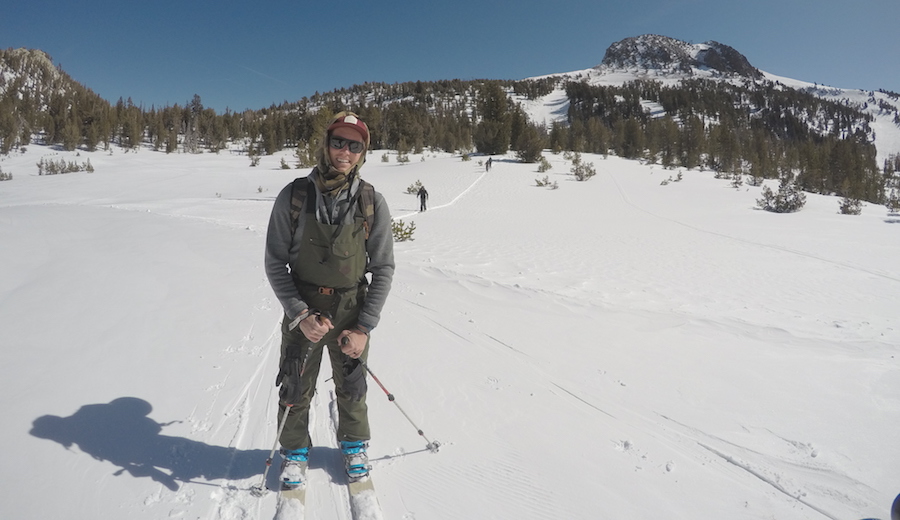
The author taking a break from sucking wind. Photo: Heyden
The second half of the day was the entreé our 15-person group comprised of powder hounds of all ages was waiting for. A quick inbounds run to the bottom of the gondola, then a trip up to the top and a shot out of bounds down the backside. After managing some ice and rocks at the top, we sniffed out some of the soft stuff everyone was after.
But in the backcountry, what goes down must also go up. So after we had our fun we transitioned to tour mode and made our way up to where we started. As I mentioned before, I quickly found myself in last sucking wind. Not that it was a race, but given the amount of time I’ve spent riding inbounds, swallowing that healthy bit of humble pie meant resigning to the fact that backcountry riding requires a completely different set of skills that require serious practice and dedication.

The author practicing kick turns. Photo: Miles Weaver
At the time I ventured out with the Backcountry Ski School, it was only in its fifth week of operation, but McCoy and the crew were already excited about the possibilities of expanding the program given its popularity in that short time. “The sky’s the limit, really,” said McCoy.
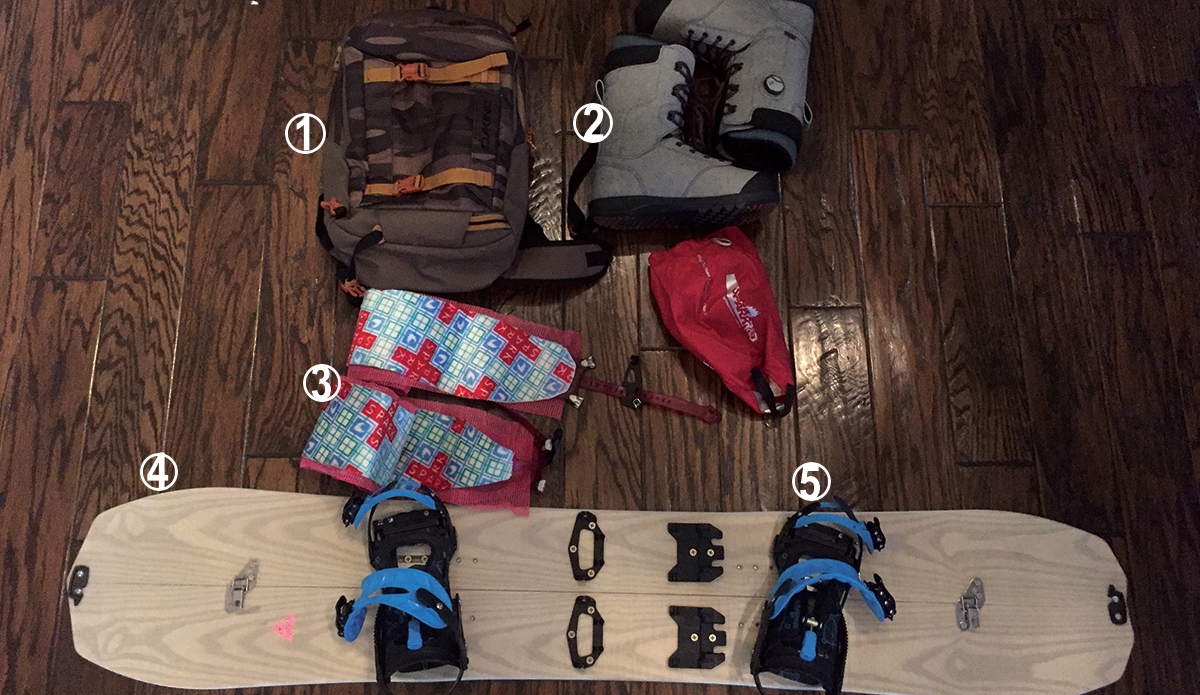
A quick rundown on the gear used for this virgin sojourn into the backcountry: 1. Dakine Mission Pro 25 L Pack 2. Vans Implant Boots 3. Spark R&D Splitboard Skin 4. Arbor Bryan Iguchi Splitboard 5. Spark R&D Arc Bindings
Editor’s note: Mammoth’s Backcountry Ski School is currently up and running with plans to operate until April 15th. To learn more check out Mammoth’s website here.

