
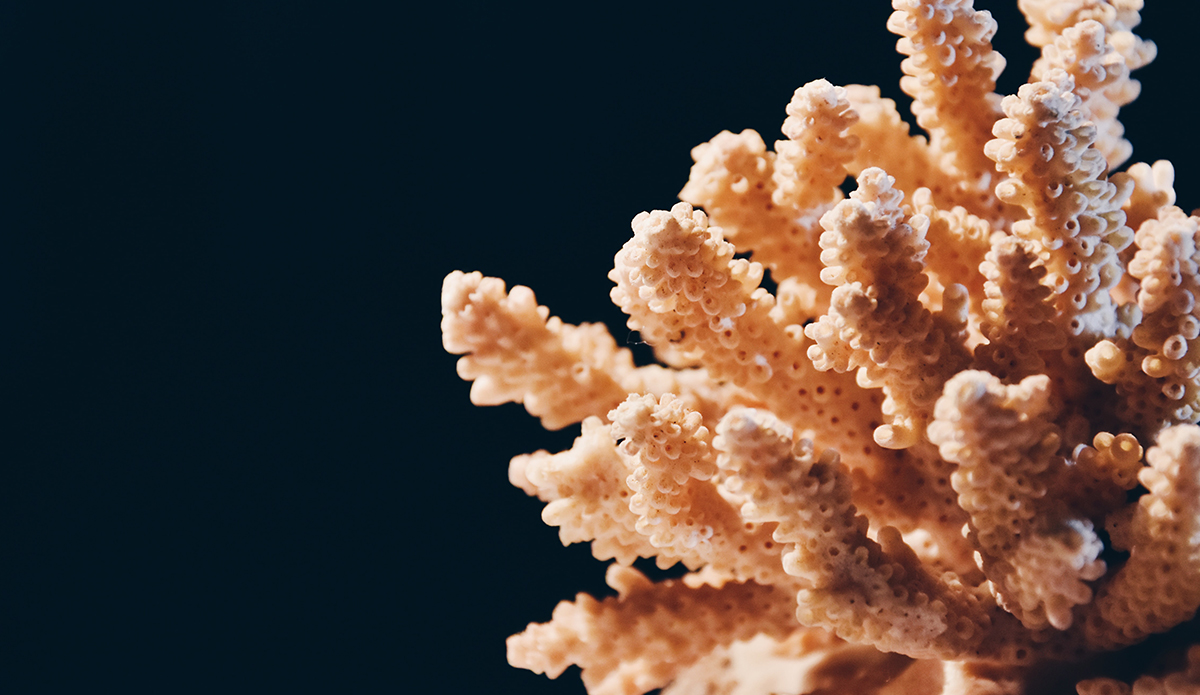
Photo: Sandy Ravaloniaina // Unsplash

Researchers at the Hawai‘i Institute of Marine Biology have successfully cryopreserved and revived fragments of coral using a process called isochoric vitrification. The technique preserves coral samples in a “glassy” state, which prevents the formation of ice that would otherwise damage larger samples. This is a promising step in the preservation of threatened coral ecosystems.
“Cryopreservation is an important intervention measure and a vital component of the modern coral conservation toolkit,” reads the abstract from a March 2023 paper authored by Hagedorn and other researchers. However, the process has until now been limited to reproductive materials, such as sperm and larvae, that could only be obtained a few nights per year during spawning. With more complex systems, such as larger fragments of coral, the formation of ice would cause damage.
“We wanted another method that would allow us to go out almost every day,” Hagedorn told Hawaii Public Radio.
The solution was to cryopreserve the samples in an ice-free “glassy” state, by a process known as vitrification. According to the paper, scientists successfully froze centimeter-scale fragments of coral and then thawed and revived the samples 24 hours later.
However, while the process is extremely promising, there is still more research to be done on the process of reviving the samples post-thaw. “It’s like a patient that goes through open heart surgery,” said Hagedorn. “It’s successful, but you can’t walk home after that. You’ve got to stay in the ICU.”
According to the study, “These findings pave the way towards an approach that can be rapidly deployed around the world to secure the biological genetic diversity of our vanishing coral reefs.”
“Is it a reef? No,” said Hagedorn. “But it is enormous amount of security to have those individuals and those species put away for now.” She continued that she expects scientists to be able to employ this method broadly in the next two years.

