
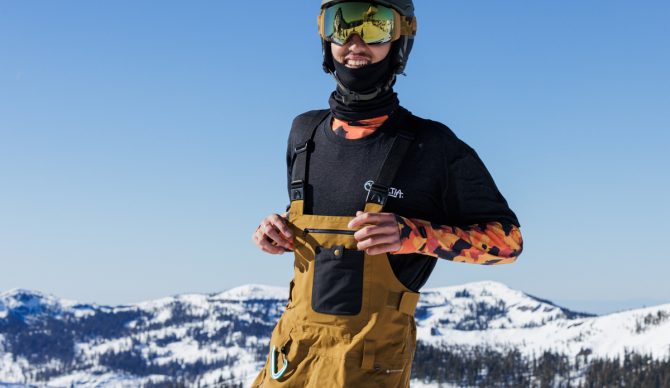
All smiles in the legendary Flylow Baker Bib. Photo: Tim Manning//The Inertia

Here at The Inertia, we’ve retired our ski pants and are firmly on Team Bib. Getting snow in your ski pants sucks. Ski bibs fix that. Ski bibs add a ton of pocket space. Ski bibs make things more comfortable at the waist, and they sure look good, too. Sure, bibs generally run warmer than pants and may add a bit of weight on the uphill (we’re certainly not gram-counters), but to us, the pros vastly outweigh the cons.
Senior Gear Editor Will Sileo hasn’t skied in pants in years, and in that time he’s tried a lot of different bibs from longstanding brands like The North Face, Black Diamond, and Mountain Hardwear, as well as up-and-coming favorites like Trew Gear, Flylow, Stio, and Strafe. We’ve done our time in them on the resort, in the backcountry, and yes, even at the aprés-scene. And as you might imagine, we’ve got some things to say about them. A whole article-full, actually. Our favorite overall bib is the newly-updated Trew Gear Trewth Bib for its thoughtful design and all-around versatility. Our favorite backcountry bib is the new Salomon Scrambler, designed in partnership with Cody Townsend.
Navigate To: Comparison Table | How We Tested | Buyer’s Guide
Related: The Best Ski Jackets | The Best Women’s Ski Bibs | More Ski Gear Reviews
Editor’s Note: We most recently updated this guide on February 6th, 2026, to update the Trew Gear Trewth Bib after testing the latest version and adjusting its ranking. We also added the Salomon Scrambler, The North Face Summit Tsirku, and a couple of other bibs released this season, now that we’ve had time on the snow with them.
The Best Ski Bibs of 2026
Best Overall Ski Bib: Trew Gear Trewth Bib Primo
Runner-Up Best All-Around/Best Value Bib: Flylow Baker Bib
Best Backcountry Ski Bib: Salomon Scrambler Bib
Best Budget (Insulated) Ski Bib: Mountain Hardwear Firefall Insulated Bib
Best Budget (Shell) Ski Bib: Scott Vertic Ripstop 3L
Best Premium Bib: The North Face Summit Tsirku Bib
Best All-Around Ski Bib
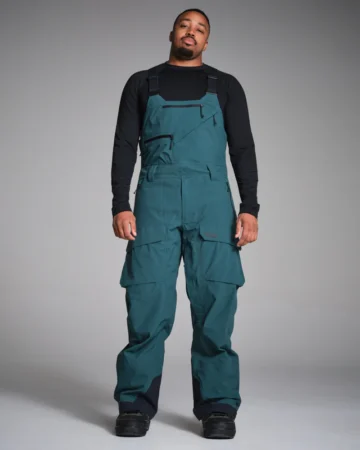
Trew Gear Trewth Bib Primo ($600)
Weight: 895 g
Best For: Resort/backcountry
Fit: Loose
Notable Features: Lots of pockets, great colors, inner and outer thigh vents, internal waist adjustment
Pros: Great pockets, durable and easy-moving material, wide selection of colors, great style, top-tier features
Cons: A bit pricey
Trew Gear has been making a name for itself recently with its fully-featured bibs that come in a variety of fun colors, and its flagship model, the Trewth Bib Primo, lives up to the hype with plenty of pockets, great style, and very durable 20k/20k waterproof/breathable Primo fabric made from recycled nylon. They’re described as a bib for both resort and backcountry, and while we’d agree they’re certainly up to both, the resort is where they truly thrive.
The bibs saw a major overhaul this season, improving the pocket layout and adding critical features like an internal waist adjustment and mesh-lined inner thigh vents. In combination with the already generous outer thigh vents, the inner-thigh vents make a big difference in terms of temperature regulation, vastly improving this bib’s backcountry-readiness. The bib features the same Primo material as before, which has been a plus from the beginning. While it doesn’t carry the same cachet as Gore-Tex, for hardwearing durability that moves and breathes surprisingly well, Trew’s Primo material deserves the praise it has received over the years.
As for the updated pocket layout, the pant-leg pockets stay the same, with the bib upper being slightly adjusted to provide a more intuitive layout. There’s now a mid-sized kangaroo pouch layered behind the smaller beacon pocket and larger diagonal-zip pocket, a slight improvement over the prior version. Another upgrade, all the zippered pockets now feature D-ring attachment points for clipping on beacons, phone leashes, etc.
From a fit perspective, we gotta call out Trew’s inclusive sizing. Combined with the new waist adjustment, a wide range of sizes (including extended sizes), and three different lengths, it’s easy to find a bib that fits you, no matter your body shape. Overall, the bib is on the roomy side, with a loose, almost baggy fit, but for skinnier folks like our tester, the waist adjustment does a great job of gathering up the loose material where it matters. The sizing has become more intuitive as well – for the prior version of this bib, our tester at 6’0″ 155 lbs had to go with a small tall as he found himself swimming in the medium (his normal size across most other brands). This year, the medium fits him perfectly. Side Note: If you’re looking to purchase a full set of jacket and bib for maximum style points, Trew has a matching jacket for every pair of bibs they sell.
In comparison to our prior Best Overall Ski Bib, the Flylow Baker, it’s an extremely close call. The Trewth bib’s mesh-lined inner thigh vents, larger vents overall, and larger pockets make it a more functional bib in our book, and we prefer the Primo material over the slightly stiffer fabric used in the Baker Bib. You pay an extra $160 for those upgrades, but between these two highly durable bibs that will last many, many seasons to come, the quality of life upgrades on the Trew bibs feel well-worth the extra bucks from the perspective of multi-season use. All that said, if you find yourself in the backcountry more than on the resort, or truly split your time evenly, it might be worth checking out Flylow’s new Baker Bib Gore-Tex ($619), which uses a lightweight, breathable Gore-Tex material for better breathability and lighter weight than both the regular Baker bib and the Trewth Bib.
Read our full review of the Trew Gear Trewth Bib here.
CHECK PRICE ON Trew Gear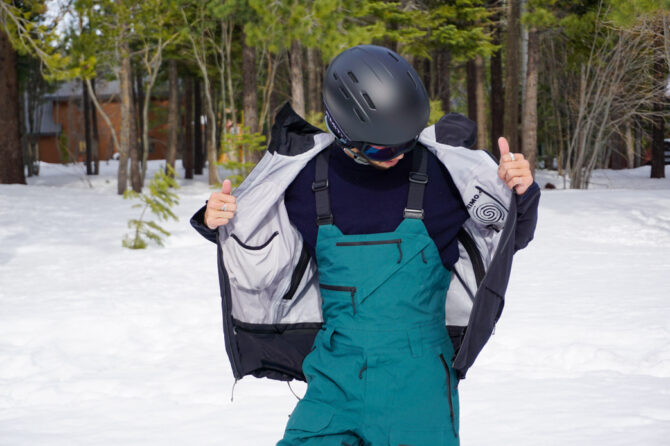
Photo: Ken Cox//The Inertia
Runner-Up Best Overall Ski Bibs/Best Value
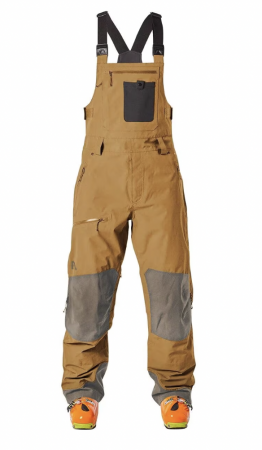
Flylow Baker Bib ($440)
Weight: 907g
Best For: Resort/backcountry
Fit: Roomy/loose
Notable Features: Plentiful pockets, inner and outer thigh vents
Pros: Tons of pockets, heavy-duty material, great ventilation, awesome price-point
Cons: Buckles for suspender straps can be a pain point with backpacks, very popular design
The Flylow Baker Bib has been at the top of this list for years, since our first publication of this guide in February of 2023. With tons of pockets, good venting, and insane durability, this “workwear-inspired” bib can do it all. It’s a bit heavier and stiffer than some options on this list, but that sacrifice is well worth it for ridiculously tough material that stands up to the test of time (and the rigors of skiing).
The bib is listed as a 50/50 resort and backcountry bib, and while it leans more towards the resort side of the spectrum, it can take on the backcountry as well. We love that the Baker bib has both inner and outer thigh vents, which compensate for the less breathable material by allowing for cross-ventilation. However, on longer tours, you’ll be happier in something lighter.
That said, Flylow just announced a new partnership with Gore-Tex, which brings the legendary material to the Flylow Baker Bib to produce something that’s lighter and more breathable while retaining the Baker Bib’s durability. The Baker Gore-Tex commands a higher price point at $620, and in testing this season, it’s well-worth the upgrade if you regularly find yourself outside of the resort. The material is a big upgrade, being lighter and much more breathable, while maintaining high weather protection and durability.
The only real downside we’ve found with the Baker Bib is the buckles for the suspenders. They’re a bit chunky and can be a little uncomfortable when worn with a backpack, but with a couple of layers on top, it’s not an issue. In comparison with our new Best Overall Ski Bib, the Trew Gear Trewth Bib, there’s a lot to love in both cases, but with the upgrades made to the Trewth Bib this season, we had to give it the nod for best overall. The Trewth bib holds the edge in its larger pockets (with D-ring attachment points), mesh-lined inner thigh vents, and ever-so-slightly higher-quality fabric. However, it’s more expensive at $600, so if you want to save a few bucks, you won’t be disappointed with the Flylow Baker, and if you are looking for a bib that’s more touring-oriented, the Baker Gore-Tex is likely the best call among the three.
Check out our full review of the Flylow Baker Bib.
Check Price on REI
Photo: Tim Manning//The Inertia
Best Backcountry Ski Bib
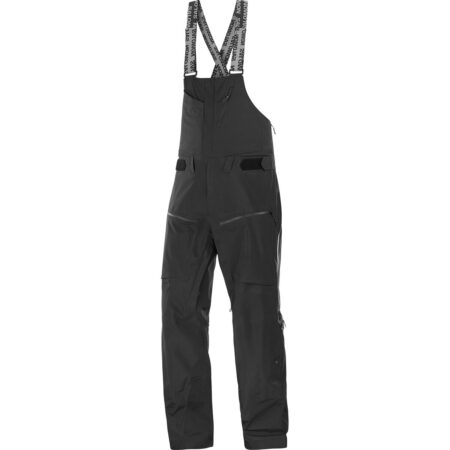
Salomon Scrambler Bib ($700)
Weight: 550 g
Best For: Backcountry
Fit: Average
Notable Features: Inner and outer thigh vents
Pros: Lightweight, easy-moving, super ventilated, what more do you want in a backcountry bib?
Cons: Less durable for heavy resort use, runs cold
For lightweight, well-ventilated backcountry storm protection, the Salomon Scrambler Bib takes the crown. It does so by pairing super-lightweight but super stormproof Gore-Tex ePE material with long outer thigh vents and sizeable inner-thigh vents for full cross-ventilating capacity. It’s on the expensive side, but with a great fit, comfortable straps, and good pockets to boot, you get what you pay for. Developed in partnership with Salomon athlete Cody Townsend, this bib is a winner.
This inner-and-outer thigh vent design is one we’ve mostly seen on “crossover” bibs like the Flylow Baker and Trew Gear Trewth bib, aimed at providing increased ventilation to make up for less breathable/heavier material. Backcountry ski bibs have seemed to avoid the feature, instead relying on breathable materials or long outer-thigh vents to keep cool on the skintrack. And that’s where the Scrambler finds its edge.
The Scrambler is a true backcountry design with lightweight fabric, minimal pockets, and one of the lowest weights we’ve seen for a bib. With a loose, comfortable cut, the bib has great mobility for both the uphill and the downhill. It also benefits from a fully mesh bib upper for better breathability under a ski jacket. The only other bib that matches it in terms of weight is our previous best backcountry bib, the Mountain Hardwear High Exposure. But the addition of the extra vents really takes the Scrambler bib to the next level. At $700 it doesn’t come cheap, and many backcountry enthusiasts will be happier going with the High Exposure bib, skipping the inner thigh vents and keeping $150 in their pocket, but for high-output stormy tours, and those pushing the limits of backcountry exploration, the Scrambler is where it’s at.
Check Price on Backcountry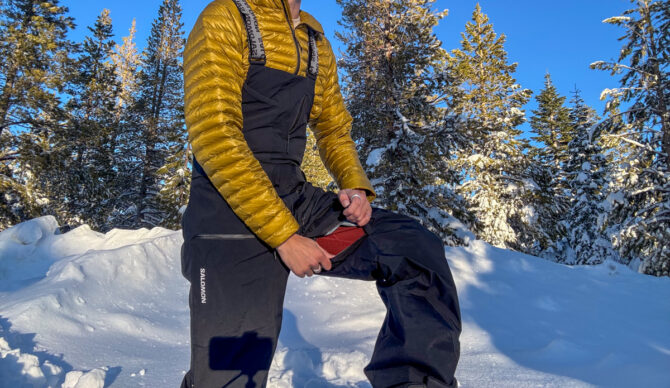
Photo: Will Sileo//The Inertia
Best Budget Ski Bibs (Insulated)
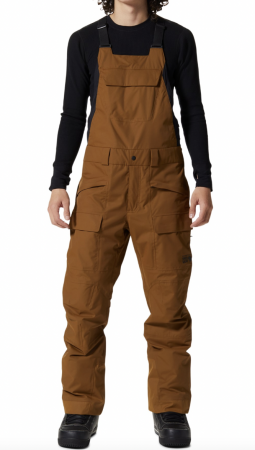
Mountain Hardwear Firefall Insulated Bib ($275)
Best For: Resort
Weight: 816 g
Fit: Trim
Notable Features: Lightly insulated, lots of pockets, big side vents
Pros: Durable, insulated bibs at an incredible price with a full feature set
Cons: Runs warm, slim fit
Interested in a fully-featured, insulated bib at an incredible price? Look no further. Mountain Hardwear’s Firefall Insulated Bib hits all the right marks, at a hard-to-believe price. The competition for “Best Budget Ski Bib” is stiff. What elevated this bib above the rest were the well-thought-out features, ample ventilation, and durable construction. The bibs sport a whopping six pockets, two knee-length side zippers for ventilation (as well as easier bathroom breaks), 60 g of synthetic insulation in the knees and seat, and a durable, 2L waterproof shell material that will last many seasons to come.
The main drawback is that the 60 g insulation will have you running fairly hot on warmer days, so these wouldn’t be our first choice for spring skiing (and certainly are not a winner for the backcountry). The fit is also fairly slim, a con for those looking for that baggy “freeride” fit, or those with larger frames. These factors somewhat reduce the bibs’ versatility, but for those interested in a mid-winter bib at an incredible price, you can’t get much better than this one. The North Face Freedom bib, below, is another great budget option, running a bit colder with the lack of insulation for better versatility. That said, we found the Firefall Bib’s outer-thigh vents to provide better ventilation than the Freedom Bib’s inner-thigh vents for when you really need to air things out.
CHECK PRICE ON Backcountry
Photo: Nick Bruckbauer//The Inertia
Best Budget Ski Bibs (Shell)
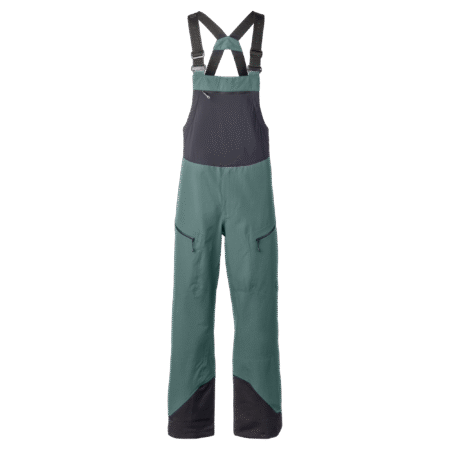
Scott Vertic Ripstop 3L Bib ($330)
Weight: 950 g
Best For: Resort
Fit: Loose/average
Notable Features: Full drop-seat
Pros: Insanely well-priced for a 3L bib
Cons: No frills, limited color selection, heavier, lower-performing material
In testing a sea of $600+ bibs, finding a pair that costs half as much while delivering on most key aspects is a special thing indeed. Scott has come up with a winning formula with the Vertic 3 Ripstop Bib, which provides robust weather protection, top-tier durability, ample pocket space, and more. Priced at just $330, they’re often on sale for much cheaper.
While minimal, the three pockets are roomy and provide plenty of space for phone, wallet, keys, beacon, and a couple of other essentials. The loose fit is easy-moving and looks great, definitely “freeride inspired” but not overly baggy. This is easily one of our favorite aspects of the bib. At the time of publishing, there are currently only two colors available on the Scott website, but one of them is a classic black that goes well with anything.
The material, often an area where lower-priced bibs suffer, is surprisingly good. It has a durable, workwear-esque feel that moves well and is not stiff. It’s a bit on the heavier side and has lower waterproof/breathability ratings than most 3L bibs (15k waterproofing, 10k breathability). The 15k waterproofing isn’t too much of an issue for the average resort skier, but those located in wet, coastal environments may want to consider upgrading to a bib with 20k+ waterproofing if they spend long days out in the elements. The 10k breathability reduces the bib’s applicability for backcountry touring, but the long side vents help this aspect considerably. That said, these wouldn’t be our first-choice bibs for those who spend a significant amount of time in the backcountry.
Overall, for resort skiers interested in saving a few bucks without dropping down to a 2L design, the Scott Vertic Ripstop hits all the marks. The nice, durable material and exceptional fit have us reaching for this bib time and time again over designs that cost twice as much, and prove you don’t need to break the bank to score great resort gear.
Check Price on ScottPremium Resort/Backcountry Option
The North Face Summit Tsirku Bib ($700)
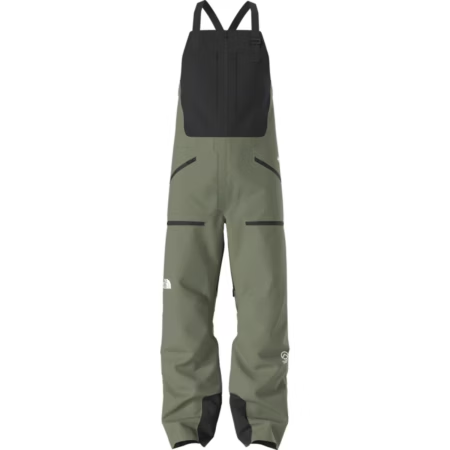
Weight: 815 g
Best For: Resort/backcountry
Fit: Loose
Notable Features: Full drop-seat, lots of pockets, inner and outer thigh vents
Pros: Versatile with premium material and features
Cons: No waist adjustment, only one color (light green)
The North Face has been working on its Summit series kits for some time now, and over the past three years that we’ve been testing them, they’ve constantly improved. This year’s Summit Tsirku Bib defines high-end crossover functionality at its best, with top-notch materials, a dialed feature set, great – albeit loose – fit, and, as always with TNF, oodles of style. If you can pocket the price, and like light green, we can’t recommend these bibs more.
The bib uses a tough but breathable Gore-Tex Pro as the main material with extra Spectra ripstop and a C-Knit backer that reduces weight and increases breathability. Protective and highly durable without feeling overly warm or heavy, the construction strikes a great balance for mixed resort/backcountry use. It’s plenty durable enough for heavier resort use, while at the same time remaining moderately lightweight for touring. The bib also gains a ton of versatility through the strategic venting. Like the Trewth bib, above, the Tsirku has large outer-thigh vents (that make a full drop-seat), and mesh-lined inner-thigh vents to let you cross-ventilate. This lets the bib run with a thicker, more durable, and windproof material (all the better for resort riding) without trending so warm that they’re a poor performer in the backcountry. Being mesh-lined, the inner-thigh vents can also be left open when working up a sweat while skiing powder.
The bib is very comparable to our Best Overall, the Trewth Bib Primo. For $100 more, we found the Tsirku bib material to feel a bit higher quality, coming with the Gore-Tex brand seal of approval, and the fully-mesh bib upper is more breathable than the Trewth bib’s mesh-backed bib upper. The main downsides of the Tsirku are really just the price and the fact that it currently only comes in one color (light green). In comparison, the Trewth bib also has that internal waist adjustment, which the Tsirku lacks. For most, the Trewth bib will be the better, more affordable choice, but for those who demand the best of the best in a true resort/backcountry crossover bib, with a bit more breathable material, the Tsirku is an incredible option.
Check Price on REIBest of the Rest
Versatile and Value-Oriented
Patagonia Snowdrifter ($240)
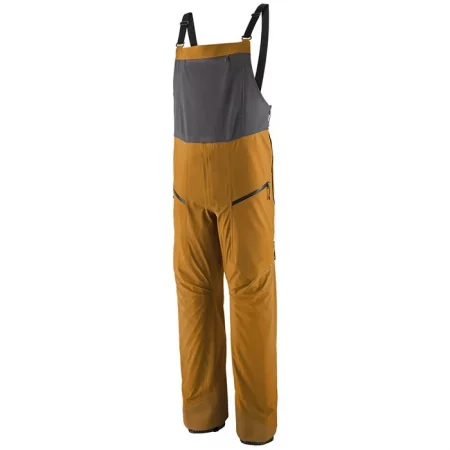
Weight: 650g
Best For: Resort/Backcountry
Fit: Average
Notable Features: Stretchy, breathable material, low-profile suspender straps
Pros: Very lightweight and breathable, but storm-ready material
Cons: Fairly basic design with just three pockets
The Patagonia Snowdrifter Bibs should be on any skier’s radar, regardless of whether they spend most of their time on the resort or in the backcountry. With super comfortable and stretchy fabric, a great fit, and solid weatherproofing, there’s very little to complain about. The material is truly where these bibs shine. Combining Patagonia’s proprietary H2No waterproofing with a stretchy face fabric and soft interior lining, they feel like a soft shell, but perform like a hard shell bib.
Features-wise, the bibs are fairly simple, but they certainly didn’t give us anything to complain about. The suspender straps are exceedingly comfortable, with low-profile attachment points that won’t feel uncomfortable under a pack. Long side zips on both legs allow for a full drop-seat, as well as plenty of ventilation when you need it, and the mesh bib upper helps keep the user’s core from overheating on the uphill. Only three pockets aren’t anything special, but they provide plenty of room for essentials. Sustainability, as with any Patagonia product, is as good as it gets when it comes to outerwear, using lots of recycled materials and no PFAS.
They’re not the lightest or most breathable backcountry bib we’ve tested, but the tradeoff there is increased durability with a sturdier overall construction than thinner options like the Mountain Hardwear High Exposure or Strafe Nomad bibs, below. It’s also worth noting the very competitive price point of $399. Go any lower than that, and you’re in budget-bib territory with associated trade-offs such as a 2L design or lower-quality construction. If you’re looking for a comfortable, do-it-all bib that is a solid performer in the backcountry and on the resort, and don’t mind sacrificing on fancier features like additional pockets, these just might be the bibs for you.
Check Price on Backcountry
Photo: Tim Manning//The Inertia
Runner-Up Best Backcountry Ski Bibs
Mountain Hardwear High Exposure ($330)
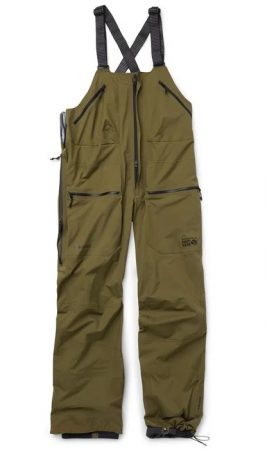
Weight: 553 g
Best For: Backcountry
Fit: Roomy
Notable Features: Elastic cuff cinches, lightweight material
Pros: Very lightweight and breathable, but storm-ready material
Cons: Not the most durable construction
Mountain Hardwear’s offering in the lightweight touring bib category is the bib for those who couldn’t decide between a softshell and a hardshell. The High Exposure bibs are made of a thin and super light material that, despite being GORE-TEX, has great breathability, helped by full side zips for ventilation. That said, they’re in no way a soft shell and are fully capable of repelling snow, rain, and harsh weather with ease.
Four pockets provide plenty of room for essentials, and the straps are low-profile and comfortable. Our main concern is the bibs’ long-term durability due to the thin material. Still, it has, almost surprisingly, stood up to multiple seasons of mixed resort/backcountry use without any signs of wear. That said, if you’re looking for a bib that will stand up to long-term resort use, the 40-Denier fabric of these bibs simply won’t bear the same amount of abuse as higher-denier fabrics like the 150-D fabric of the Flylow Bakers.
These bibs were updated in 2025, receiving better pockets, a roomier fit, and a couple of extra features. They’re also now made with GORE-TEX ePE, a more environmentally friendly material. Read our full review of the High Exposure Bib here.
CHECK PRICE ON Backcountry
Photo: Nick Bruckbauer//The Inertia
Another Overall Runner-Up
Black Diamond Recon Stretch ($480)
Weight: 779 g
Best For: Resort/backcountry
Fit: Trim
Notable Features: Inner pocket organization, belt loops, comfy suspender straps
Pros: Comfortable suspender straps, good pockets, bomber material
Cons: Material is on the heavier side
Black Diamond has a top-tier bib option with their Recon Stretch Bibs. The best part about them is that there’s really nothing to complain about. The straps are comfortable, and the quantity of pockets isn’t as legendary as the Flylow Bakers, but the two thigh pockets are deep, with a sleeve on the right side for organization, and the chest pockets are spacious, providing plenty of room to store essentials. The fit is awesome, and the stretchy material means these are exceedingly comfortable bibs that move with you in a way that many other bibs on this list don’t. Speaking of, the material was quite different from most options here, a stretchy but extremely durable and storm-ready construction.
The only hit that the bibs take is on weight. The material is burly and weighs as such, so these wouldn’t be our top choice for heading out on a longer tour or multi-day backcountry mission. However, for sidecountry and shorter, stormier tours, these perform admirably with the stretchy material, full side vents to dump heat, and a breathable upper-body construction. And on the resort, these will stand up to just about any abuse you can throw at them. Those interested in a top-quality, but simpler bib than the Flylow Bakers should seriously consider the Recon Stretch bibs.
Editor’s Note: The Recon Stretch Bibs have been updated for 2025/26. The changes are mostly cosmetic, but the bib upper now has a center-front zipper with two chest pockets instead of one, and the bib is now made with a PFAS-free DWR. It has also shed a significant amount of weight, going from 913 g to 779 g.
CHECK PRICE ON reiRunner-Up Best Budget
The North Face Freedom Bib ($220)
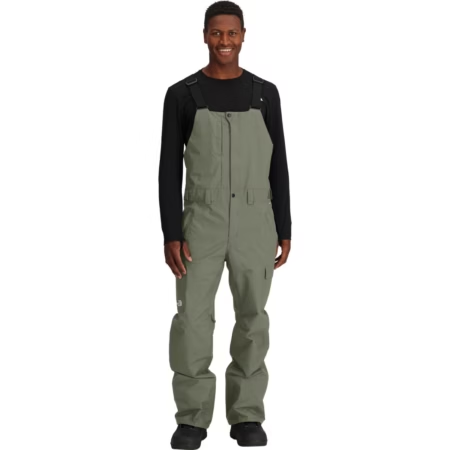
Best For: Resort
Weight: 935 g
Fit: Average/trim
Notable Features: Inner thigh vents, belt loops
Pros: Well-featured bibs at a great price
Cons: Some budget-feeling features, minimal ventilation, no drop seat
The North Face is by no means a budget brand, but it’s certainly a brand of the people and has produced some budget-friendly winners over the years. One such piece is The North Face Freedom Bib, which has been keeping backsides warm and dry at an affordable price for many seasons. The fact that not much (if anything) has changed about the bib in the years it has been around speaks to its enduring appeal and bang-for-buck value.
For just $220, you get an uninsulated bib with plenty of pockets, comfortable suspender straps, durable fabric, some ventilation, as well as belt loops and velcro waist adjustments to dial in the perfect fit. The bibs are also offered in a variety of colors and sizes, so you can dial in your perfect ski kit. While it is not an insulated bib, it does run a good bit warmer than true 3L shell bibs due to the 2L construction and recycled polyester lining that has a fleecy feel to it.
What kept this bib away from the “Best Budget” top pick were a few things. First of all, the bib definitely has a bit of a budget feel to it, as it’s easy to see where some compromises were made to save a few bucks. The center front zipper is a one-way zipper, and starts at the top of the bib, making bathroom breaks more difficult as you’ll need to open the front of your jacket or awkwardly reach under and up to the top of the bib to unzip. Furthermore, the vertical chest pocket has only a velcro closure, which had us a little worried about trusting it with something as valuable as one’s phone.
Finally, the ventilation could certainly be improved, especially for a warmer shell bib. While the bib is not really insulated, the liner adds some warmth, and with only interior-thigh ventilation zippers (that are mesh-lined, further cutting down on breathability), it can be hard to dump heat on warmer days. Vents on the exterior of the thighs tend to be better at getting rid of heat in a hurry. However, having interior and mesh-lined vents means you can keep them open while skiing without worrying (too much) about snow getting in, which is a definite plus. For another budget-priced bib with a bit better ventilation, check out the REI Co-op First Chair GTX, below.
CHECK PRICE ON REIPremium Pant with a Zip-Off Bib Attachment
Norrona Lofoten Gore-Tex Pro Pant + Bib Attachment ($900)
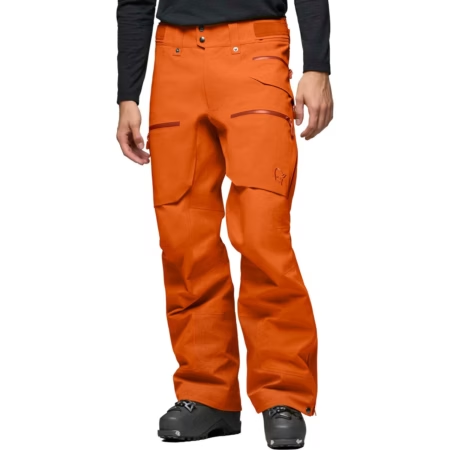
Weight: 860 g (pant only)
Best For: Backcountry/resort
Fit: Roomy
Notable Features: Massive side vents, zip-off bib upper, waist-adjustment
Pros: Versatile, top-notch fabric, three versions to match various price-points
Cons: Expensive, requires add-on bib upper to be a true bib
Norrona has made a name for itself in the high-end ski gear market, with its legendary Lofoten Pro ski jacket. The matching pants, the Lofoten Gore-Tex Pro Pant and zip-in bib attachment, follow the same formula for excellence with high-end material and top-notch features. Unique in this review in that it is a pant first, and a bib second by way of the zip-in bib attachement (sold separately for $69), the zip-off bib is something we’ve seen briefly over the years with the Mammut Haldigrat bib having that feature a couple of seasons ago (they’ve gone back to being a fully attached bib now) as well as the Backcountry Cottonwoods of years past.
The Lofoten pant/bib sports an adjustable waist, as well as belt loops, which provide great versatility to adjust the fit depending on how you want to wear it. Extra-long outer-leg vents extend from the hip down to the ankle, opening up completely at the bottom, but stopping just short of the waistline at the top. That means, when in bib mode, there’s no true “drop-seat,” but if you really need to drop trou, unzipping the bib upper is fairly straightforward. Pockets are decent but nothing spectacular. Where this pant really shines is in the versatility of the zip-on bib upper.
We tested the Lofoten Gore-Tex Pro version, but the pant also comes in a base-level Gore-Tex version with shorter side vents and heavier material, as well as a Gore-Tex Pro Plus version, which adds mesh-lined inner-thigh vents.
Check Price on BackcountryDurable Design for Mountain Professionals
686 Dispatch Bib ($385)
Weight: Not listed
Best For: Resort
Fit: Baggy
Notable Features: Mesh-lined inner-thigh vents, bombproof fabric, 9 pockets
Pros: Durable, fully-featured bibs
Cons: Outer thigh vents are tiny, a bit heavy/warm
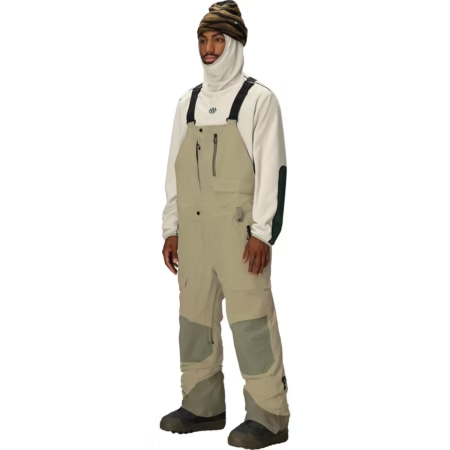
686 is known for its high-quality, reasonably priced gear, with a focus on durability, and the Dispatch Bib is no exception to the rule. With a 2L Gore-Tex construction, a canvas-like face fabric that’s supple and durable, solid ventilation and pockets galore, this bib is ready for day-in, day-out use over the course of 200+ day seasons. 686 supplied this bib to the Mammoth Unbound terrain park staff – the guys who are out there from the first snowfall until the lifts close for summer – to prove the bib’s durability and all-season use. And if it can survive a full Mammoth season under park staff, it can handle just about anything most riders will throw at it.
Being a 2L construction, the bibs run fairly warm, and are certainly on the heavier side with the durable materials, loaded features, and 686’s baggier fit compared to most other ski brands. As such, this is mainly a resort bib in our book. That said, large, mesh-lined inner-thigh vents, combined with two small outer-thigh vents, help evacuate heat on warmer days. The nine pockets add a ton of storage space and versatility, combined with useful features such as internal headphone routing, reinforced knees and kick patches, and various attachment points for keys, a beacon, or other gear.
These bibs are a top-tier choice for lifties and other mountain professionals who spend long stretches standing in the elements, while patrollers constantly hiking, bootpacking, and responding may prefer something more lightweight and breathable. For the rest of us, if you’re a resort rider who runs cold, or tends to ski in colder conditions (think Rockies, Midwest, or the East Coast), these are a great, versatile choice, and likely the last bib you’ll buy for many years to come.
Check Price on BackcountryHefty, Fully-Featured Resort/Sidecountry Option
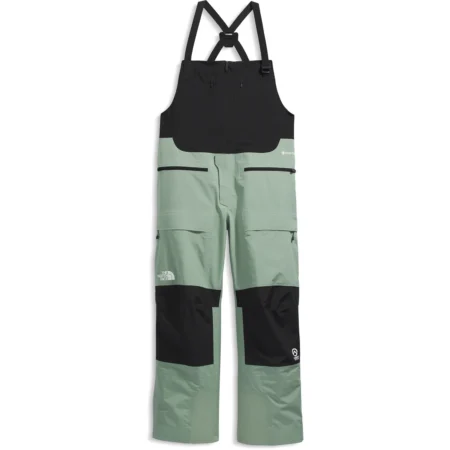
The North Face Summit Verbier Bibs ($600)
Weight: 833g (last year’s version)
Best For: Resort
Fit: Loose
Notable Features: Inner and outer thigh vents, lots of pockets
Pros: Feature-packed with bomber (and now GORE-TEX) material
Cons: On the heavier side
The North Face really came oh-so-close to all-terrain bib perfection with the Summit Verbier bibs. The pockets are great; there are five total, with plenty of room and internal organization sleeves and loops to keep essentials where you want them as you ski. The material is bomber, with great waterproofing, and it’s now made with a GORE-TEX membrane. The bibs feature a flannel backer from the waist down to the calves, so breathability isn’t great, but the two side zips and mesh-lined inner thigh vents provide great ventilation when necessary.
However, the weight of the material led us to classify this as more of a resort bib rather than a true resort/backcountry one. We were stoked on the small details like a small clip at the front of the gaiters to attach to boot laces, should you find yourself wading through the snow in your Sorels, internal pocket organizers, low-profile suspender straps, and a breathable stretch panel located at the lower back to keep the bibs from running too hot.
While they don’t come in the wide array of colors that some bibs do (2 color options), if you’re looking to complete the look, The North Face’s Summit Verbier Jacket is a similarly awesome piece of gear with incredible pockets and colors that match the bibs perfectly. The 25/26 version, in comparison to the 24/25 bib we tested last season, adds a second outer-thigh zipper for a full dropseat and full cross-venting functionality.
CHECK PRICE ON REIAnother Great Value Pick
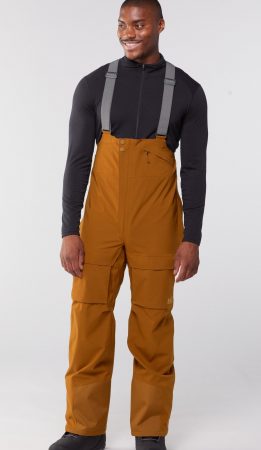
REI First Chair GTX ePE ($270)
Weight: 847g
Best For: Resort
Fit: Average
Notable Features: Comfy suspender straps, drop seat
Pros: Great price, comfortable fit, recycled materials
Cons: 2L construction reduces breathability
For a reliable and cheap option that looks good, too, the REI First Chair GTX ePE bibs don’t disappoint. Three pockets provide decent room for essentials, and while they’re a 2L rather than 3L construction (see the buyer’s guide section below for more info on the difference), the use of GORE-TEX provides some added peace of mind in terms of durability and waterproofing. We did not find ourselves disappointed with the performance of the material while at the resort. Notably, the bibs’ shell and liner are made with recycled materials, and the GORE-TEX ePE membrane is a new, lower-impact technology that reduces the carbon footprint of the GORE-TEX manufacturing process.
Best of all, they’re exceedingly comfortable, and the hanging liner provides a bit of extra warmth for colder days on the mountain. With that in mind, these are certainly more of a resort bib than a backcountry one, although they sure won’t kill you on the odd tour or two. Priced at $270, they’re often to be found for much cheaper on REI.com.
CHECK PRICE ON REILightweight and Easy-Moving
Mammut Haldigrat Bibs ($370)
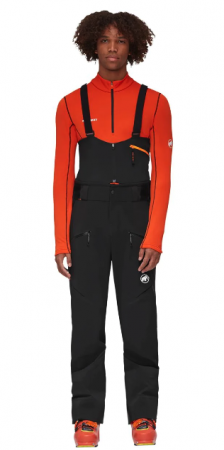
Weight: 496g
Best For: Backcountry/resort
Fit: Trim
Notable Features: Lightweight material
Pros: Lightweight and easy-moving material
Cons: Trimmer fit, no longer has a removable bib upper
Mammut’s Haldigrat Bibs used to have a pretty standout feature, being a removable bib upper which could be zipped off, turning the bibs into a pair of pants. We thought it was a pretty cool idea, especially if you’re someone who is interested in the added coverage of bibs but doesn’t want to completely give up skiing in pants. However, that feature has been discontinued this season in favor of a more streamlined design. Taking out the zipper and extra pants pieces, such as belt loops and velcro adjustment at the waist, certainly makes the bibs a bit more comfortable, but we were disappointed to see the versatility disappear for those who can’t decide between bibs and pants.
As far as construction goes, the Haldigrat bibs feature a durable, waterproof material that is also fairly lightweight and breathable. However, this lightweight and breathable fabric does run a little cold, requiring extra layers for cold resort skiing days. Style-wise, these weren’t a top pick due to what we’d describe as a fairly trim “euro” cut. Otherwise, these are a well-made bib with great material, a simple no-nonsense design, and top-tier comfort.
CHECK PRICE ON BackcountryAnother Runner-Up Best Backcountry/Resort Ski Bib
Strafe Outerwear Nomad Bib ($620)
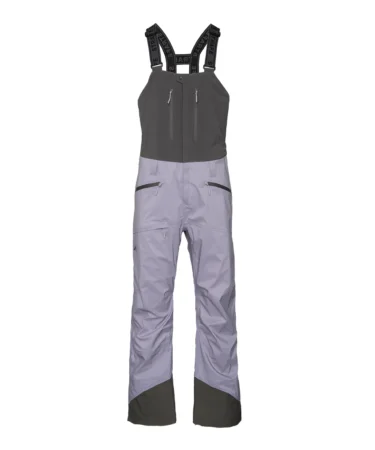
Weight: 705 g
Best For: Backcountry/resort
Fit: Loose
Notable Features: Interior pocket organization
Pros: Lightweight and fully featured bibs for a mix of resort and backcountry use
Cons: Lightweight construction isn’t as bombproof as some other options, and runs a bit cold for dedicated resort use, no drop seat
Strafe Outerwear is a brand that’s recently come onto our radar, and we’re very glad that it did. Their Nomad kit (jacket and bibs) strikes an incredible balance of lightweight and breathable material that is well-prepared to stand up to inclement weather and the rigors of resort use. It’s not as durable as some materials that we have experienced in our testing, but it has yet to let us down after a season of regular use, and the trade-offs of lightweight breathability and easy movement are well worth it if you’re looking for a bib that will excel in resort and backcountry skiing.
These bibs do run a good bit colder than your classic resort-oriented bib due to the increased breathability, but that’s easily fixed by layering up underneath, and the “freeride” (a.k.a. roomy) fit provides plenty of room for layering without decreasing mobility. Other outstanding features include a super-breathable and stretchy bib upper, plenty of pockets (with internal organization!), reinforced scuff guards, and a comfortable suspender-strap system. In comparison to the Patagonia Snowdrifter bibs, above, the Strafe Nomad has a lighter and thinner overall construction that isn’t stretchy like the Snowdrifter, but moves just as well thanks to a slightly roomier fit through the legs. Our main complaint here is the lack of a full drop-seat or swing hatch. Not as big a deal for the guys as it is for the ladies, but worth noting.
Editor’s Note: The Nomad Bib has been updated for 2025/2026 with a new fabric, 3L Pertex Shield, replacing the 3L eVent fabric used prior. It has also gone up in weight slightly from 695 g to 705 g.
CHECK PRICE ON evoSustainable GORE-TEX
Patagonia Untracked Bibs ($650)
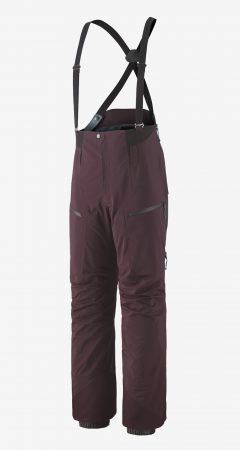
Weight: 650g
Best For: Resort/backcountry
Fit: Trim
Notable Features: Low-cut bib, belt loops
Pros: Sustainable, storm-ready GORE-TEX protection
Cons: Pricey, pockets are sufficient, but not a standout feature
One of Patagonia’s more recent releases is the Untracked outerwear kit (bib and jacket). The standout feature of the Untracked Bibs is the sustainable GORE-TEX construction. GORE-TEX, while providing the gold standard in terms of durable, waterproof/breathable fabric, takes a toll on the environment, which is why Patagonia has always gone with its own in-house waterproof/breathable fabric made with more sustainable materials. Last year, the two snowsports giants came together to produce a PFC-free and 100% recycled GORE-TEX fabric that’s up to Patagonia’s rigorous environmental standards.
And the fabric performs. Super durable and capable of withstanding wet conditions, the fabric, with a light flannel backer, moved extremely well, both on the resort and for colder backcountry expeditions. The fabric wasn’t the most breathable we’ve tried, and ran a bit warmer due to the flannel backer, landing this bib a little further on the resort side of the spectrum, though for colder, stormier tours, this bib certainly is up to the task. Features-wise, the bibs have two deep pockets and a low-rise bib that sits fairly snug, keeping snow out despite the low coverage. The suspender straps are extremely low-profile as to be almost unnoticeable. The bibs are also backed by Patagonia’s Ironclad Guarantee — if you break them, they’ll fix them. Classy, bombproof, and sustainable, the only things that kept this bib from hitting top marks were the high price and lack of pockets.
CHECK PRICE ON evoPremium Backcountry Design
Arc’teryx Rush ($700)
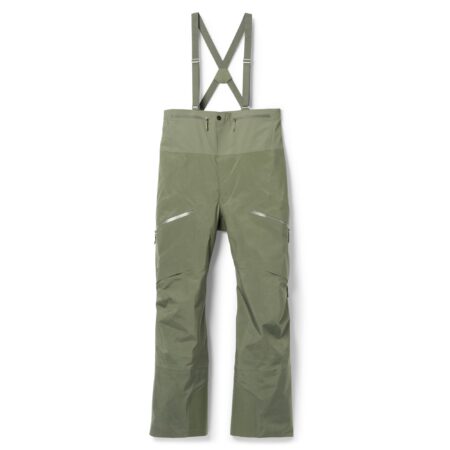
Weight: 536g
Best For: Backcountry
Fit: Average/trim
Notable Features: Low, breathable bib upper
Pros: Sleek and lightweight feel, great, low-profile suspender straps
Cons: Pricey, not the most breathable backcountry bib
Editor’s Note: Arc’teryx has updated the Rush bib and jacket for 2025/2026, with different material, a few feature tweaks, and a roomier fit.
The Arc’teryx Rush bibs deliver with a trim fit, low-profile suspender straps, durable materials, and four pockets. The material was a bit stiff at first, but loosened up considerably after the first tour in them, and had a burly feel with the use of 70-denier GORE-TEX PRO Most Rugged material, which is noticeably tear-resistant, especially when compared with other backcountry-oriented bibs. Pockets are sufficient. Not a standout feature, but for a pair of backcountry-oriented bibs, the fact that they weren’t a “con” is notable.
Our favorite feature was the strap system, one of our favorite suspender straps among all bibs featured here. The small metal clips for attachment and adjustment were unnoticeable under a backpack (a pair of bibs’ greatest enemy). Another favorite feature was the snow gaiters, which include protected openings that let you buckle a ski boot powerstrap over the gaiter for faster adjustments, but don’t let snow in while doing so.
On the breathability side of things, these bibs were solid but not a standout among competitors like the Mountain Hardwear High Exposure, where breathability is the top priority. The heavier-duty fabric made for a bit warmer of an experience on the uphill, and while the low-cut bib did keep the upper body cooler than full-cut bibs, the side zips for ventilation were average at best. But to be fair, it’s hard to have durable materials, low weight, and breathability at the same time. You’re going to have to sacrifice somewhere, but at the price point, we’d love to see more ventilation features from Arc’teryx.
CHECK PRICE ON evo
REI’s First Tracks bibs are cost-effective and comfortable. Photo: Tim Manning//The Inertia
Honorable Mentions
There are so many awesome ski bibs on the market these days, and in this review, we’ve only got room to talk about the absolute best of the best. That said, there are a couple of other awesome bibs that almost made the cut, and we’d love to mention them here.
First off, the Norrona Tamok. Norrona’s attention to detail and quality are undeniable, but for a $600 pair of bibs, we’d like to see some more features, like more pocket space and better venting options. With mesh-lined outer-thigh vents, we found these to be a bib that is perfect for colder days on the resort – the mesh-lined vents are great for this, letting you dump heat but keep powder out at the same time. However, mesh-lined vents just don’t release heat as well as unlined ones, so we wouldn’t recommend these bibs for high-output touring or spring-skiing conditions.
We’re also big fans of the Trew Gear Capow bib, specifically designed for backcountry use with a much lighter and more breathable material than the Trewth bibs, featured above. With light material, inner and outer thigh vents, and plenty of pockets, these bibs stick to the Trew programming of feature-forward design. However, they feature the same chunky strap-adjustment system as the Trewth bibs, which is not our favorite with a backpack on, and we ended up giving the nod to backcountry bibs with more low-profile straps.
We have yet to test the Mountain Hardwear First Tracks Bib ourselves, but we have heard great things about this insulated design. At $300 for a lightly insulated bib with solid venting options (mesh-lined inner-thigh vents and medium-sized outer-thigh vents), great pockets, and durable material, this bib provides a great value for the resort-riding crowd, especially those who rarely venture off-trail, or tend to ski in colder conditions.
Another solid option that caters to the budget-conscious crowd is the Patagonia Powder Town Bib, priced at $300. Super comfortable, lightweight, and easy-moving, it’s easy to forget you’re wearing a piece of ski gear. That said, they’re fully waterproof, made with Patagonia’s sustainable H2No material and a PFC-free DWR. The 2L design cuts down on breathability, so we’d only recommend these for resort use – however, the lightweight and mobile shell material wasn’t the most durable option we’ve tested at only 75 Denier, making these a better choice for casual use rather than racking up long days on the resort. That said, we plan on testing the latest Patagonia Powder Town bibs this season, which have been updated with a much more durable 150 Denier fabric.
Lightweight breathability is the name of the game with the Rab Khroma Kinetic Bib. At just $400, the bib is lightly featured, but uses Rab’s top-tier ProFlex material that provides softshell-like comfort and breathability with the weather-protection of a hardshell. We found bibs with more ventilation to be our preference for backcountry use, but if you’re someone who hates hardshell material, but still demands weather protection in the backcountry, this might be the bib for you.
REI’s Powderbound Insulated Bib just might be the best deal on a pair of bibs that we’ve seen. Priced at $219, it’s frequently on-sale for $160. However, we found the insulated design, with only mesh-lined inner-thigh vents and a small side zipper, to run too warm for full-season use in most climates. If you’re just getting out there a couple of times per season in midwinter conditions, this bib is a decent option, but most skiers will be happier with the budget bibs we included higher up in this review.

The Black Diamond Recon Stretch Bibs don’t skimp on functionality or durability. Photo: Ryan Salm//The Inertia
Best Ski Bibs Comparison Table
| Bib | Price | Best For | Weight | Material/Waterproofing |
| Trew Gear Trewth Bib Primo | $600 | Resort | 895 g | 20k/20k 3L PNW Primo |
| Flylow Baker Bib | $440 | Resort | 907 g | 3L Intuitive 20k/20k |
| Salomon Scrambler Bib | $700 | Backcountry | 550 g | 3L Gore-Tex ePE |
| Mountain Hardwear Firefall Insulated | $275 | Resort | 816 g | 2L waterproof Dry.Q |
| Scott Vertic Ripstop 3L Bib | $330 | Resort | 950 g | 15k/10k Vertic Ripstop 3L |
| The North Face Summit Tsirku | $700 | Resort/backcountry | 815 g | 3L Gore-Tex Pro |
| Patagonia Snowdrifter | $240 | Backcountry/resort | 650 g | 3L H2No |
| Mountain Hardwear High Exposure | $330 | Backcountry | 553 g | 3L Gore-Tex C-Knit ePE |
| Black Diamond Recon Stretch | $480 | Resort/backcountry | 779 g | 20k/20k Bd.dry stretch |
| The North Face Freedom Bib | $220 | Resort | 935 g | 2L DryVent |
| Norrona Lofoten Gore-Tex Pro Pant + Bib Attachment | $900+ 69 (for bib attachment) | Backcountry/resort | 860 g (pant only) | 3L Gore-Tex Pro |
| 686 Dispatch Bib | $358 | Resort | Not listed | 2L Gore-Tex |
| The North Face Summit Verbier | $600 | Resort | 833 g | Gore-Tex 3L |
| REI First Chair GTX ePE | $270 | Resort | 847 g | 2L Gore-Tex ePE |
| Mammut Haldigrat | $370 | Backcountry/resort | 496 g | 20k/20k Mammut DRYtechnology Pro |
| Strafe Outerwear Nomad Bib | $620 | Backcountry/resort | 705 g | Pertex Shield 3L |
| Patagonia Untracked Bibs | $650 | Resort/backcountry | 650 g | 3L Gore-Tex |
| Arc’teryx Rush | $700 | Backcountry | 536g | 3L Gore-Tex Pro |

How did we test the best ski bibs? We skied in them, of course. Photo: Tim Manning//The Inertia
How We Tested The Best Ski Bibs
For this review, we scoured the internet for the best ski bibs on the market, checked in with ski buddies and local pros on the bibs they trust for the deepest of days, and got our hands on over 15 different options from the top outerwear manufacturers in the industry to test out. Lead tester and The Inertia‘s Senior Gear Editor, Will Sileo, is a lifelong skier with a passion for the best gear in the industry. He took the selected bibs on a tour de force during the best winter (2022/23) that Tahoe has seen in years, the perfect testing ground for ski bibs. From backcountry laps to his favorite powder stashes, to strike missions from the North Cascades to legendary Jackson Hole, he put them to the test.

All lined up and ready for testing. Photo: Will Sileo//The Inertia
We first published this review in February of 2023, with the best ski bibs in the industry available at the time. That spring, we tested another round of bibs for the upcoming 2023/24 season and updated this article in October of 2023 as the first snows began to fall, with the best ski bibs for the 2023/2024 season. We continued testing a variety of ski bibs during the 23/24 season and updated this review in early March to reflect our findings after a season of getting after it on the resort and in the backcountry.
In October of 2024, we revised this review to reflect the current state of the ski-bib market, removing some discontinued options and adding some additional comparison info to help you decide between all the awesome options presented here. In early January of 2025, we removed the significantly changed Backcountry Cardiac Bibs and added the Patagonia Snowdrifter Bibs. In our pre-season update in the fall of 2025, we removed some options that have been discontinued, added the Scott Vertic Ripstop Bibs after testing at the end of last season, and provided some details on recent updates to bibs already included in this guide.
Our most recent update in February of 2026 comes after a bunch of early-season testing with the latest bibs on the market. With the snow as poor as it’s been this season in the US West, we also took a quick trip across the Pacific to Japan for some true powder skiing, putting bibs like The North Face Summit Tsirku and the Trew Gear Trewth Bib to the test in the light, airy powder that Japan has on offer.

Belt loops also make great attachment points. Photo: Tim Manning//The Inertia
Ski Bibs Buyer’s Guide
For this buyer’s guide, we’re going to cover three main categories. Bib construction, focusing on materials and decoding some of the jargon. Features, covering what we look for and what you can expect to find on a pair of bibs. And finally, a quick note on how to best take care of your bibs so they last you for many seasons to come.

The OR Skytour bibs use Ascentshell material, which is very stretchy and breathable. Photo: Tim Manning//The Inertia
Bib Construction and Materials
It’s tough to strike the right balance between waterproof material, durability, and weight, but luckily, there have been some incredible advancements recently in material technology that have brought these two aspects closer together. GORE-TEX is the top-of-the-line choice, but we were similarly impressed with the performance of proprietary fabrics and waterproof finishes like Black Diamond’s BD.dry, Patagonia’s H2No, and Mammut’s DRYtechnology Pro, among others.
On the durability front, it’s all about striking the right balance between lightness and flexibility against heavyweight durability. Extra reinforcement in key areas, like scuff guards on the ankles, is a key durability feature.

Rubberized scuff patches on the Arc’teryx Rush bibs add a lot of durability in a key area. Photo: Ryan Salm//The Inertia
What’s the Difference Between 2L and 3L Material?
When discussing shell fabric, one of the biggest defining points between higher and lower-quality gear is whether it’s made of a 2L or 3L construction. The terms point to the number of fabric layers sandwiched together to make the outer shell of the garment. Any piece of snowsports outerwear has an outer layer of durable fabric with a waterproof/breathable membrane underneath that keeps water out while letting water vapor (your sweat) escape.

The Mountain Hardwear Firefall Bibs use a 2L design and strategic insulation with a comfortable liner material. Photo: Nick Bruckbauer//The Inertia
However, that waterproof membrane needs to be separated from your skin. In a 3L construction, there’s a third layer of fabric fused to the inside of the waterproof membrane. In a 2L construction, there’s still a third layer of fabric, but it’s not fused to the membrane, adding a bit of bulk and usually reducing the breathability, though some 2L ski bibs use a mesh liner.
Having the materials all fused together in a 3L construction adds breathability, a bit more of a streamlined or shell-like feel without that hanging liner, and often a significant uptick in price. That’s great for high-output activities (like heading into the backcountry) but not always necessary if you’re just hitting the resort. That said, for warmer days and hard-charging resort skiing, the added breathability sure is nice.
Waterproof/Breathability Ratings Explained
On many ski bibs, especially 3L designs, you may notice a “Waterproof/Breathability” rating provided for the material. These often are presented together, like “15k/15k” or “20,000mm/15,000g.” The first number expresses the material’s waterproofness in mm – the amount of water pressure the material can withstand before it lets water through. The second number represents the material’s breathability by showing how many grams of water vapor per square meter (m2) of material can pass through the fabric in 24 hours. For both, higher numbers indicate a better rating – higher waterproofing and higher breathability.
20k/20k or better is what you can usually expect from a high-end 3L material found in most ski bibs around/above the $500 mark. The DWR (see below) also plays a significant role here, as does zipper construction and seam taping. Anything 20k and above for waterproofing will be able to withstand heavy rain without letting water through. 15k should be able to endure anything but a true downpour.
For breathability, 15k tends to be solid enough breathability for high-exertion activities like heading into the backcountry, but if you get out there often, upgrading to a fabric with 20k breathability will likely be well worth the extra cost. Anything more than that, and you’re heading into softshell territory, though we have seen a couple of 30k hardshells. Worth noting here, while high breathability ratings are great, also make sure your bibs have proper venting to really air things out as needed.

How water should look on a DWR. If water is soaking into your bibs instead of beading up like so, it might be time to re-up your DWR treatment. Photo: Will Sileo//The Inertia
What’s a DWR Finish?
A DWR (Durable Water Repellant) finish is a waterproof treatment applied to any piece of technical waterproof outerwear. Its main purpose is to keep water from soaking into the first layer of fabric. However, it is actually a bit of a misnomer, as said waterproof treatment is often the least “durable” part of the item in question, prone to rubbing off over time.
When that happens, water will soak into the first layer of fabric (though it shouldn’t make it past the waterproof membrane beneath), adding weight and chill to your outerwear, neither of which is ideal. If you notice that happening to your ski bibs or other outerwear, it’s worth getting your hands on a spray-on or wash-in treatment to revive the water-repellency of the fabric.
Features
Here are some things your bibs should (and all of the ones on this list) have. Ventilation, lots of pockets, drop seat capabilities, and solidly waterproof material.

The North Face Freedom Bibs have mesh-lined inner-thigh vents. Photo: Tim Manning//The Inertia
Ventilation and Breathability
This is one of the most important features of a backcountry bib. Bibs keep you warm, but it’s easy to overheat, especially as you work hard in the powder. Pay attention to the material bibs are made of, as some materials are more breathable than others. Some bibs come with mesh-guarded vents to let in cool air but keep out snow. A cool idea, but in our opinion, they often don’t let enough air in by themselves for touring or warmer days on the resort.

Exterior and interior thigh vents on the Flylow Baker Bibs allow for cross-ventilation to really cool things down. Photo: Ella Boyd//The Inertia
The best ventilation in a pair of bibs is full side zippers that let you open up from waist to knee for full-on airflow. Another great (but rarer) feature is inner-thigh vents, which, in combination with outer-thigh vents, can really get a cross-breeze going. Better yet, if the inner-thigh vents are mesh-lined, you can keep them open while riding in deep powder without fear of letting snow in. The Flylow Baker Bibs have a four-vent construction with unlined inner-thigh vents, and new this season, both The North Face Summit Verbier Bibs and the Trew Gear Trewth Bib nail it on the head with two mesh-lined inner-thigh vents and two unlined outer-thigh vents that pull double-duty as a swing hatch/dropseat for easier bathroom breaks.

Plenty of pockets on the Flylow Baker Bibs. Photo: Tim Manning//The Inertia
Pockets (lots of them)
Pockets can be a matter of personal preference, but it’s hard to deny their usefulness. We love to stash all our little gear items (headphones, snacks, avvy beacon, phone, etc.) on ourselves, even when wearing a backpack, to avoid constantly taking the pack on and off to reach what we need. For us, lots of pockets are a must, but we’re not everyone.
Pockets (and the bib material necessary to house them) add weight and stiffness, so for those looking to go lighter, lots of pockets can be a downside, and in all likelihood, your jacket will have a number of pockets as well. So pick your poison. Another great pocket feature to look for is internal organization, such as interior stretch pockets and attachment points for lanyards and beacon leashes.

A full side-zipper on both sides of the Patagonia Snowdrifter bibs allows for easy ventilation and a full drop-seat when nature comes a-calling. Peep those low-profile suspender straps, too. Photo: Ken Cox//The Inertia
Suspender Straps
The biggest con of a few bibs here is their suspender straps and how well they jive (or don’t) with backpacks. Surprisingly, as you’d imagine. This is something bib manufacturers should have figured out by now. In short, the various types of buckles and attachment points for the straps are often a bit bulky and uncomfortable when worn under a backpack.
Our favorite strap systems include Arc’teryx’s Rush bibs as well as Patagonia’s Snowdrifter bibs, which use low-profile strap ladders for adjustment, and similarly low-profile clips for bib-strap attachment. Another standout here was the Black Diamond Recon bibs, and The North Face Summit Tsirku Bib.

The Ortovox Deep bibs have waist-to-knee side-zips, allowing for a full drop-seat. Photo: Ken Cox//The Inertia
Drop-Seat Capability
This is a big one. No one likes to take their bibs completely off to go to the bathroom, especially when you have a jacket or other layers over your bibs. Drop seats are either one or two full-side zippers that let you open up the back of your bibs. One side zipper is sufficient, but it means you need to hold the rest of the bib to the side for a successful trip to the loo. For men, a front zipper is a must as well.

A lace hook on the Patagonia Snowdrifter bibs helps keep your gaiters securely attached to your boots. Photo: Tim Manning//The Inertia
Ski Bib Care
Storage
Properly storing your ski bibs will go a long way toward making sure they last as long as possible. The most important aspect to keep in mind is that the DWR will rub off over time, so do your best to hang your ski bibs whenever possible in a warm, dry place.
Washing
While it’s best to minimize the number of times you wash your ski bibs, eventually, the time will come. When it does, be sure to read the tag for proper washing instructions, and avoid normal detergent, as well as hot water. When you wash your ski bibs, it can be a good idea to use an outerwear-specific wash or DWR-reviver like this Nikwax wash-in treatment. That can re-up the water-repellency of your ski bibs without impacting the breathability.
A beacon pocket with a lanyard or attachment point is a great feature to have if heading into the backcountry. Photo: Tim Manning//The Inertia
Final Thoughts
Any of the ski bibs included in this list would make a great companion out on the slopes. We’ve tested a wide variety of bibs in the past few years, and these are the ones that rose to the top with high-performing materials, great features, and comfy fits.
While we do spend a lot of time calling out both pros and cons of the bibs in this review to give you the full picture in making a purchasing decision, overall, we stand behind all of the bibs featured on this list as an incredible option to keep you warm, protected, and performing at your peak while out in the snow.
Return to Top Picks | Return to Comparison Table
Related: The Best Ski Jackets | The Best Women’s Ski Bibs | More Ski Gear Reviews
Editor’s Note: If you’re a boarder, or don’t see a difference between ski and snowboard bibs, you’ll find more options in our guide to The Best Snowboard Pants. For women, see our guides to The Best Women’s Ski Jackets and Ski Bibs. For more gear reviews and features on The Inertia, click here.

The Best Snowboard Pants of 2026


