
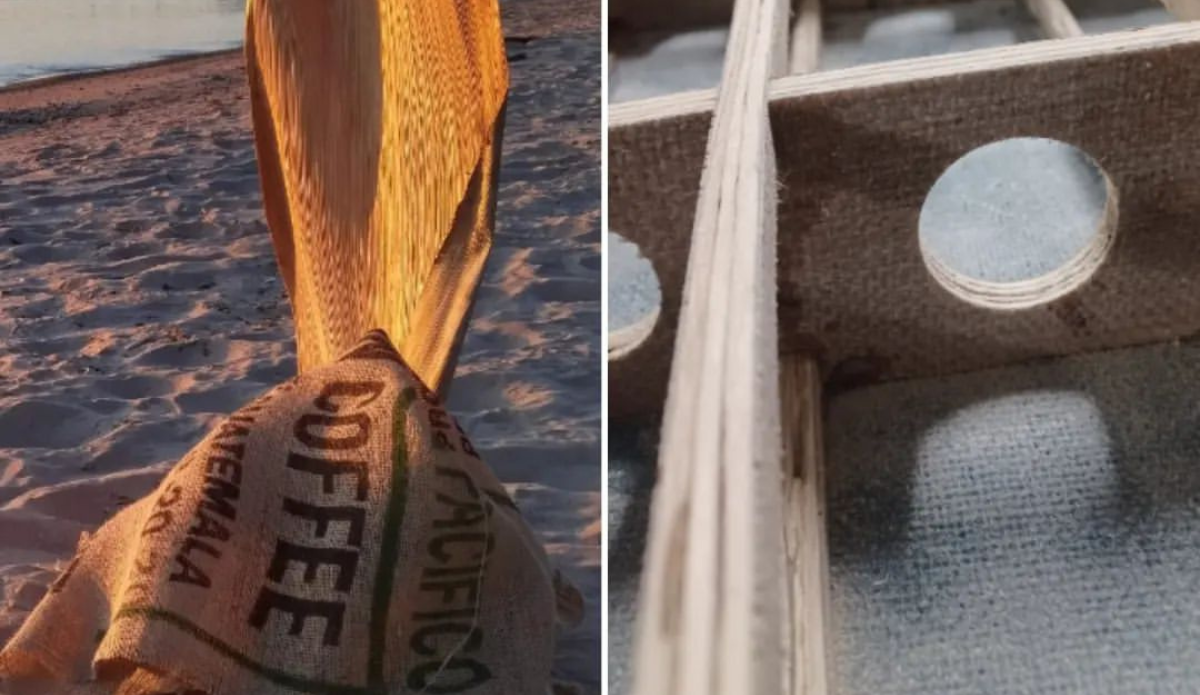
Photo: @greenhousesurf

A decade ago it was big news to hear of shapers setting out to create more sustainable surfboards. We all knew the process of making our equipment wasn’t consistent with surfers’ perceived stewardship of the ocean but the alternatives to polyurethane boards weren’t so widely available. Not like they are today.
A lot has changed. You’d be hard-pressed today to find any major surfboard manufacturer who doesn’t tout some kind of sustainable construction. And when you dive into the ecosystem of local shapers there’s a ton of innovation, highlighted by men and women figuring out how to build boards with materials you’d never imagine could catch a wave. A little project brewing in the Great Lakes, of all places, is doing this with coffee bags and palm leaves.
According to the Milwaukee Journal Sentinel, Ken Cole took a break from pumping out surfboards for his side business back in 2021, Greenhouse Surfboards. He took the time to study different materials and dive into learning about sustainable practices that could be brought into his shaping process, eventually recalling the palm leaf utensils he’d seen at a friend’s backyard party in 2019. He started working with another Milwaukee-based surfer by the name of Micael Sevier, who brought a very useful resumé into the new endeavor — an assistant professor of mechanical engineering at the Milwaukee School of Engineering. They tested the materials and different designs with the help of others, and eventually enlisted an industrial design professor from the University of Illinois—Chicago, Ted Burdett. Burdett was also in pursuit of a more sustainable surfboard with Great Lakes Surf Craft. The prototype the group poured themself into replaced polyurethane foam and used a plywood created with jute and palm leaves. The traditional glassing has been swapped out with materials like jute, hemp, bioresin, basalt, and there are even Collectivo coffee bags thrown into the mix.
“We just want to show what can be done. That in and of itself is a statement,” Cole told the Milwaukee Journal Sentinel. “When I tell people we made a surfboard out of leaves, they assume we glued a bunch of leaves together. They don’t understand the engineering behind it by a rag tag group of creative visionaries without any guarantee this would work. Just to prove it can be done. We hope it’ll get more shapers to think, ‘what else can be done?'”
The new prototype has been several years in the making but whether or not the board will work is yet to be seen. But once again, flash back a decade ago and the same wait-and-see approach was given to almost all equipment that explored alternative materials. The experimentation of shapers throughout that time is exactly why sustainable boards are no longer a novelty or an exception to the rule — they’re a standard our entire industry has adopted and is working toward.
“If [this material] can be formed into a strong yet light craft that can glide through waves, it can easily carry the weight of a person as furniture,” Burdett told Gear Junkie in 2023. “If it can endure the frigid waters of the Great Lakes during winter sessions, clearly it can become a durable component in objects for transportation.”
View this post on Instagram

