
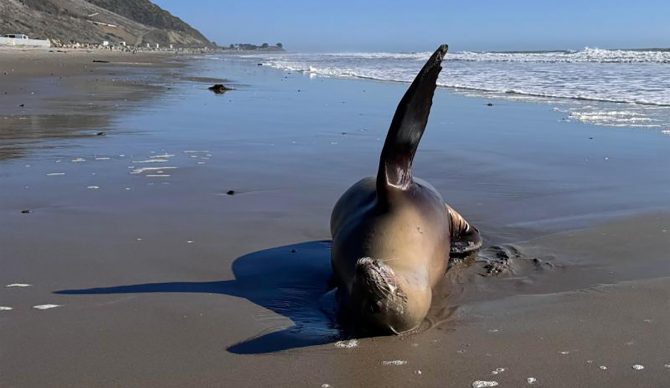
Things have not been good for wildlife rescuers. Photo: Channel Islands Marine & Wildlife Institute

Out in the lineup, I overheard the surfer next to me describe the bizarre state of the beach to his friend. “I was grabbing my flip flops,” he said, “and I turned around and there was this dazed pelican staring at me, swaying side to side. It was eerie.”
Since February, beaches up and down the coast of Southern California have been awash with sickened and deceased sea lions, dolphins and seabirds. At least two species of whales have also been impacted, according to a press release from the Pacific Marine Mammal Center. Social media is full of concerning videos of encounters with confused and aggressive sea lions, and personally I’ve encountered a number of dead and injured seabirds and sea lions on the beach.
Zombie pelicans and freaked out surfers aside, the tragic sight of suffering marine animals leaves surfers and concerned onlookers wondering what exactly is going on, and how they can help. According to Jeni Smith, SeaWorld San Diego’s Curator of Rescue, the root of the problem is an overly robust toxic algal bloom, a process which produces pseudo-nitzschia, a marine planktonic diatom genus that in turn, creates domoic acid, a neurotoxin. Plantivorous fish and plankton eat the algae, and the neurotoxin travels dangerously up the food chain.
“It’s safe to say,” Smith told me, “that the dead dolphins washing ashore are probably due to domoic acid (DA) toxicity.” What creates such an algal bloom so rich in toxins? Michael Milstein, spokesman for NOAA Fisheries West Coast Region, contends that the “main driver off the California coast is the upwelling of deep ocean water,” which this year is “higher in nutrients than ever before.” While these supercharged nutrients account for California’s rich marine ecosystems, they’ve arrived in concert with the algae that generates domoic acid, plus warming seawater via climate change. This creates what Milstein calls a “perfect storm of conditions.” While this type of bloom has occurred for the past four years, Milstein says that this bloom started much earlier in the year than normal and so far, is showing no signs of lessening.
Each year, Smith says, the rescue team at Sea World doesn’t know exactly what to expect. However, this winter, when they checked out the seawater off Scripps Pier and at other coastal locations, it was quickly clear that the levels of both nutrients and resulting pseudo-nitzschia were off the charts. Soon the algal bloom began in the Los Angeles area and expanded north and south. Smith tells me that this season’s stats reveal why it has become so common to see injured wildlife at the beaches: in 2024, there were 18 sea lions that had to be rescued due to domoic acid. As of April 17th, 2025, Smith says she can confirm 50 California sea lions being rescued, 32 birds — 27 of which were pelicans — and one common dolphin that was a DA “suspect” at the time (the animals are first classified as DA “suspects;” they undergo tests to be certain).
Milstein asserts that he’s seen an increasing number of impacted dolphins over the past few weeks, and that while this season’s numbers aren’t pinned down yet, they are “well into the hundreds.” While some reports come in multiple times for the same animal, this interactive stranding event tracker tells a sobering story about the sky-high numbers of suffering animals.
Sea lions, Milstein reports, are the “most obvious victims,” since many have violent seizures on shore. The domoic acid “throws their nervous systems out of whack, and they lose control of their bodies,” he says. Smith tells me that the acid can cause parts of the animals’ brains to shrink, leading to difficulties with spatial navigation, which is why some sea lions have wandered into residential areas and some dolphins have been swimming in waters far too shallow.
“If they see someone on a surfboard, they could react in an aggressive, unpredictable way,” Milstein adds. While many of the dolphins are beyond saving and already close to death, hardy rescuers like Smith pick up struggling sea lions and attempt to flush the toxins from their systems. Some have recovered in this way, but not a huge number.
When I tell Smith about the concerns I’ve heard voiced in my local lineup, she says that it is helpful when the public calls in, and inspiring to know how many people are passionate about the animals that populate our beaches. However, she cautions that even when multiple calls come in for the same animal, rescuers cannot always get there right away. Sometimes, she says, some of the team is working in-house with an animal that is already in tough shape.
“We need to triage all the animals we can get to,” she says, and describes the long, challenging hours these last few months have warranted, with rescue team members charging down long flights of steps at breaks like Swamis, and looking at San Diego County “geographically” for the team at SeaWorld to be as effective as possible. The Pacific Marine Mammal Center describes the current plight as “one of the largest harmful toxic algae blooms recorded along the Southern California coast,” and Smith agrees, adding that “this is really the first time we’ve seen anything like this.”
She offers some sage advice in case you roll up to the break and spy a pelican, dolphin or sea lion acting strangely. “It’s a helpful reminder that wild animals are unpredictable,” Smith says, “so first off, keep your distance.” Then, options include calling 1-800-541-SEAL or shooting an email to swc.rescue@seaworld.com. Milstein offers NOAA’s West Coast Marine Mammal Stranding Network at 866-767-6114, and concerned beachgoers can also call the California Department of Fish and Wildlife at 916-358-2790 to report injured birds.
When I ask if there is any end in sight, Smith cautiously reports that as of late, they are seeing slightly less impacted sea lions, but unfortunately the toxic bloom is still “running high” off Scripps Pier. Milstein agrees that the situation is dire, adding that as long as the nutrients in the water are so high, the bloom will unfortunately keep growing.
Hopefully, these potent algal blooms go the way of the dinosaurs, and our marine animals will see an end to their suffering. In the meantime, if you see something strange on your way out for a surf, first be sure to stay safe — then make the right call.

