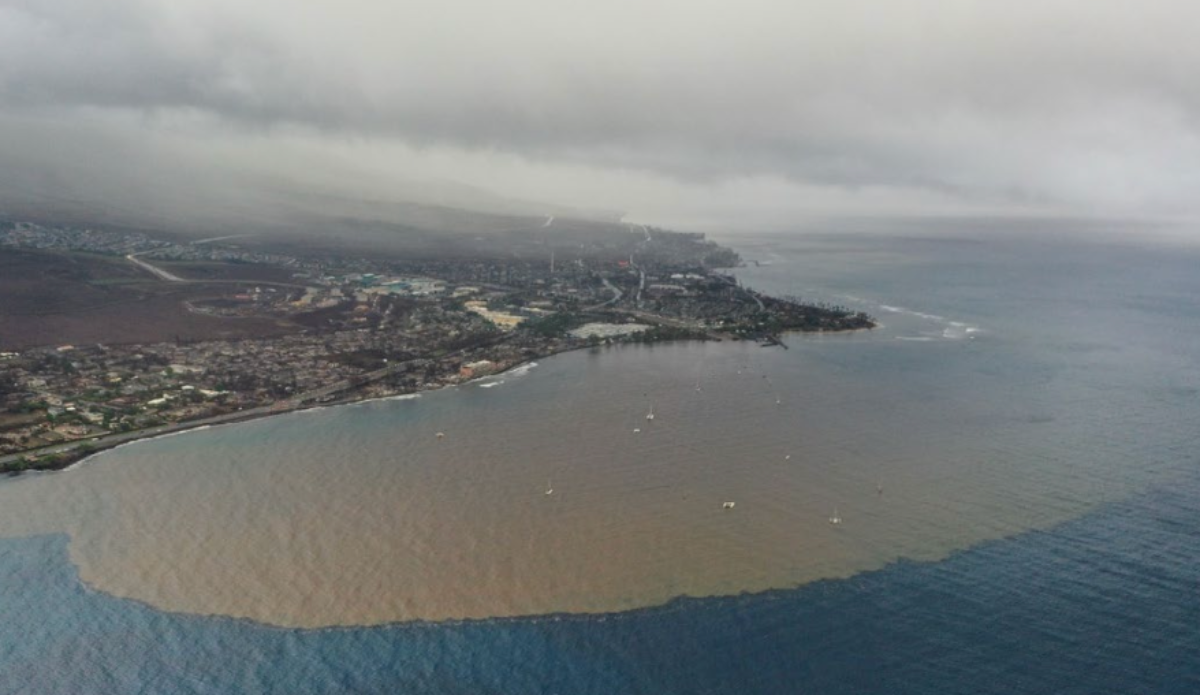
Runoff from the Lāhainā burn zone washes ash and sediment into the ocean on West Maui, following the first significant rain event post-fires in January 2024.

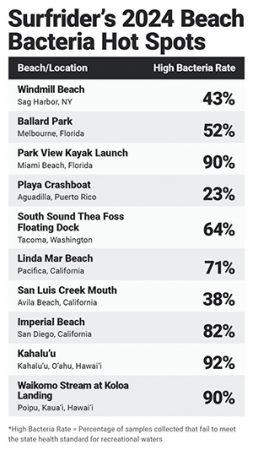
The Surfrider Foundation released its 2024 Clean Water Report Tuesday and revealed the results of more than 10,000 water sample tests from over 600 U.S. beaches in the past year. The annual report is the culmination of work by Surfrider’s Blue Water Task Force and is used to raise awareness of water pollution problems and advocate for solutions to protect clean water and healthy coastal ecosystems. As such, the foundation has named 10 beach bacteria hotspots — testing locations which had the highest rates of samples collected that failed to meet local and state health standards for recreational use.
“Each location regularly shows dangerous levels of fecal-indicator bacteria tied to human illnesses, including gastrointestinal issues, flu-like symptoms, and serious skin conditions like MRSA and staph infections,” the report says.
A few highlights (or lowlights, if you will) included San Diego County’s Imperial Beach, which is impacted by flows of stormwater, sewage, and industrial pollution through the Tijuana River Valley. The beach “had the dubious distinction of failing to meet health standards every single time they were tested by Surfrider in 2023.” The border-straddling beach is on Surfrider’s list again as the organization campaigns the Trump administration to declare the threat to public health a national emergency. While the situation remains dire, Surfrider says it secured $491 million in 2024 for infrastructure improvements that can address the crisis at the border.
“Despite this progress, affected communities continued to suffer,” says the organization. “They faced not only water pollution but also dangerous levels of hydrogen sulfide released into the air from heavily polluted, fast-moving streams within the watershed.”
Two beaches in Hawaii joined Imperial Beach at the top of Surfrider’s list: Oahu’s Kahalu’u and Waikomo Stream at Koloa Landing on Kaua’i. The Kahalu’u site is used as an access point to go snorkeling and fishing in Kāne’ohe Bay. They say there is a high concentration of cesspools and stormwater runoff into the beach contributing to water pollution. Kaua’i’s Waikomo Stream at Koloa Landing is another popular spot for snorkeling as well as diving, and Surfrider says it also found markers of sewage there every time it was sampled.
It might surprise some that no locations near Lahaina made the list following the late 2023 wildfire that devastated Maui.
“There were many questions about the safety of water at the beach near the burn zone and along the entire west side of the island. There were federal and state agency-led programs to monitor the air, soil, and ash for fire-related contaminants,” Surfrider says. “Academic researchers were also monitoring water quality to determine the potential impacts of the fires on the coral reef ecosystems in the near-shore waters.”
In spite of this, Surfrider says the public lacked sufficient answers to whether or not it was safe to swim. The organization launched the Maui Post-Fires Coastal Water Quality Monitoring Program, which collected its first samples on January 10, 2024, following the first significant rainfall after the August 2023 fire, and several months later in June. Surfrider tested eight different sites for enterococcus, fecal indicator bacteria, and fire-related contaminants, including heavy metals and PAHs (Polycyclic Aromatic Hydrocarbons) and says it found no evidence of fire-related contamination that would pose a risk to people simply by swimming in the water.
“While finding appropriate human health/recreational guidelines for fire-related contaminants was challenging, nearly all of our test results were also well below the aquatic life criteria, which are typically much lower than recreational standards,” reads the report. “The one exception was the concentrations of copper that exceeded aquatic life criteria in Lāhainā Harbor, which was most likely a pre-existing problem, as copper-based products are heavily used to
clean boat hulls.”
You can read the full report here. The top 10 beaches in terms of bacteria tested by Surfrider can be seen below.