
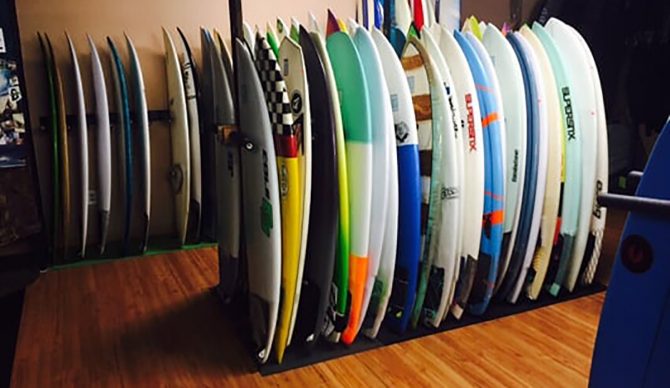
Craigslist and Facebook Marketplace are full of gems. But you might have to put the work in. Photo: Used Surf

You want to surf the latest Pyzel, DHD, or …Lost model but you can’t afford it, or can’t justify the purchase.
Surfboards are expensive, and they don’t always last long. They ding, crack, water-log, and break. It can cost a pretty penny to get a brand new one when the old one gets destroyed.
As a child raised by a loving and frugal mother, I naturally developed the same attitudes towards surfboards. I bought used surfboards and learned to Jerry rig them. After a few years, once I figured out how to patch boards, I started buying new models with a “big issue” like a busted fin box or blown out rail.
Throughout those salad days I compiled a guide for surfboard surgery. It helped me become proficient in the art of fixing sticks, so that I could buy broken or beaten up boards that people didn’t want.
Fixing boards is a process of trial and error, word of mouth, and experimentation. You have to start somewhere, and then make it your own.
Start with the basics: ding repair.
The simplest way to keep a board riding is to repair dings as they come. This was a foreign concept to my teenage mind. I’d just ride boards into the ground and one day think, “why is this thing so heavy and have zero pop?”
My mind was blown when my dad saw a crack in my board and slapped a sticker over it. It kept most of the water out and looked cool. After a few surfs the sticker started to fall off. I didn’t have another sticker, but I had wax. I waxed the hell out of the sticker and found my first water tight(ish) seal. Wax and stickers, it’s two things every surfer should have and something every surf shop sells (and there’s always ding tape).
But some dings are too big — especially those with large open holes and spiderweb cracks — for stickers and wax. One time I noticed an area was leaking water and got curious, so I cut open the board with a razor blade. The foam was soaked. I let it dry. I went to Home Depot to find a solution. EnterJB WaterWeld. The putty sets within hours and can be sanded down. It’s a little heavy, but lasts longer than the board will.
The sticker, wax, and JB Weld formula kept me going for years. But my boards became cumbersome, and I wanted to build out a better quiver. That’s when I stumbled upon the mother-load of used surfboards in California: Craigslist.
Odds are you’ll find someone who has a nice board, but isn’t willing to fix what’s wrong with it. I once snagged a 6’8“ …Lost Mayhem pro-stock board shaped for Shayne Beschen… for $50 and a six-pack of beer. The poor fella deemed the board dead from a busted fin box. It’s now my magic board for winters in San Francisco.
There’s also a bevy of surfboards with busted out rails. I snagged an Al Merrick CI with a beautiful psychedelic paint job for $100. I had a feeling the JB Weld would be too heavy on such a light board; it would turn into a lemon. That’s when a local shop owner at Sonlight Surf Shop in Pacifica, California told me about foam filler, epoxy resin, and fiberglass.
When mixed with water, the foam filler basically handles like Cool Whip. Apply a generous layer and use your hand to reshape the rail. Sand down once hardened. Mix the resin and catalyst to the prescribed ratio, wet the fiberglass, and place it over the foam filler. Finish it with a fresh sanding and then another layer of resin. Apply and let dry. With fiberglass and resin, less is more.
I ended up with a perfectly usable high performance shortboard I’ve always wanted — but could never afford — in my quiver.
Fiberglass, foam, and resin also open up other avenues like fin boxes, de-laminations, and leash plugs. Replacing a fin box is a procedure. When I bought the 6’8” …Lost Beschen pro-stock, I went down to my local shop for a lesson in fixing fin boxes. Remove the old box and loose foam, refill the foam, dremel a new cavity for the new box, install it with resin, then glass over it. But for boards that I didn’t want to put the full time and effort into, a quicker fix I figured out was to pack the old fin box hole with fiberglass and resin, and stick the new box in with it, then glass over.
For leash plugs, I’d pretty much do the same thing, or hole saw a new cavity for the plug.
De-lams are the most fun because you can say, “I need 50ccs of resin stat!” Inject resin into the center of the de-lam with a syringe and then place a bunch of heavy books, or bricks, onto the spot.
With all of these little tricks, I’ve been able to add a step-up …Lost, everyday rider Al Merrick CI, and a HaydenShapes Hypto Krypto to my quiver — all for less than the price of a new surfboard.
Save yourself some dough, get a new hobby, and try all of the boards you want by getting a hard knocks degree in surfboard surgery.
Surfboard repair is an art. Many aficionados have credited the book, The Ding Repair Scriptures, as the technique bible.

