
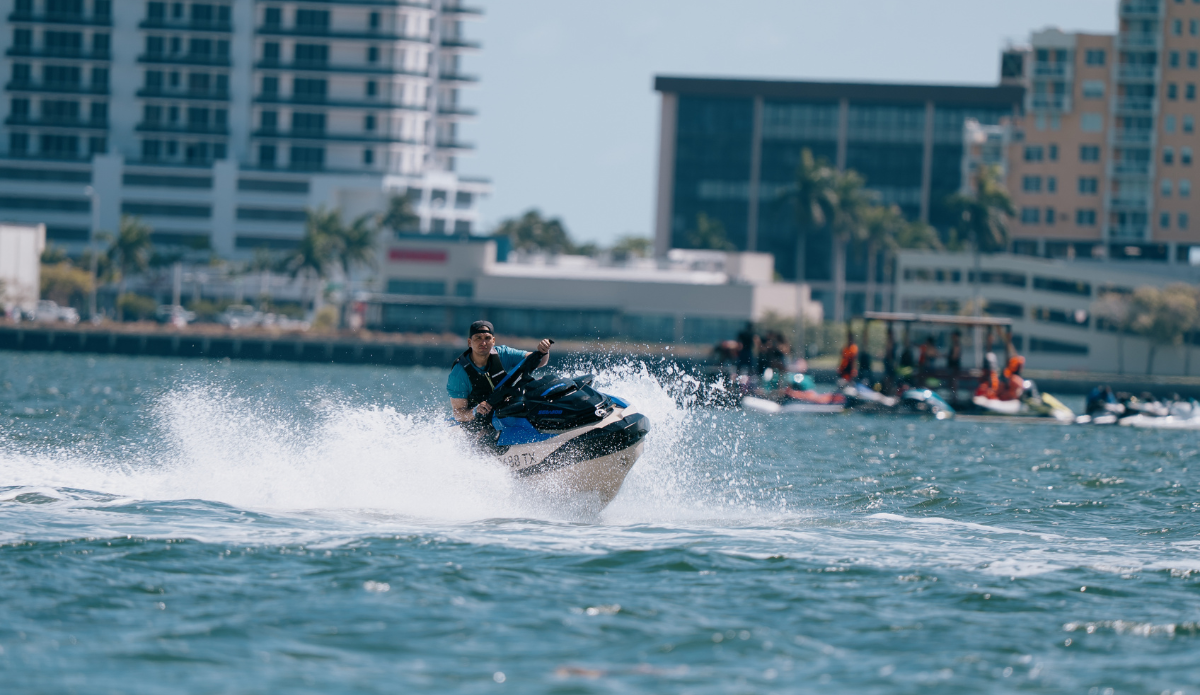
The author, no where near a breaking wave but getting familiar with big wave surfing’s most advanced tool. Photo: Sea Doo

Personal watercrafts have changed surfing as much as any element of surfboard design. No amount of progression in surfboard building materials or cutting-edge fins would have put humans into 80-foot waves without the ability to tow into them. The pursuit of a 100-foot wave wouldn’t even exist. Even without Laird, Dave Kalama, Buzzy Kerbox, and Darrick Doerner’s intuition to deploy a tow rope, there’s no way to measure how willing our sport’s most daring athletes might be when paddling in heavy surf at places like Pipeline or Teahupo’o — all knowing that somewhere outside the impact zone a fellow waterman sits on a PWC ready to save them if all hell breaks loose.
Even so, for a piece of equipment that’s laid the foundation for surfing’s progression into heavier conditions — even for the everyday Joe stepping off when the buoys go haywire, knowing local water safety has his back — most of us have no familiarity with PWCs.
I count myself as one of those people, and an invitation to join Sea Doo for a demo of their PWC line was an opportunity to change that earlier this year. If there’s one eye-opening thing about the entire experience it’s the realization that PWCs are not one-size-fits-all machines. They’re as unique as the boards we ride, each designed with different elements for different aspects of performance. There are unique preferences among riders, from big wave tow teams to safety personnel and even the drivers who taxi photographers through the lineup.
As I mentioned, this all started with an invitation to test a few models. A couple days in Miami and one of them dedicated entirely to zipping around Biscayne Bay? Obviously, I was in.
There isn’t much of a learning curve to just ripping the throttle open on calm waters with low winds. But I found all of those factors helpful in recognizing the nuances of each model. Sea Doo’s specialists brought out the GTX Limited 325, FishPro Apex, GTI SE, and a Wake Pro, and many of their differences are clear to the eye. There are cosmetic details, trim packages tailored to each, and even functional accessories that vary. A FishPro with a space in the back for large coolers, for example. Or an adjustable tow hitch on the back of a Wake Pro because, well, you’re going to be towing wakeboarders. You get the picture. Other variables like ride height, overall size of the craft, and the shape of the hull were the most obvious to spot for being an inexperienced rider, and I was curious how these design elements would translate to tangible performance.
First, on a personal level, I’ll say that zipping around on a sunny day with music blasting (current models are equipped with bluetooth stereo systems) is as fun as any day on the water, anywhere, any sport. If I were a surfer in South Florida I would absolutely endure every flat spell by riding. And no, this is not an advertisement, it really is just that fun.
In a single day we toured Biscayne Bay from Miami’s Haulover Marina on down to South Beach, viewed the Downtown Financial District and world famous Bayside Market all from the water. We gawked at yachts, stopped on islands, and made a pit stop to rip around in one area of the bay where we could treat the PWCs like dirtbikes. It was more than enough time to recognize differences in acceleration, stability, handling, braking, and so on across models.
For example, hitting anything around 35 mph on the GTX made riding through another boat’s wake or hitting the tiniest bit of chop created by wind feel unstable. With a top speed that pushes close to 70 mph I was barely scratching the surface of what the GTX could do in a straight line and ironically, the model is designed to be one of the brand’s most versatile PWCs performance-wise. In contrast, the Wake Pro, which also uses the same ST3 hull, felt incredibly stable inching up to 50 mph and its handling and stability made it my personal favorite ride for the day. Two models, same hull, entirely different feel. What gives?
I asked Hawaiian water safety driver Curtis Chong Kee about details like this once I’d flown back to California. After comparing the spec sheets on both, the key difference came down to engine size, with the power of the GTX’s larger engine having its way with me like a 1,000cc sport bike compared to a smaller 600cc model.
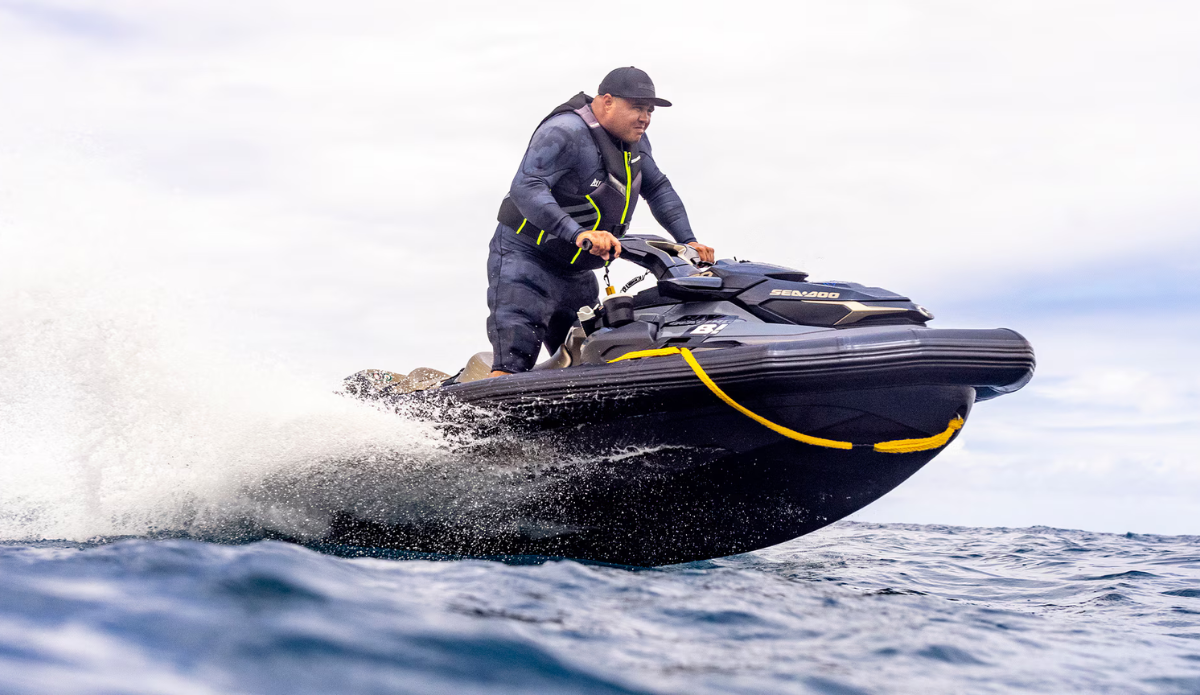
Sea Doo Ambassador Kurtis Chong Kee. Photo: Sea Doo
The devil’s in those details for any tow team or water safety personnel, according to Chong Kee. The Maui native started piloting PWCs for photographers and became one of the most respected water safety experts at Jaws. He’s managed water safety for the WSL’s Pe’Ahi Challenge, he’s an avid fisherman, and has spent more time driving PWCs through the heaviest surf on the planet than most. Minor details make a world of difference in his craft, which he passes on to athletes like Kai Lenny, for example.
“My body type is way different than Kai’s,” he points out, explaining that he rode one of Lenny’s preferred models in Mexico last year and came back to the big wave surfer with some insights. “I was sliding that thing at 30 miles an hour and just doing the craziest slides.” It was fun, he admits, but “for turning on an 80-foot face, you might want to think about it. Because if that thing slides out on a wave, you’re going to be in a lot of trouble.”
He points out that many big wave surfers around the world prefer machines with more responsive turning. He leans toward a specific hull in Sea Doo’s line because it pushes through rougher waters and chop reliably — an obvious need for somebody patrolling XXL lineups. As another anecdotal point he mentions friends in Morocco who ride Sea Doo’s Fish Pro, a model that, you guessed it, is designed for fishing. Since that PWC is a larger craft and the extended back end allows them to pack extra fuel. That simple detail has nothing to do with performance but the longer excursions they take to access bigger waves makes the luxury of bringing more fuel critical.
Kurtis is an encyclopedia when it comes to his knowledge of PWCs. He lists off the specs of different models like a shaper retracing every detail of his latest pro model. It makes sense because in his line of work something like having a specific impeller can be a world of difference.
“The way I look at it is, these guys got families,” he said. “They’re going home too, and if I don’t get them, they’re not going home. That can really make a person braver than they actually are, you know.”
It takes years of experience to be proficient enough to drive XXL lineups, let alone save lives in them. I got a crash course on a calm spring day with no wind. The biggest waves I navigated came from the wake of a $50-million yacht. Still, it was obvious even in those mild conditions how diverse the watercrafts used for tow surfing and by water safety personnel around the world can be. Without their existence and without companies progressing the technology that powers them, big wave surfing would have likely hit its limits already.
“You can talk all you want about a machine, but you know, you take it to the proving grounds and there’s no BS-ing that,” Kurtis says. “You know, that’s the real deal. And if it can handle that, it can handle anything.”

