

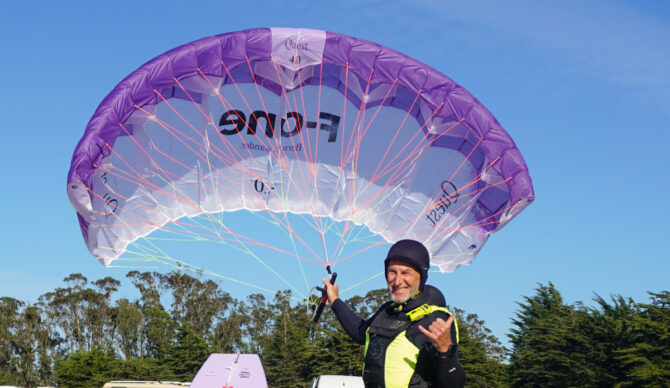
The F-One Quest is our top pick for the all-around best parawing of 2026 with incredible ease-of-use and a wide wind range. Photo: Will Sileo//The Inertia

In a way, the whole point of the parawing from the beginning was to use it as little as possible – but as we head into the third season of this still-new sport, it’s clear that lots of riders are using parawings not just to pack away on downwinders but for free riding, blasting upwind, even racing, and as full-on replacements for inflatable wings. While there are still situations where inflatables remain a better tool, parawings do offer several built-in advantages over inflatable wings, with their simplicity, packability, lighter weight, and the lack of the need for a pump.
In this third edition of our comprehensive, industry leading comparative parawing review, you’ll find our take on the best parawings on the market, along with a complete buyer’s guide to parawing technology and design features.
In 2026, there are already at least 25 parawing models from 15 brands, with more coming out all the time. Some designs are already in their third generation, and boundaries are being pushed in all directions with single, double, and hybrid canopies, new bar designs, and trim systems.
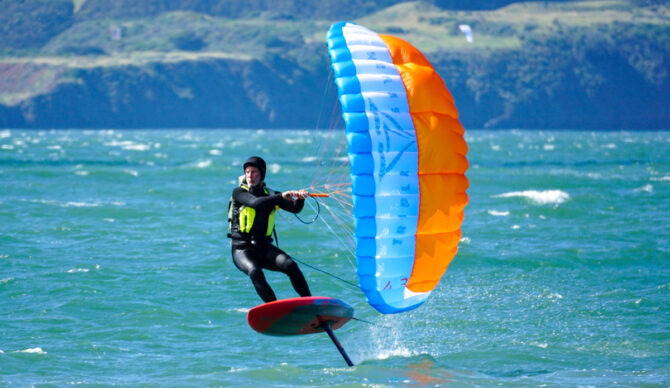
Flying the Triple Seven P.T. Hybrid at Crissy Field. Photo: Will Sileo//The Inertia
Here’s the TLDR: Of our top picks, the Quest sets a new benchmark for overall ease of use and versatility. On the other hand, if you want the widest wind range currently available on a parawing, the Triple Seven P.T. Hybrid is the leader on that score. The BRM S3 is, yet again, in a class by itself for innovation and leadership in design, offering a unique combination of range, speed, and packability. For the cleanest, sharpest sword of a canopy, the Ozone PRv2 is the winner, but you sacrifice wind range. Then there’s the Triple Seven LTX – more nimble than a full hybrid, and with more top end than a single skin. For some people, this is going to be the bomb!
Much respect to the designers and manufacturers who have put in the work to develop and bring these new parawings to market. All of the products included here are well-built, but there are important differences. Our goal here is to provide our best and most authentic, direct, and usable feedback on parawings currently available for various uses.
Editor’s Note: At this point in the season, we’ve tested just about every top-performing and well-received parawing on the market, with the exception of the Frigate V2 (highly anticipated, but not yet released) and the PPC Orbit (we should get our hands on this in the next few weeks). The Frigate currently does not have a release date, but it’s looking more like a fall release or later at this point. Other parawings we’re stoked to try include the Sroka Fynix, AFS Stow, Altis Focus and Focus Hybrid, and the Ozone Afterburner. We will update this article as soon as we’re able to get out and test any new parawings.
Navigate To: Comparison Table | How We Tested | Buyer’s Guide
Related: Best Foils | Best Wingfoil Boards | More Foil Reviews
The Best Parawings
Best All-Around Parawing: F-One Quest
Widest Wind Range: Triple Seven P.T. Hybrid
Most Innovative, Ergonomic, and Packable: BRM S3
The Rock-Solid Ripper, Updated: Ozone Pocket Rocket V2
Light, Compact, and Nimble Semi-Hybrid: Triple Seven P.T. LTX
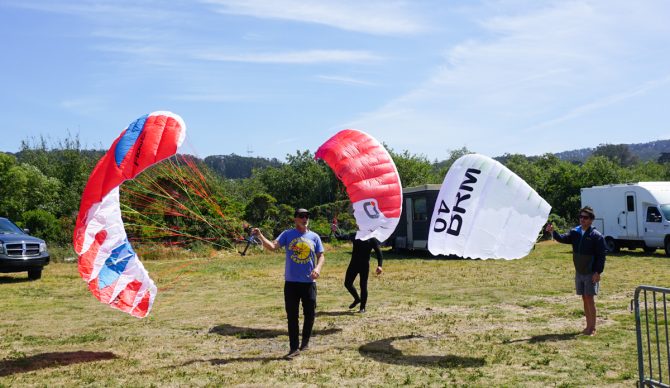
“Ground handling” practice at Crissy Field. Photo: Will Sileo//The Inertia
Overall Best Parawing of 2026
F-One Quest
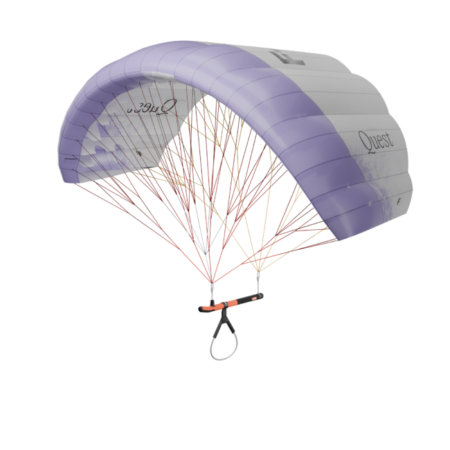
Sizes: 2 / 2.5 / 3 / 3.5 / 4.0 / 4.5 / 5.0 / 6.0
Sizes Tested: 3 / 3.5 / 4 / 5
Price (4m): $999
Defining Characteristics: Best-in-class ease of use
Pros: Very stable and intuitive, highly versatile, excellent refly, great bar, outstanding lineset and color coding
Cons: Not quite as much range, speed, agility, or upwind angle as some other parawings on an individual basis – but the usability wins overall
A global brand with a full suite of wings, kites, boards, and foils, F-One released the Frigate in June 2025 and the Quest in April 2025. The Frigate was a winner last time around, and not only has F-One done it again with the Quest, but they’ve also made a wing that sets a new benchmark for ease of use and all-around flexibility. While there are plenty of other great wings out there this season, if we had to pick one to recommend to more people in more places for more types of riding, right now it would be the Quest.
While the Quest doesn’t quite max out any of the performance criteria such as range, speed, or upwind angle, the overall combination of performance in all areas, combined with stability, predictability, intuitive handling, and outstanding design in all aspects of the package, makes for a design that edges out the competition. As noted above, if you’re looking for max speed, the widest range, the most packable, or the most nimble, there are other choices, but the Quest is the most well-rounded, most usable, most universal solution on the market right now.
We ranked the Frigate v1 as the first parawing that could be used effectively as an inflatable wing replacement, and the Quest certainly fulfills that mission as well. You get perhaps a bit less top-end speed and VMG than the Frigate, but better low end, and an improved bar and bridle system that is pretty much flawless. The F-One bar was already great, but now it’s mated with a two-point bridle connection and a nice little bent nub for your front hand. You still get the high-quality, semi-rigid harness line included, a design that’s easy to balance and also lets you hook in one-handed.
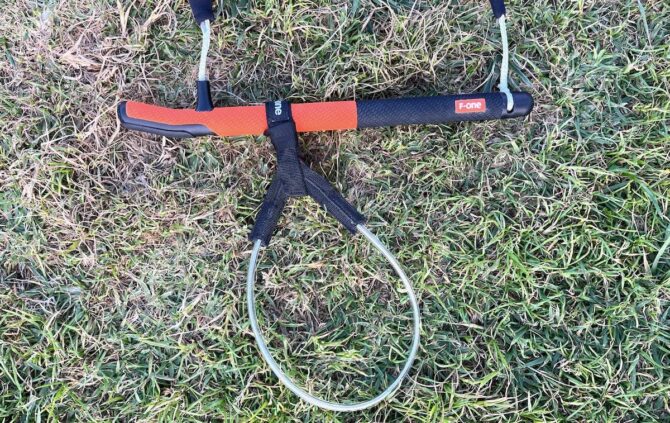
Photo: Bowen Dwelle//The Inertia
Line length on the Quest is spot on (140cm for the 4m), and collapse is clean and simple. The material isn’t as light as that used by BRM or Triple Seven, but it still packs down very well, in part due to the simple, compact canopy design. Relaunch is quick and reliable. Depower and range are two more big selling points of the Quest – the new bar system makes it easy to hang off the front end when overpowered, so you can fly it in winds that would rip your arms off on a parawing with less depower.
The back-to-back top spots earned by F-One reflect their deep history in kite and wing design and their commitment to functional design at the highest level. Kudos to the entire F-One team and parawing designer Nicolas Caillou for another winner!
Read our full review of the Quest here.
Check Price on Mackite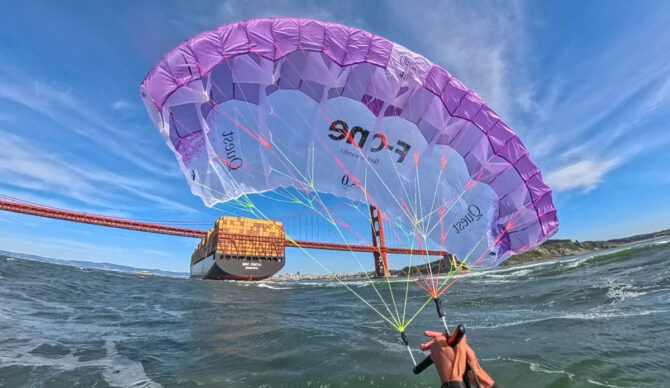
Photo: Will Sileo//The Inertia
Widest Wind Range
Triple Seven P.T. Hybrid
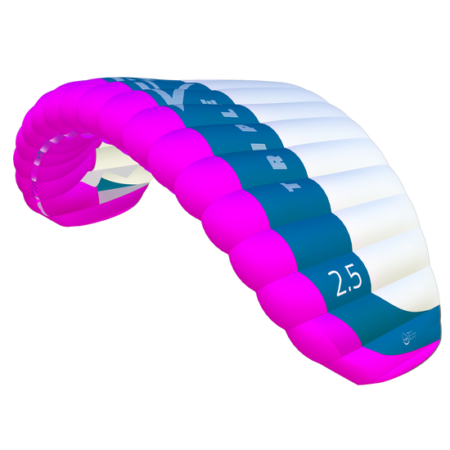
Sizes: 2.5 / 3.1 / 4.3 / 5.7 / 7.2 m
Sizes Tested: 3.1 / 4.3 / 5.7 m
Price (4.3m): $1,329
Defining Characteristics: Hybrid double/single-skin construction
Pros: Huge wind range, huge size range
Cons: Requires a tad more technique and not quite as nimble as simple single-skins
A leading paraglider brand out of Slovenia, Triple Seven was one of the first entrants in the parawing market. We loved the P.T. Skin last year (it’s still a great wing), and they kicked off 2026 with a major innovation – the P.T. Hybrid, which combines a double-skin canopy for the front half of the wing and a single skin for the back.
The hybrid design combines the advantages of a dual-skin in terms of efficiency, high-wind stability and top end wind range, with single-skin grunt and simplicity — and it works incredibly well. While the double-skin wings released so far have had potential, they’ve also proved to be cumbersome, finicky, and require going a full size up. The hybrid flies just about like a single-skin parawing, and while it might make sense to size up a third if a meter or so, there’s plenty of grunt, and the gain on the high end is massive.
One way to think about it is that a 4.3m PT Hybrid compares to a 4m single-skin in terms of low-end pull, but that same 4.3m hybrid is going to be usable well into 3m territory. Of course, once you’re deep into that 3m range, ideally you’d want to switch down a size, but the point of having that mega wind range available is that you don’t have to. For riders who need a wide usable wind range on the water due to widely varying wind conditions, nothing beats the PT Hybrid.
The dual front canopy of the hybrid design also makes power delivery incredibly smooth. The PT Hybrid simply eats gusts. When overpowered, instead of the leading edge becoming unstable, it starts to wobble around and “jellyfish” a bit, but remains controllable and usable. The result is that although there are parawings that point higher, many riders can achieve higher overall VMG with the Hybrid because you don’t get pulled off your line in the gusts, and you still have power when the wind backs off.
Obviously, there is more fabric in the canopy than on a single-skin parawing, but the material that Triple Seven uses is the lightest in the industry (right along with BRM), so the PT Hybrid packs down just as small. I was able to pack my 5.7m PT Hybrid in a v1 Ozone Parawing Stash Belt, no problem.
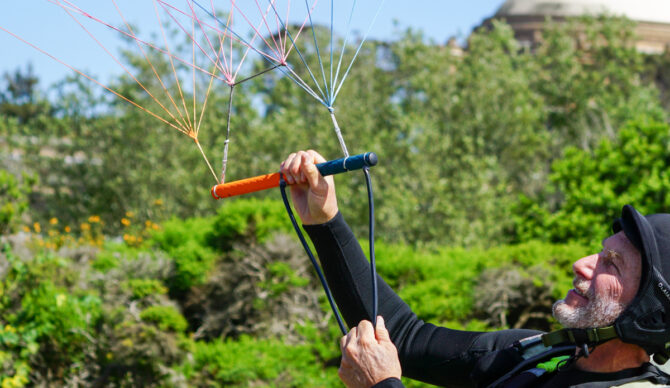
Photo: Will Sileo//The Inertia
The Triple Seven bar is very well designed and includes a nub for your front hand as well as a built-in (removable) harness line. The harness line is static and covered in a semi-rigid plastic coating, making it easy to hook in with one hand.
The front lines on the 4.3m Hybrid are 152cm – a bit longer than the Quest but still much shorter than those on the Pocket Rocket v2. Collapse, douse, and redeploy are very clean. The extra material in the front part of the wing can billow out a bit, but again, the wing packs down very small, and we didn’t have any tangles.
One last thing to mention is that, like Triple Seven’s other models, the PT Hybrid comes in a massive 7.2m size that works down into the ~10-knot range. Running from the small end with a 2.5m that easily handles 40+knots, this is the widest size and wind coverage range on the market.
The Hybrid is also pretty nimble, and overall a super-fun parawing to fly – if your riding requires a wide usable wind range, the PT Hybrid is your winner!
Check Price on Mackite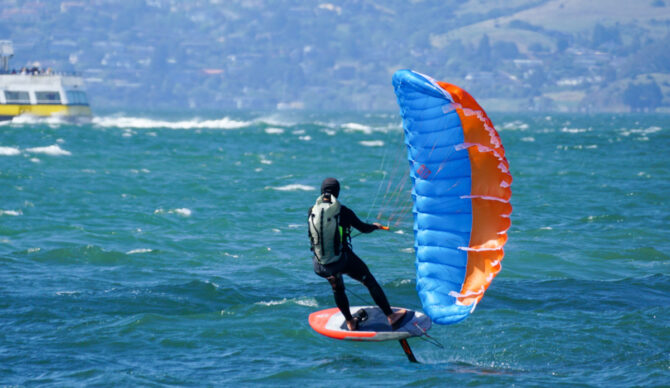
Photo: Will Sileo//The Inertia
Most Innovative, Ergonomic, and Packable
BRM S3
Sizes: 2.1 / 2.7 / 3.4 / 4.2 / 5.3
Sizes Tested: 2.7 / 3.4 / 4.2 / 5.3
Price (4.2m): $1,220
Defining Characteristics: Unique, ergonomic “D” handle, flatter canopy profile, ultra-compact material
Pros: Ultra-packable, great range, stable, nimble
Cons: Requires learning a new bar handling technique
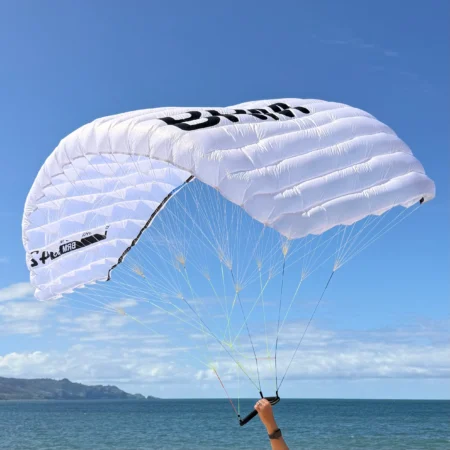
From the strutless Cloud kites to the first Maliko parawing, Boardriding Maui has always been known for cutting-edge innovation – and Greg Drexler has done it again with the third-generation S3 parawing. In 2025, BRM had no fewer than four parawing models, and this year they’ve managed to combine everything in a single wing that will satisfy many riders in a very wide range of conditions.
The most obvious differentiator of the S3 is the unique ergonomic “D” handle that takes the place of the traditional straight control bar. BRM came up with the handle primarily to improve the ergonomics of sheeting in and out. Having your front hand oriented perpendicularly almost eliminates the feeling of being “overpowered” because your wrist isn’t jammed into an uncomfortable, unsustainable position. Our testing brought us to the conclusion that many riders will indeed find the handle to be a much more comfortable and powerful way to ride – it may even help to reduce strain injuries that some parawing riders are encountering.
If we were starting from scratch and had never seen a parawing with a straight handle, the “D” handle would probably seem totally natural. Since we’re all used to bars, of course there’s a bit of adaptation required to learn how to use the D handle, but it only takes about 10 minutes.
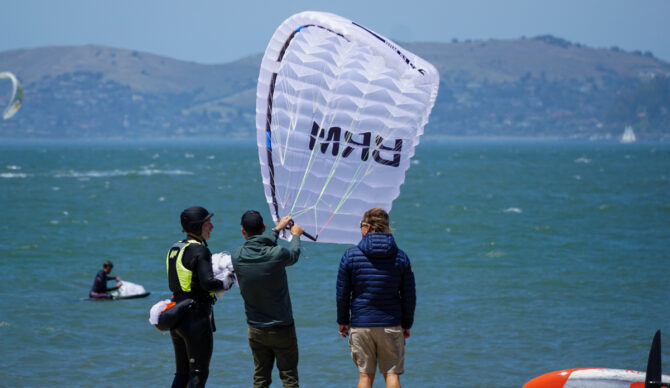
Photo: Will Sileo//The Inertia
It’s important to keep in mind that the S3’s D handle is intended mainly for riding with two hands. If you prefer riding with just one hand—or just prefer a traditional bar—no problem, just add the S3 Carbon Bar to your order. Greg D breaks it down right here: S3 handle vs bar.
In terms of performance as a parawing, the S3 rocks! It feels very fast on the water and slices upwind at a higher angle than both the Quest and the PT Hybrid. The S3 is also plenty nimble, and it’s the most minimal, most packable, most compact parawing on the market right now. I swear, you could just about scrunch one of the smaller sizes into the side pocket of a pair of boardshorts!
The wind range of the S3 is also excellent, with very solid low end and outstanding pumpability due to the unique bridling and flatter canopy profile. While the low end isn’t unique to the S3, BRM is leading the way here, to the extent that Greg and others have changed their recommendations for board sizing from 100 percent of bodyweight down to sinkers (see Buyer’s Guide below for further detail). High end is very good too, resulting in a usable wind range on par with the Quest and almost as good as that of the P.T. Hybrid.
Check Price on BRM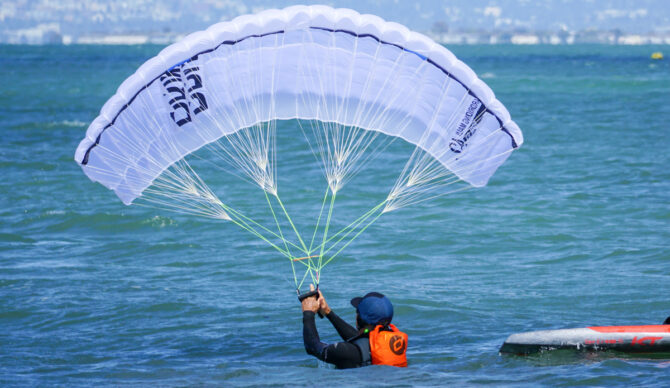
Photo: Will Sileo//The Inertia
The Rock-Solid Ripper, Updated
Ozone Pocket Rocket V2
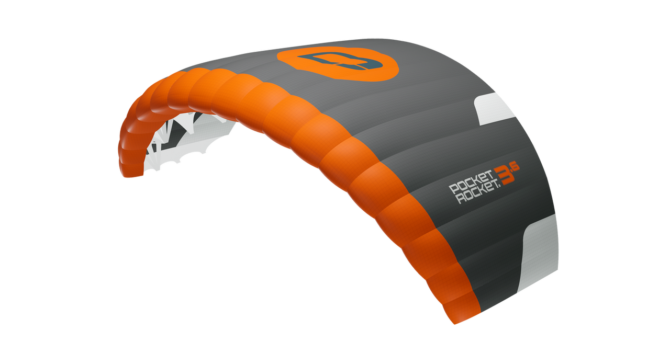
Sizes: 1.9 / 2.4 / 3 / 3.6 / 4.3 / 5
Sizes Tested: 3, 3.6 & 4.3m
Price (4.3m): $1,059
Best For: Downwind, laps, swell, freeriding
Defining Characteristics: Outstanding VMG, locked-in canopy
Pros: Fast upwind, stable, nimble
Cons: Thick lines, thicker canopy material, narrower wind range
Ozone’s pioneering first-generation Pocket Rocket was an early screamer – with a few flaws, all of which have been addressed in the new Pocket Rocket v2.
The PR v1 was great upwind, and the v2 is even better, with an incredibly clean canopy that’s so locked-in it’s an impressive thing to look at, a real sailing machine. The two main complaints with the v1 had to do with the lines: they were too long and too thin, both contributing to less-than-ideal collapse, douse, packing, and redeploy. The v2 solves this with shorter, thicker lines, and our testing confirmed super clean douse and redeploy. If anything, our take is that Ozone might have gone a bit overboard on the line thickness, but they certainly aren’t too thin! The canopy is similar in that Ozone used a relatively thick, robust material — very durable, but a bit less packable.
As with all other leading 2026 designs, Ozone has gone to a two-line bar connection system, and the resulting setup is super clean, simple, and durable. While Ozone doesn’t ship the Pocket Rocket with a harness line, they offer both a single-point fixed loop and a stretchy harness line option, as well as a killer parawing stash belt.
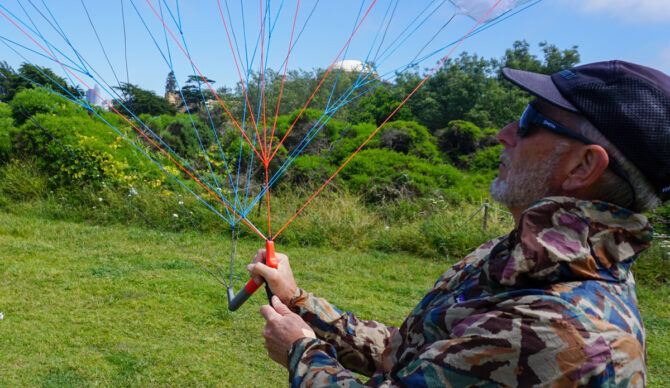
Photo: Will Sileo//The Inertia
Like the Quest, the Pocket Rocket is a simple single-skin parawing, and as such, it’s very intuitive and easy to use, and it will satisfy riders who want a solid wing that rips upwind. One downside is that we found usable wind range to be narrower – the PRv2 pumps pretty well at the low end (much better than the V1, but not as well as the Quest or the S3), however, it becomes unforgiving pretty quickly at the top end, leading us to recommend the Pocket Rocket more for riding in more consistent wind—or if you’re cool swapping sizes a bit more often.
Check Price on Mackite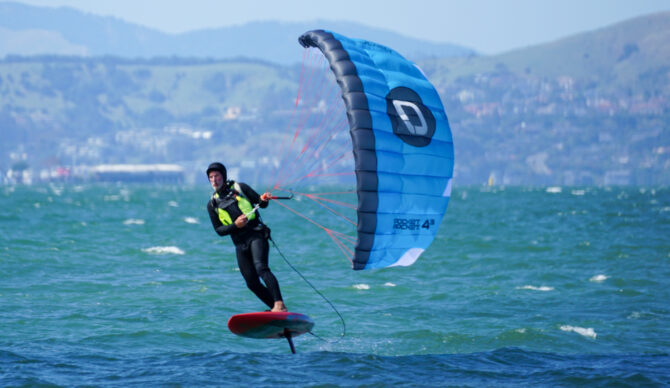
Photo: Will Sileo//The Inertia
Light, Compact, and Nimble Semi-Hybrid
Triple Seven P.T. LTX
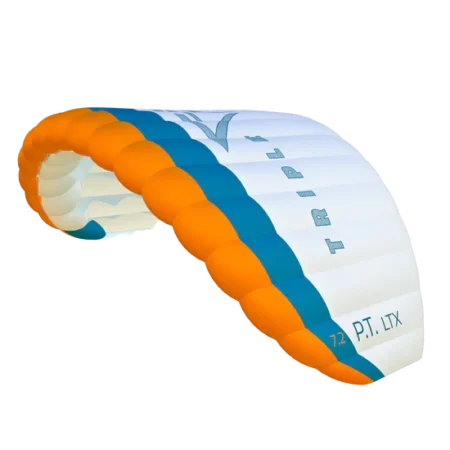
Sizes: 2.4 / 3.1 / 4.2 / 5.5 / 7.2 m
Size Tested: 4.2 m
Price (4.2m): $1,199
Defining Characteristics: 25% double / 75% single-skin hybrid construction
Pros: Great wind range, compact, light
Cons: Not quite the same upwind ability or range as the P.T. Hybrid
Triple Seven’s Hybrid parawing has received a ton of well-deserved praise. However, there’s no doubt it’s a parawing aimed at a more advanced user. With longer lines and the complication of a half-double-skin design to deal with, this is not a wing we’d recommend to a beginning parawinger. With the LTX, Triple Seven aims to take what’s so great about the Hybrid design (namely a wider wind range with better top-end) and condense it into a more user-friendly design. And for the most part, the LTX delivers on those promises.
Like the Hybrid, the LTX combines single- and double-skin construction, but in different proportions: just the front quarter of the wing is dual-skin, with the remaining 75 percent single-skin. Triple Seven also reduced the aspect ratio by squaring off the wingtips, resulting in a parawing that is very light, very compact, nimble, easy to fly — and with some of the increased range and stability of the Hybrid.
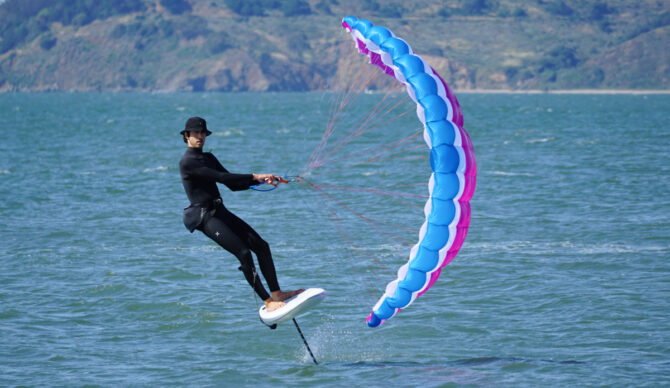
Photo: Bowen Dwelle//The Inertia
Line length is also reduced from the Hybrid to 140cm (same as the Quest), making for a very whippy little package even in the 4.2m size – and the LTX is available from 2.4m all the way up to 7.2m, giving you an incredibly wide range. The LTX has the same bar and lightweight construction as Triple Seven’s other wings – it’s very comfortable to fly and packs down super small.
All this comes together to deliver a parawing that is easy to use, nimble, and has solid upwind ability and great wind range. However, we found that much of what makes the hybrid so special, that glider-like feel, insane upwind angles, and soft, almost pillowy feel as it munches up gusts that would rip a single-skin parawing out of your hands, is muted with the LTX. No doubt, it still has a great wind range with awesome depower and top-end, and great upwind ability, but it trades a decent amount of those characteristics in exchange for the nimbleness and user-friendliness of the wing. If you are looking to capture a mix of that special sauce, but don’t want to deal with the technicalities of the Hybrid, the LTX is likely the wing for you.
Check Price on Mackite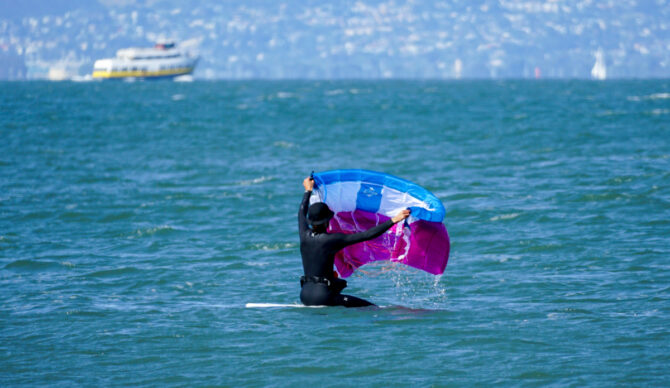
Photo: Bowen Dwelle//The Inertia
Best of the Rest
The above “top picks” represent what we see as the creme-de-la-creme of parawings. Below, we call out some other options that are, incredible parawings as well, but we found the performance of the above options to win out in one form or another.
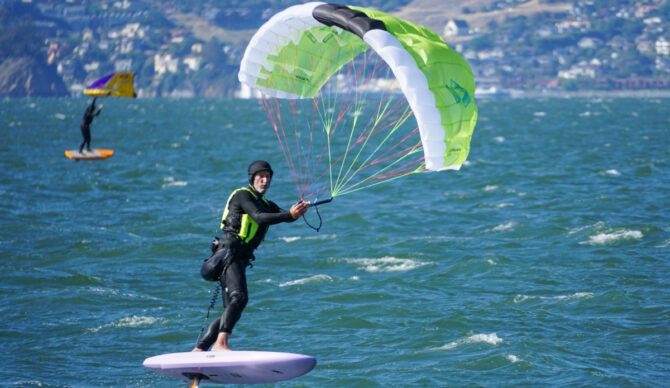
Photo: Will Sileo//The Inertia
Duotone Stash V2
Available Sizes: 2.2, 2.8, 3.4, 4, 4.8, 5.6
Duotone’s V1 Stash did receive a mention in our 2025 review, but it didn’t come close to cracking our top picks, having poor upwind ability, especially when highly powered. For 2026, Duotone has gone back to the drawing board, and cooked up a design that sits in that “solid all-rounder” spot taken by the Flow D-Wing V1 last year. It’s not a particular standout in any category, but it’s a highly usable, and solidly capable parawing with good range, great depower at the top-end, and great stability when highly powered.
The bar is a unique one, with a curved hook at the front end that’s quite nice to hang off of when overpowered, and an integrated harness line. It doesn’t have the best-in-class VMG of parawings like the BRM S3 or Triple Seven Hybrid, but this is certainly a worthy parawing that should not be disregarded off the bat simply because it isn’t one of the “best.”
check price on MacKite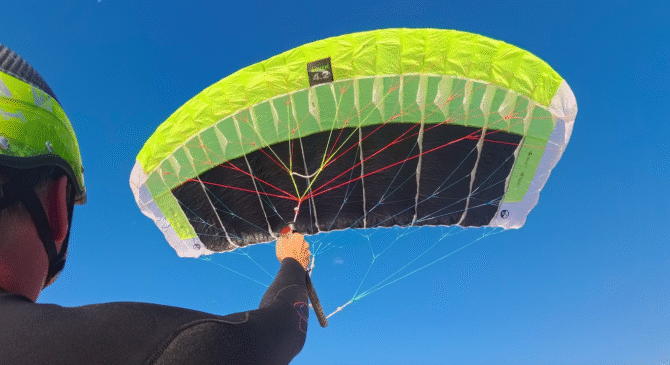
Photo: Joe Carberry//The Inertia
North Rover
Available Sizes: 2.4, 2.9, 3.5, 4.2, 5.0, 6.0m
When North released its Ranger, it took a lot of guff in the industry for that parawing’s instability and overall difficulty to control. Fast forward to 2026, and the Rover is a world away and carrying a completely different narrative around it. We tested the 4.2 thoroughly and found it about as stable as you can get. It just sits in the wind window, doesn’t want to pull in different directions, and allows for everything from easy upwind travel to turning and making your move downwind. If you’re learning to parawing, you really couldn’t ask for a better product – even though pros and experts might want something a bit more lively.
The toggle system is an interesting new method for stashing the wing – basically, it’s a small rubber grommet that can be run down the lines to aid in stashing the wing. And it works beautifully for the stow, but can cause some friction on the redeploy. Which leads us to perhaps the one drawback of this parawing, albeit slight: because of the way the lines are attached to the handle, it has a tendency to tangle at times, especially if you’re sitting on your board and trying to get the leading edge to catch and get full deployment. Our tester didn’t feel this was a major issue, but it was apparent at times.
But North nailed it with an industry defining backpack carry-bag system that comes included with the parawing and provides a great place to carry a backup wing when on the water. Whether packing an extra wing or just using it for your single parawing, it’s a well-thought-out, comfortable system and North deserves a lot of credit (it’s also great if your launch spot is covered in brush or trees so you can deploy it in the water while protecting the material). All in all, a great product from North that is ideal for a wide range of abilities.
check price on MacKite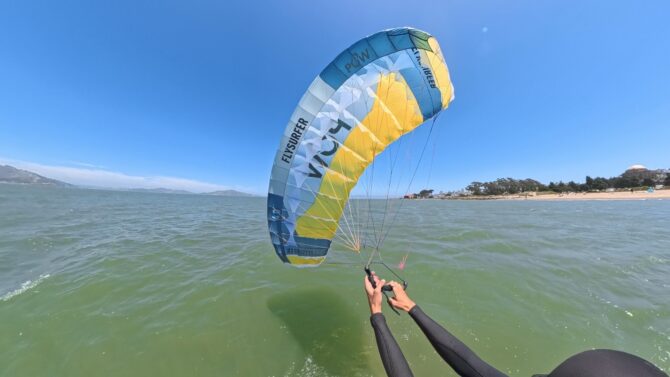
Photo: Will Sileo//The Inertia
Flysurfer POW2
Available Sizes: 1.7, 2.3, 3m, 4m, 5.5m
Flysurfer’s V1 POW (Pop Out Wing) was a top performer in the 2025 version of this review, and the POW2 carries a lot of this forward with some important updates. The line length has been greatly reduced, the pulley is gone, and the J-bar stays but has shrunk as well for better packability.
In our testing, we found the wing to be a solid performer with lots of low-end grunt. However, the wing was difficult to depower cleanly with the design of the handle. We found ourselves hanging off the front end of the J bar when riding overpowered, and felt that if the center of pull was shifted a bit further back on the bar, it might be a more pleasant experience at the top end of its wind range. And because of how grunty the wing is, that’s a real consideration. When more ideally-powered, the wing is a rocket upwind, and its low-end grunt is among the best in the latest crop of parawings.
One ace up its sleeve – the POW comes with one of the best included parawing stash-backpacks that we’ve seen yet, with a hydration sleeve, front pouches, and more. It also has a massive interior that is capable of taking more than one parawing. For 2026, Flysurfer has also released the ZAP, a performance-freeride double-skin parawing that we have yet to try out.
check price on MacKite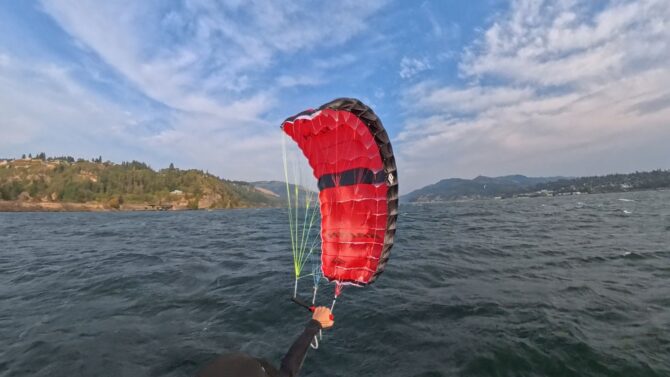
Photo: Will Sileo//The Inertia
Naish Hatch
Available Sizes: 1.9, 2.7, 3.5, 4.3, 5.1m
The first phases of parawing development produced some… interesting designs. One such parawing was the Naish Morph, a parawing with a pulley system to change the camber depending on the angle at which the bar was set. Unfortunately, the result was a parawing with a lack of direct steering, among other issues. No need to harp on that here.
Naish’s second-gen parawing, the Hatch, loses the pulley and returns to basics with a straightforward straight-bar, three-connection-point design. And it gets a lot of things right. The wing has great upwind ability, solid power in the low end, and clean stow and deploy. The bar has a front nub to hang off of for enhanced depower, which is a favorite feature of ours. The wing can get a little unstable as it gets overpowered, but if you keep it within its wind range, it’s a ripper.
check price on MacKite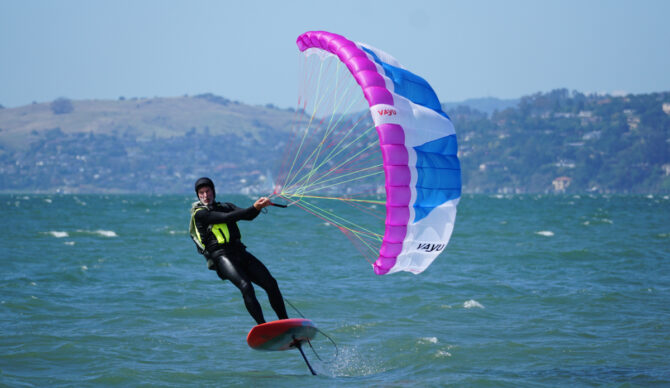
Photo: Will Sileo//The Inertia
Vayu Pyro
Available Sizes: 2.5, 3.2, 4.0, 5.0m
Vayu’s Pyro parawing has received a lot of hype, being one of the first 2026 “third gen” parawings to hit the market. In testing, we found it to be a solid parawing, but not a standout performer in any category. The wing thrives more in the high end of its wind range, but when overpowered, can fall prey to the sort of issues we found more common in “second gen” parawings, such as twitchiness and instability. Upwind ability is solid, but not class-leading. We do love the backpack that the wing comes with, one of the best included stash packs we’ve seen, along with the new Flysurfer POW2 pack.
check price on Vayu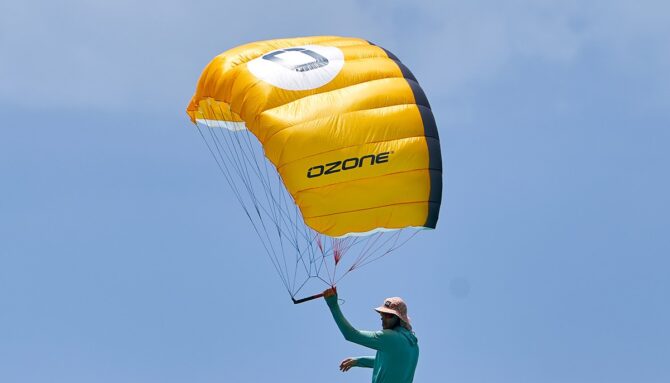
Photo: Ozone
Ozone Power Pack
Available Sizes: 1.9, 2.4, 3.0, 3.6, 4.3, 5m
The Power Pack is a controversial topic in parawinging, with riders either loving it or hating it. We didn’t have the opportunity to spend much time on it ourselves, but from all the feedback we’ve heard, we’ve come to the conclusion that this is a fairly specific, narrow-use-case parawing. With great grunt, easy packability, but poor upwind ability and VMG, the Power Pack is best suited to learners and those interested in short laps, riding waves or long downwinders with little or no upwind riding.
check price on MacKite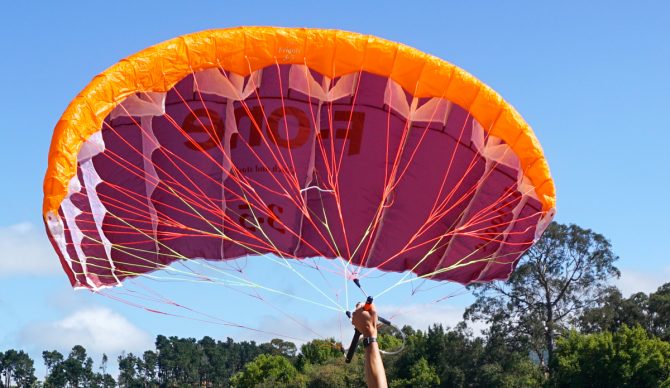
The F-One Frigate won top marks in more categories than any other for 2025. Photo: Ed Sileo//The Inertia
2025 Parawings Still Worth Considering
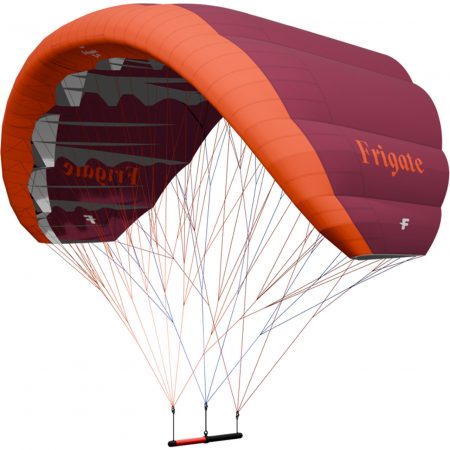
F-One Frigate (Overall Best Parawing of 2025)
Sizes: 2.5 / 3 / 3.5 / 4.0 / 4.7
Pros: Best upwind performance, very wide wind range, very stable, excellent refly, great bar, outstanding lineset and color coding, includes harness line
Cons: Lines are a bit longer than we’d like
A global brand with a full suite of wings, kites, boards, and foils, F-One announced the Frigate in June 2025, and we gave it top marks amongst the competition at that time. F-One has continued its run of excellent designs with the Quest this year, and the Frigate remains a great pick at the time of this review, especially if you’re looking at the market for used parawings.
The Frigate really makes its mark with its very broad usable wind range, going from the low end where you can really pump the wing through a wide sweet spot of user-friendly power to an extensive top end. While at first we didn’t expect parawings to go upwind as well as inflatable wings, nor to have the same breadth of wind range, with the Frigate we’re getting a parawing that matches the performance and versatility of inflatable wings.
The 3.5m Frigate felt like it had the full available wind range of a 3.5m LEI hand wing, from low-end pump and grunt to greasy-smooth, well-balanced, light-touch smokin’ high-end. Not only that, but the Frigate is fast – I easily hit the same 35-40kph stop speed that I do when winging, without any struggle. The Frigate excels at the low end as well, with solid pump due to the structure and cross-bracing, making for an overall wind range wide enough that the Frigate can be used as an inflatable wing replacement.
The Frigate is also very stable when highly powered. No collapsing, squirming, or yapping. The mid-aspect, rounded shape of the wing also makes for intuitive trimming, excellent agility, and flawless relaunch.
check price on MacKite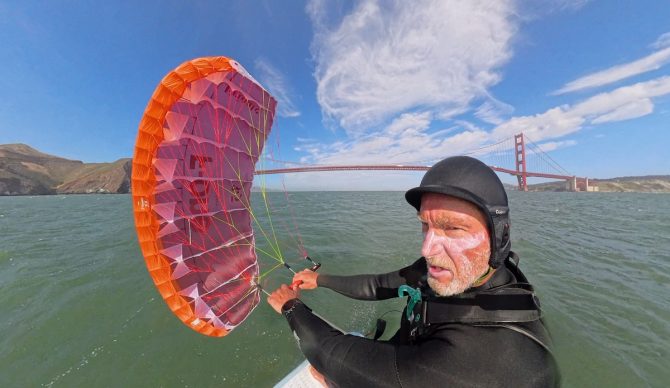
Photo: Bowen Dwelle//The Inertia
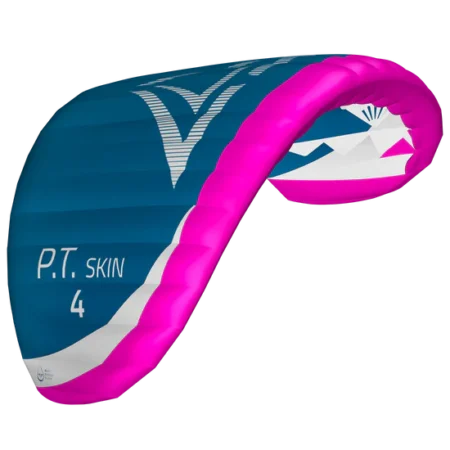
777 (Triple Seven) P.T. Skin
Sizes: 2.4 / 3 / 4 / 5.4 / 7.3 m
Pros: powerful, stable, good low end, very packable
Cons: lines can be a bit catchy, price differences for those based in the U.S.
A highly-regarded paraglider and kite brand based in Slovenia, Triple Seven was one of the first entrants in the parawing market and offers five parawing models including the double-skin P.T. Tow, downwind-specific P.T. UDW, 50/50 P.T. Hybrid, 25/75 P.T. LTX and the all-around P.T. Skin.
We tested the 4m P.T. Skin towards the end of the 2025 season and found it to be an incredibly well-designed parawing which offers outstanding stability, versatility, lightweight packability, and all-around performance good enough to place amongst the best parawings on the market. One of the most notable features of the PT Skin is the ultra-lightweight D10 canopy, which collapses super easily into a very small, clean, stowable package. The PT Skin flies clean, well-balanced, intuitive, quick, nimble and has instant pop-open re-launch. Like the LTX and Hybrid, the PT Skin is one of the few parawings that come in 7m+ sizes, providing low-end range for the lightest conditions.
Check Price on Mackite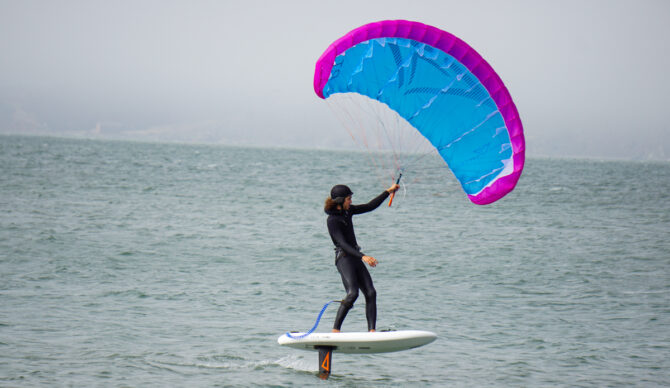
Photo: Bowen Dwelle//The Inertia
BRM Kanaha
Sizes: 2.5 / 3.2 / 4.0 / 4.7 / 5.5 / 6.2
Pros: Light, most packable, clean re-deploy, elegant, nimble, goes upwind very well, excellent range
Cons: Less low-end than the Frigate and the POW, not quite as fast in an upwind race, some people may not love the short bar
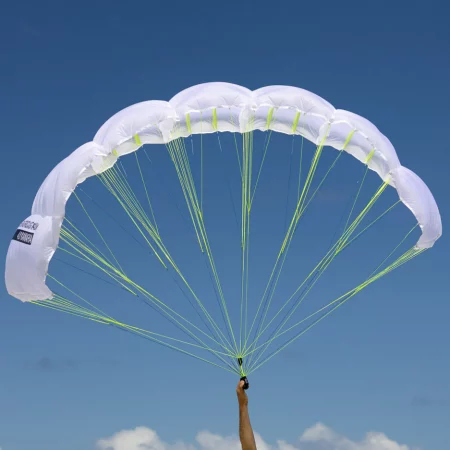
After pioneering the category with the first upwind-capable Maliko parawing in 2024, BRM was again first to market with three second-generation parawing models in early 2025: the Maliko 2, Ka’a, and Kanaha. Of those, the Kanaha was by far the most popular, and the Kanaha is still a good option if you’re looking at the used market.
Our testing showed the Kanaha to be an excellent tool that benefits from BRM’s history with the pioneering Maliko—as well as their unique Cloud kites. The BRM parawings feel like the result of an organic, evolutionary process, resulting in a parawing that’s remarkably stable, powerful, and highly versatile, with a wide wind range, decent low end, excellent upwind performance, and still flies quietly even when pushed to the point of starting to deform when completely overpowered.
Check price on Board Riding Maui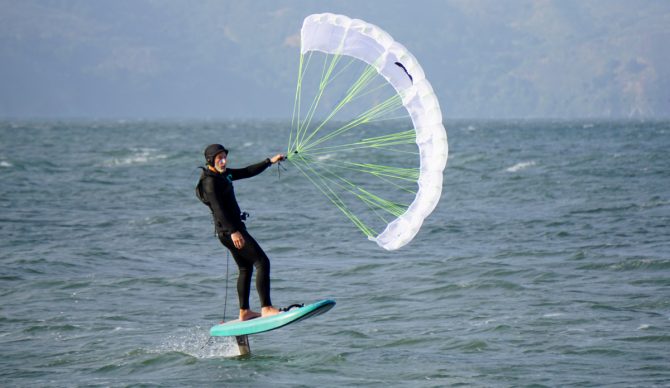
Photo: Will Sileo//The Inertia
BRM Paia
Sizes: 3.1, 3.8, 4.5, 5.3, 6.1 m
Sizes Tested: 3.8, 4.5
Price (3.8m): $1440
Best For: Absolute best upwind angles
Defining Characteristics: Double skin parawing
Pros: By far the best upwind performance among parawings we’ve tested, incredible top-end
Cons: Poor low-end that requires sizing up, not as easy to pack or as nimble in the air, proper redeployment takes training and patience
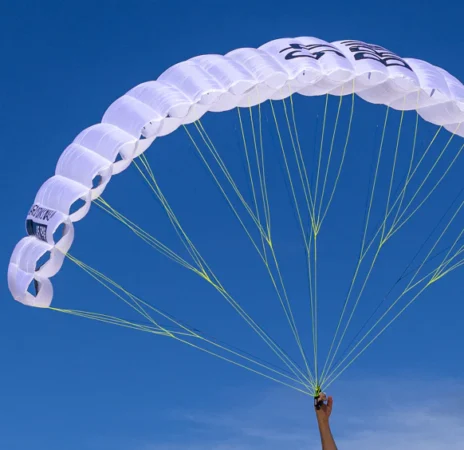
Given that Greg Drexler basically started this parawing revolution, it makes sense that he would be the first to crack the double skin code. The BRM Paia launched in late July of 2025 and quickly proved that the double-skin concept is sound. With the right technique, the Paia absolutely rips upwind, achieving the best upwind angles we’ve seen from a parawing.
There are pros and cons, though. The Paia requires a more delicate touch than single skins, and it’s not something we’d recommend for beginners, but in the hands of someone who knows what they’re doing, it’s an absolute rocket ship. Reduced bar pressure is another big plus. The Paia gobbles up gusts like none other, without feeling like your arms are being ripped off, even in highly-powered conditions, and even when hauling hard to achieve those better upwind angles.
The downsides are few but significant. First off, the wing has poor low-end and generates less power overall for its area (that’s the corollary of “more efficient”), so you have to size up one size for any given wind range. If you fly a 3m single skin, you would need at least a 3.8m Paia. Second of all, it’s not as nimble or packable as a single skin parawing. Packability is an obvious one, with the two layers of material, and as for nimbleness, the Paia is less of a whippy little parachute and more of a finely tuned upwind machine. For pure upwind-downwind, the Paia is a great option to maximize your laps.
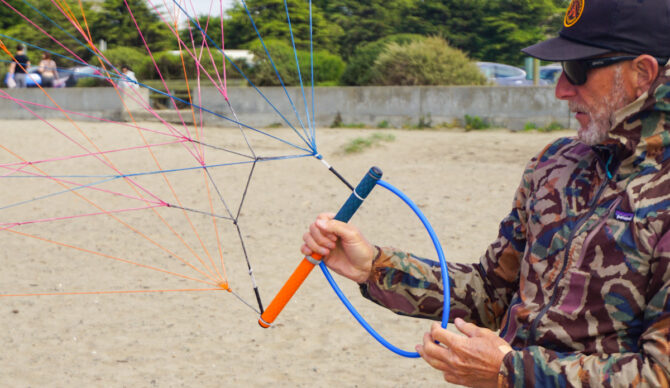
Inspecting the harness line on the P.T. Hybrid. Photo: Will Sileo//The Inertia
Coming Soon
F-One Frigate V2
The Frigate was our top pick for parawings in 2025, and the Quest is our top pick this time around. With that in mind, it will be hard for F-One to beat their own winner with an update to the Frigate. Based on the design program for the Quest, we expect a more performance-oriented upwind machine, but time will tell, and we’re excited to see what happens!
Flow D-Wing V2
A highly-regarded paraglider brand based in Australia, Flow introduced its D-Wing in 2025 and the D-Wing v2 in early 2026. We haven’t had the opportunity for a full test, but we’ve heard good reports about the D-Wing v2, and we have no doubt that it’s a solid all-around parawing.
PPC Orbit
It’s no secret that parawings look and work a lot like paragliders, and so it makes sense that PPC has partnered with NOVA for its entry into the market with the Orbit – a double-skin parawing incorporating a trailing-edge trim mechanism called the “Power Assist Line system (PAL),” which aims to offer both the top-end range associated with double-skin wings and the low-end power of single-skin wings.
Altis Focus and Focus Hybrid
With the success of the Triple Seven P.T. Hybrid, it’s no surprise that other manufacturers are working with the hybrid concept. Altis offers both single-skin and hybrid versions of their new Focus wing. We’ve seen the Altis hybrid in the wild, and it looks awesome, but we haven’t had the chance to fly it yet.
Sroka Fynix
It’s surprising that trim systems from kitesurfing bars didn’t make their way into parawings earlier, but we’re happy to see Bruno Sroka working on something like that with the Fynix “Pushbar” system – and we can’t wait to get our hands on one!
Ozone Afterburner
Along with the Powerpack and Pocket Rocket v2, we’ve heard rumors of another Ozone wing in the works, perhaps to be called the Afterburner – part of an emerging category of performance/race-oriented parawings.
Other Brands
Many other brands have parawings available or in development, including AFS, Core, Element, Elf, F4, Gin, Gong, Kitech, KT, Naish, ON, Slingshot, Takoon – the list goes on, and there’s no way to test them all!
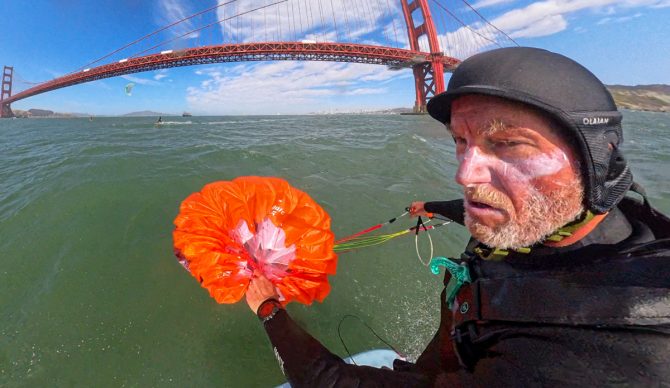
Riding bumps outside the Golden Gate Bridge with the F-One Frigate neatly collapsed. Photo: Bowen Dwelle//The Inertia
Best Parawings Comparison Table
Jump To: Top Picks | How We Tested | Buyer’s Guide
| Parawing | Sizes | Price (4m) | Weight (4m) & packability | Pros / Key differentiators | Cons |
| F-One Quest | 2 / 2.5 / 3 / 3.5 / 4.0 / 4.5 / 5.0 / 6.0 | $999 | 650 g Good packability |
Best-in-class ease of use | Doesn’t max out any key stats |
| Triple Seven P.T. Hybrid | 2.5 / 3.1 / 4.3 / 5.7 / 7.2 | $1,329 | 488 g (canopy only) Good packability |
Best in class top end and upwind ability | Not for beginners |
| BRM S3 | 2.1 / 2.7 / 3.4 / 4.2 / 5.3 | $1,220 | 611 g Best packability |
Great packability and range | D-handle can take some getting used to |
| Ozone Pocket Rocket V2 | 1.9 / 2.4 / 3 / 3.6 / 4.3 / 5 | $1,059 | 690 g Good packability |
Fast upwind | Narrower wind range |
| Triple Seven P.T. LTX | 2.4 / 3.1 / 4.2 / 5.5 / 7.2 | $1,199 | 550 g (canopy only) Great packability |
Great wind range | Not the same upwind performance as the P.T. Hybrid |
| F-One Frigate | 2.5 / 3 / 3.5 / 4 / 4.7 | $1,049 | 640g Good packability |
Lots of range and speed. Dynamic bridle system. Depower tab. Includes harness line. | Lines can pinch hand when overpowered. |
| 777 P.T. Skin | 2.4 / 3.4 / 4 / 5.4 / 7.3 | $760 | 600g Very packable |
Low price, huge size range, two-connection bar, powerful, stable, good low end, very packable. | Lines can be a tiny bit catchy |
| Boardriding Maui Kanaha | 2.5 / 3.2 / 4.0 / 4.7 / 5.5 / 6.2 | $1,000 | Lightest wing we tested @ ~500g. Very packable. |
Light, stable, nimble, intuitive. Quiet when overpowered. Most compact bar & only bar with space in front of A lines. Shorter lines. | Some may prefer a longer bar. Not quite as fast upwind as Ozone. |
| BRM Paia | 3.1, 3.8, 4.5, 5.3, 6.1 m | $1,440 | N/A Poor packability |
By far the best upwind performance among parawings we’ve tested, incredible top-end | Poor low-end that requires sizing up, not as easy to pack or as nimble in the air, proper redeployment takes practice |
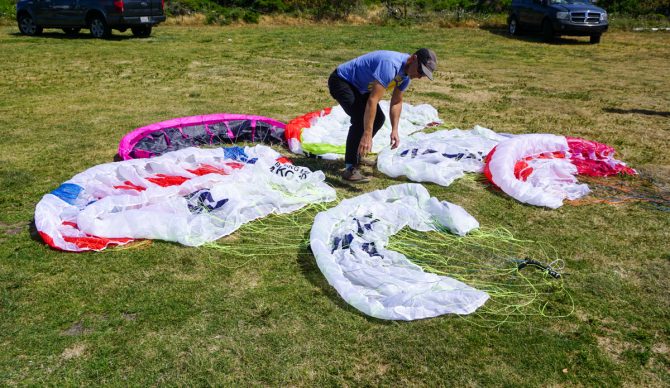
Laying out options for an afternoon of testing at Crissy Field. Photo: Will Sileo//The Inertia
How We Wrote This Guide
Our lead writer for this guide is Bowen Dwelle, a San Francisco native and lifelong sailor. He’s a windsurfer, kitesurfer, kitefoiler, wingfoiler, adventure guide, and writer. Bowen has logged thousands of miles of high-wind foiling in San Francisco, Brazil, the Philippines, Mexico, and elsewhere over the years.
He brings all of his experience to bear, along with hands-on experience and testing, meticulous research, and many conversations with parawing designers and experts, including Greg Drexler of Boardriding Maui, Matjaz Klemencic of Triple Seven, Matthew Hoffman from Naish, Daniel Paronetto of the Lab Rat Foiler podcast, Cynthia “Cynbad” Brown, John Heineken, Dmitry Evseev, and others.
Will Sileo, Managing Gear Editor at The Inertia, also contributed to this review with testing, photos, conversations, in-water swaps, and comparisons at Crissy Field.
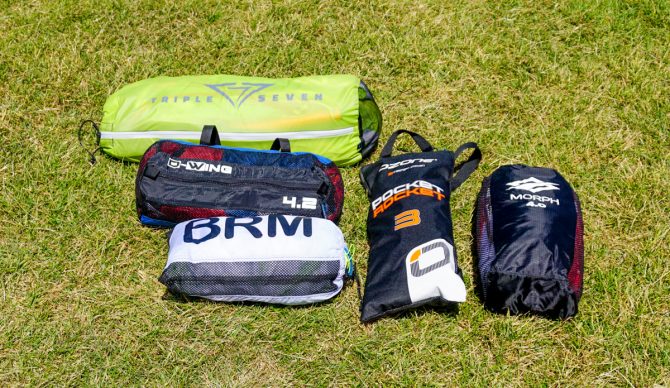
Just a few of the parawings we tested for this review. Photo: Will Sileo//The Inertia
We tested all the parawings we could get our hands on in wind from 12 to 30+ knots in the San Francisco Bay, Hood River, and Maui, evaluating characteristics including ease of use, comfort, agility, stability, collapse, relaunch, packing, bridle, lines, speed, upwind angle, low end, high end, usable wind range, bar, and overall versatility.
The biggest change in parawing development from 2025 to 2026 has been the expansion of usable wind range; last year, most parawings still had a narrower range than inflatable wings, and the cutting edge of development was high-end stability. The lack of range still required using a larger board to be able to get on foil efficiently and not be overpowered going upwind. This year, stability at the top end of the wind range is no longer an issue, and most designers have focused on extending the lower end of the wind range and on overall versatility. The result is that the leading parawings now offer enough range to let you use a board in the same size range as you would use with inflatable wings.
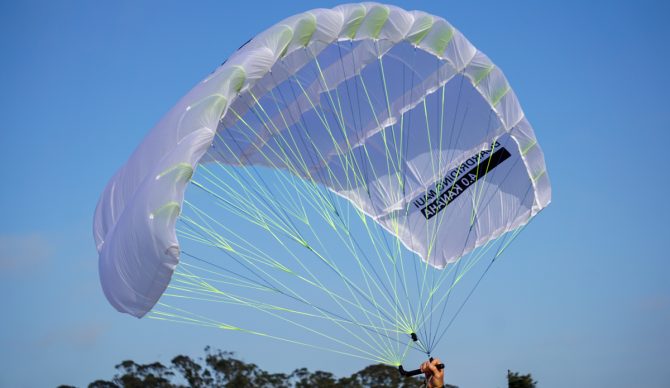
A year ago, who would’ve thought we’d be flying around with these mini glider kites? Photo: Will Sileo//The Inertia
What’s Next / The Future of Parawinging
2026 is the second full year for parawinging (and the third season for market leaders like BRM), so we’re out of the early-adopter phase and into the mainstream. The majority of parawings now work well across a wide range of conditions and have excellent stability and range. Coming down the road in the second half of 2026, we’ll see:
- More hybrid (Triple Seven, Altis) and double-skin parawings like the Flysurfer ZAP
- More control and trim systems like those on the Sroka Fynix and PPC Orbit
- Continued emergence of racing and freestyle parawinging
- Many more inflatable wing riders fully transition to parawings
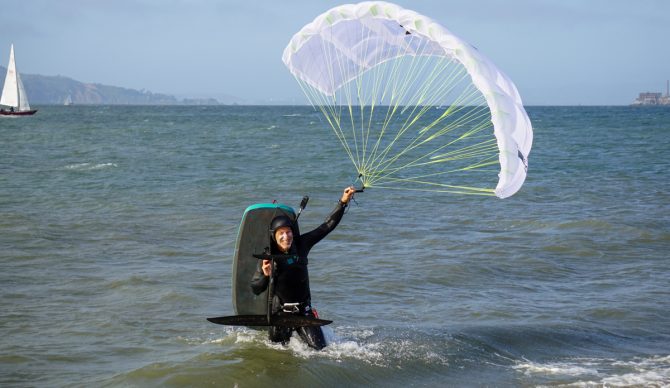
All smiles after a killer session on the BRM Kanaha. Photo: Will Sileo//The Inertia
Parawing Buyers Guide
Return To: Top Picks | Comparison Table | How We Tested
Navigate To: Parawing Disciplines | Parawing vs Inflatable Wing (and K-Wing) | Selecting Parawing Gear | Learning to Parawing | Parawing Technical Details
We’re here to help you make finding the equipment that fits your style an enjoyable and stress-free part of your riding journey. The most important variables in determining which parawing setup is going to work best for you are:
- The parawing disciplines you’re interested in.
- Your skill level and previous experience in winging, kite-foiling, and other foil sports.
- Your weight (don’t forget to include wetsuit & equipment).
- The conditions that you expect to ride in.
- Which aspect of performance is most important to you in your equipment – speed, versatility, glide, ease of use, maneuverability?
- What’s your personality as a rider – racer, gearhead, ‘keep it simple’ kind of rider, or somewhere in between?
- Your budget.
Overall, it’s pretty hard to go wrong if you use this guide and honestly assess your athletic ability and ambitions, talk to some reps and other people in your local riding community, and – most of all – follow your intuition towards the gear that fits your personal riding style.
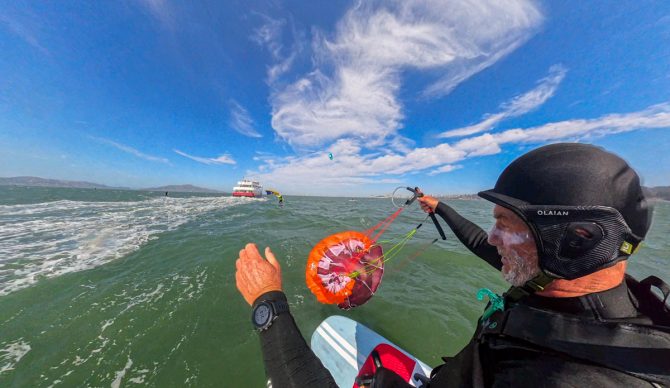
Redeploying the F-One Frigate. Photo: Bowen Dwelle//The Inertia
Parawing Disciplines
The first and most important question in selecting a parawing is: how are you going to use it? Are you going to be packing the wing away for extended downwind foiling, using it for short laps in sets of waves, long upwind runs, or free-ride reaching back and forth with occasional riding of swells and bumps?
Keep in mind that while parawings can be used as replacements for inflatable wings, they make power differently, and the riding styles that work best with parawings are different. You can use a parawing like an inflatable wing, but, just as with the transition from kite-foiling to winging, a big part of parawinging is that it opens up new ways of riding.
Downwind Foiling
This is the original use case for a parawing – use the wing to get up on foil, and then pack it away for a long downwind run, playing the infinite chess game of connecting bumps without any other power source. A parawing with plenty of power and easy, maximal packability is ideal for downwinding.
A harness isn’t really necessary; just somewhere to pack the wing (and perhaps carry a second one, along with some water, food, radio, phone, safety gear, and maybe a paddle). For pure downwinding, we like a wing that packs really small such as the BRM S3 or the Triple Seven PT Skin.
Short Laps In Waves
Many riders are also using parawings for quick laps or runs in swell, waves, and wakes where they “douse” or collapse the wing and then hold it loosely “wadded” or balled up while riding purely on foil for a short time before quickly redeploying the wing. In these situations, it isn’t practical or necessary to pack the parawing away, and so a design that makes it easy to douse and then re-fly the wing reliably and quickly is what you want. We recommend not using a harness line for short laps in waves, as it’s not needed and just presents another place where the bridle lines can get caught. The BRM S3, F-One Quest, Triple Seven P.T. LTX, and the Ozone Power Pack are our top picks in this category.
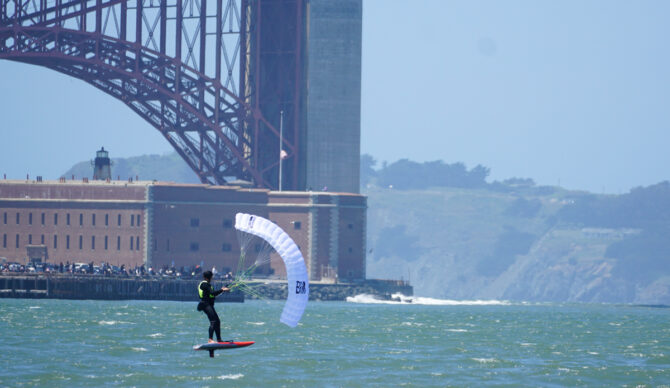
Photo: Will Sileo//The Inertia
Long Upwind/Downwind Laps
One of the most attractive uses for parawings is for combined upwind/downwind runs. For this sort of riding, you want a very stable wing that flies forward in the window, drives hard upwind, and handles being overpowered well, because going upwind generates the most apparent wind, and therefore the most ‘overpowered’ feeling. You will certainly want a harness so you can hook in for this sort of riding. You may want to pack the wing away on downwind legs, but parawings designed for this discipline can afford to be a bit bulkier, in a trade-off for stability and upwind ability. The Triple Seven P.T. Hybrid, BRM S3, and Ozone Pocket Rocket all fit the bill in this category.
Free Riding and Cruising
Although parawings were originally intended to be packed away once on foil, it’s inevitable that many riders are going to use them in place of inflatable wings for free riding and cruising in conditions that mostly involve reaching back and forth, carving turns on whatever bumps and lumps happen along the way. For free riding, you want a stable, user-friendly wing that excels at reaching and going upwind. You’ll want as wide a wind range as possible, and packing the wing isn’t really a factor. For free riding any of our top picks will serve you well, but the usability and range of the F-One Quest, Triple Seven P.T. Hybrid and LTX, and BRM S3 would be our top picks.
Rescue/Backup
Another legit use for parawings is as a backup power source for offshore downwind missions, or just to carry a second size. Although you can carry a second parawing in the waist belt/harness, that, of course, makes it impossible to stow your primary parawing there, and quite a few riders have reported losing parawings stowed this way after crashing. A better solution is to carry your “get back” parawing in a backpack. A lot of riders we know carry a 5m+ getback parawing in a compact dry bag inside a backpack. Running backpacks or drybag packs have been the options of choice here. Some parawings also come with a backpack-style carry bag that can be used to carry the parawing while riding.
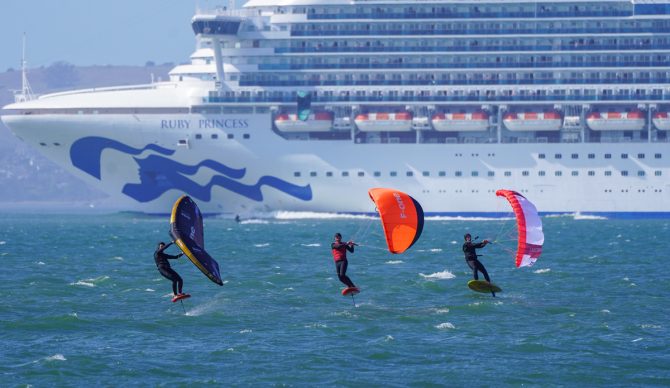
Wing, K-Wing, or Parawing? Photo: Nicolas Ostermann
Parawings vs Inflatable Wings (and K-Wings)
Especially for those of you coming to parawinging from inflatable wings, keep in mind that a parawing is a different kind of power source. They were originally invented for downwinding, a discipline that generally involves using foils with more glide than we typically use for winging, which in turn means that you can use a smaller parawing with such foils. You can use a parawing like an inflatable wing – with small boards and foils – but you’ll spend more time heavily or over-powered because of the narrower sweet spot in the wind range.
Said another way, don’t start by looking at parawings as 1:1 replacements for inflatable wings. Just as wings involved a new kind of riding from kite-foiling, parawings are different from wings, and as Dan Paronetto of the Lab Rat Foiler podcast said recently in this conversation with Ken Adgate, one way to look at that difference is that “the beauty of the parawing is when it’s not flying,” In contrast to how we tend to ride powered up most of the time when out winging; with parawings, we’re inclined to use the foil more, and to use the wing as little as possible.
Here’s our take on how these power sources compare:
Parawing
A small parafoil kite (or “wing”) flown on very short (1-1.5m) lines, with a control bar. Various alternative and brand names exist, but it seems clear that “parawing” is going to stick as the term for the overall category. Parawings are roughly ¼ of the weight and much more compact than inflatable wings, but overall, they still have a narrower sweet spot in their usable wind range.
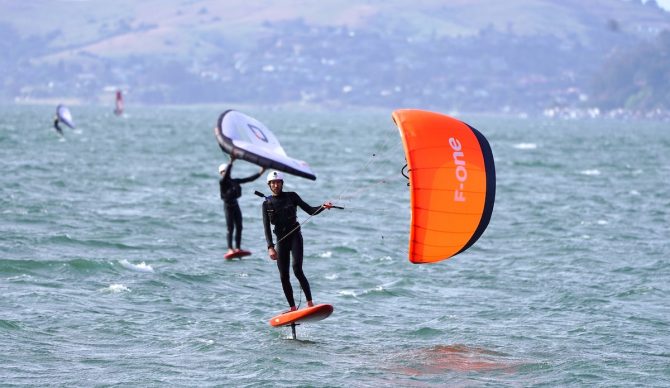
Don’t discount the F-One Plume. While it doesn’t pack down like a parawing, it’s a real joy to ride. Photo: Nicolas Ostermann
K-Wing
Named for the fact that it’s a hybrid between a kite and a wing, a “K-Wing” (as recently introduced by F-One) is a small, low-aspect leading-edge inflatable kite flown on very short ~1.5m lines, with a kite control bar. You can’t pack it away while riding like a parawing, but a K-Wing can be flagged out behind you like an inflatable wing. The K-Wing is about half the weight of an inflatable wing.
Inflatable Wing
A vertically-oriented leading-edge inflatable (LEI) sail that is held directly by handles or a boom on the center strut. Also known as a “hand wing” in some circles, or more often just a “wing.”
| Parawing | K-Wing | Inflatable (LEI) wing | |
| Athleticism | More than with LEI wings | More than with LEI wings | Less than parawinging, for sure |
| Wind range | Leading parawings have similar wind range to inflatable wings, but still a narrower sweet spot | Much less low-end power than LEI wing, but very high top-end range | Wider wind range than most parawings; good low-end power and high-end range |
| Stability | Most 2026 parawings are very stable now | Very stable | Very stable |
| Upwind riding | As good as LEI wings | Better than most parawings | Very good |
| Downwinding | The best! | Less cumbersome than an LEI wing when flagged, but not nearly as good as a packed-up parawing | Can flag out, but the wing can be cumbersome and get in the way |
| Wave riding | Can be great, requires more skill | Good for swell | Very good |
| Free riding/ cruising | Can be great with the right gear | Can be great with the right gear | The best! |
| Freestyle | Still emerging | TBD | Oh hell yes |
| Racing | Starting to happen! | TBD | Lots of it |
| Bar pressure | Most riders use a harness upwind | Very light; no harness required, but can be useful for upwind | Most riders use a harness upwind |
| Weight | ~0.6 kg / 1.3 lb | ~1 kg / 2.2 lb | ~2 kg / 4.5 lb |
| Compactness | Much more compact than LEI wings | More compact than LEI wings, less compact than parawings | Bulky, especially wings with booms |
| Simplicity | No center strut, no LEI bladders, no pump – but many bridle lines. | No center strut, but there is a bladder that requires a small pump. | No lines, but bladders require inflation. |
| Versatility | Best for downwinding, good for free riding. | Not really better than a parawing or an inflatable wing for any specific discipline, but requires less skill than parawings | Excellent for many disciplines; not as good as a parawing for downwinding. |
| Visibility | Much better view than LEI wing | Much better view than LEI wing | Downwind view blocked by wing |
| Durability | TBD on long-term durability, but no risk of puncturing a bladder and less risk of damaging the wing | Probably a bit less risk of damage than with an LEI wing | Proven long-term durability, although there is always the risk of puncturing a bladder or putting your foil through the wing |
| Cost | Less than LEI wings: 4m $700-$1,100 | Same as parawings | More than parawings: high-performance 4m avg $1,000-$1,800 |
| Board size | 90-100% of body weight in kg/ liters is ideal to cover a wide range of conditions. | 110-120% of body weight in kg/ liters may be ideal to cover a wide range of conditions. | 100% of body weight in kg/liters is ideal for many riders to cover a wide range of conditions. |
| Foil Size | Better with larger foils | Better with larger foils | Can use smaller foils than with a parawing |
| Travel | Very light and compact. Bring however many you need. | More compact than LEI wings, a bit more bulky than parawings; range means you can probably travel with just one or two sizes. | Bulky, especially wings with booms. Travel with two or three sizes. |
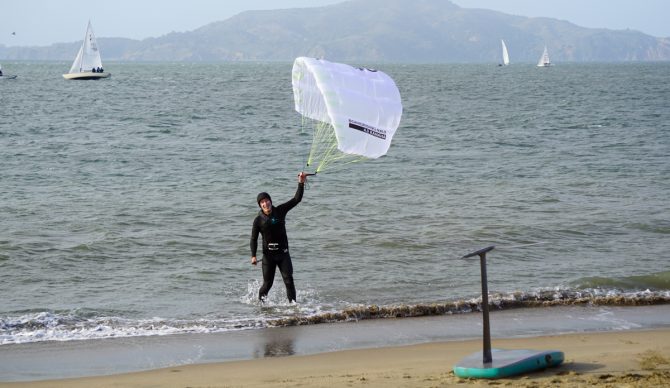
While your old wing board and foil might do the trick, getting your setup dialed for parawinging specifically will provide a much better riding experience. Photo: Will Sileo//The Inertia
Selecting Parawing Gear
Jump To: Top Picks | Comparison Table | How We Tested | Buyer’s Guide
The Parawing Itself
As obvious as the idea may seem in retrospect, parawings emerged when they did through a classic case of convergent evolution, thanks to a series of prior developments in kiting, winging, and downwind foiling that brought certain innovative riders to the point of envisioning a small collapsible power source that could be used to get on foil and then packed away for downwinding and wave riding.
There are already more than two dozen parawings on the market, and although the basic concept is the same, there are some important differences. If you’re choosing parawing gear for the first time, our recommendation is to keep it simple with a single-skin wing, a simple bridle layout, and color-coded bar, lines, and leading edge.
Of course, there are always going to be tradeoffs – the most packable parawing isn’t going to make the most power, nor is the most stable going to be the most nimble. Also keep in mind that while the downwind stoke is real, and parawings certainly broaden access to this style of riding, your own riding style may or may not call for packing the parawing away very often – or at all – so be sure to make your choice based on how you’re actually going to use the gear, not someone else’s mega-downwinder on Youtube.

Wake-thieving with the 3.2m Kanaha. Photo: Will Sileo//The Inertia
Wind Range/Low & High End
Any given size of sail, wing, or kite has an optimal wind range. Perhaps the most important thing to understand about parawings as power sources is that, at this point, while the best parawings have a total wind range that’s roughly similar to that of an inflatable wing, parawings still tend to have a narrower sweet spot in their usable wind range than inflatable wings. This means that, in general, for parawings, the “ideally powered” part of the wind range is narrower, and the portion of the wind range that’s in what we call the “heavily powered” zone is larger.
Since there’s a range between the sweet spot or ideal wind range and the truly overpowered zone, a wing is still usable when heavily-powered but not really when truly over-powered. In general, inflatable wings, kites, and K-wings handle being heavily powered much better, because parawings are more sensitive to apparent wind and deform more when heavily loaded and as they are sheeted.
The result is that the sweet spot of ideal power is something like 3/4 of the total usable range for inflatable wings (with the remaining upper quarter being heavily powered), and the sweet spot for parawings is only something like 1/2 of the usable range, with the other half being heavily powered.
Double skin and hybrid parawings defy this stereotype. Depending on the design, they typically have more limited low-end ranges, often requiring sizing up a half or full size of parawing, but the return is an extremely good top end, with heavily-powered and even overpowered ranges that hold their shape and stay controllable more like an inflatable wing than a traditional single-skin parawing. Parawings like the 777 P.T. Hybrid and BRM Paia are good examples of this — both trade away some low-end grunt for a top end and upwind performance that closes the gap with inflatable wings, staying locked-in and predictable well past the point where a single skin parawing would start folding up or getting squirrelly.
Riders often talk about “grunt,” or the ability of a wing to generate power at the low end of its optimal wind range. Parawings pull differently, and they’re not rigid, so you can’t pump them as well as inflatable wings. Instead, you have to pump the board and foil as well. However, parawings with lower aspect ratios and sturdier inner structures have proven to be better at pumping.
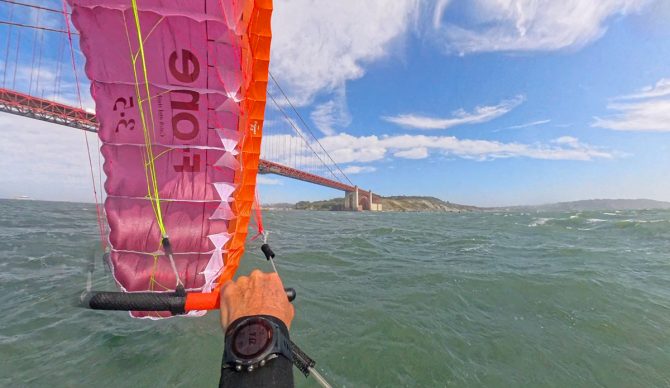
The F-One Frigate is exceedingly stable when flown off the front lines. Photo: Bowen Dwelle//The Inertia
At the high end, and this is most important for upwind riding, you want a parawing that remains controllable and with manageable bar pressure as far as possible above its ideal wind range before becoming overpowered to the point of unpleasant, unmanageable, and potentially unsafe riding. Think about how it feels to be truly overpowered on an inflatable wing or a kite. At some point, it goes from feeling groovy to feeling a little too lit, and perhaps you can still hold it down, but then if the wind gets even stronger, at some point the thing just starts flapping and bouncing around, and you can no longer hold your line upwind.
Also – and this is very important – the effective wind range of a parawing has a lot to do with the board and foil you’re using and the type of riding you’re doing. More so than for other wind sports. Because of the narrow powerband of parawings, it’s really important to select a board and foil that are optimal for parawinging if you want to go upwind.
If you insist on using your normal wing equipment, it’s very likely that you won’t be able to get up at all unless you’re using a parawing of a size that results in being overpowered going upwind. And, relative to how LEI wings work, you will probably also feel underpowered until you get up on foil.
Our point here is that if you insist on using gear that isn’t well suited to parawinging, it won’t feel great – but if you select proper equipment so that you can ride in the lower-middle part of the wind range of whatever size parawing you’re on, you’ll have a much better experience. All of the above is most important for upwind parawing riding, much more so than any other type of parawinging. See Boards for Parawinging, below, for more.
The diagram below is a rough illustration of the approximate relative power band of parawings, the K-Wing, and inflatable wings, given the same rider, board, and foil.
- Under: can’t get on foil, or only with great difficulty
- Ideal: most comfortable, light bar pressure
- Heavy: less comfortable, heavier bar pressure, less than ideal wing behavior
- Over: no longer enjoyable, can’t stay on the desired course, potentially dangerous
- The black arrow indicates the effective usable wind range

Photo: Bowen Dwelle//The Inertia
Most parawings of the current generation are manageable to some extent when heavily powered; it’s a question of how much less stable and less pleasant they become to use in that state, before becoming totally overpowered. The F-One, Flysurfer, Ozone, Triple Seven, and BRM parawings were our favorites at the high end for upwind riding. By the way, the F-One Plume K-Wing blows all of the (single skin) parawings out of the water with its huge top-end range. At the low end, the F-One Quest, Ozone Pocket Rocket V2, BRM S3, and Flysurfer POW2 have some of the best grunt that we’ve tested. Of course, under- and over-powered are relative to so many other factors, and the ranges differ for each parawing, so use the above as a general guide at most.
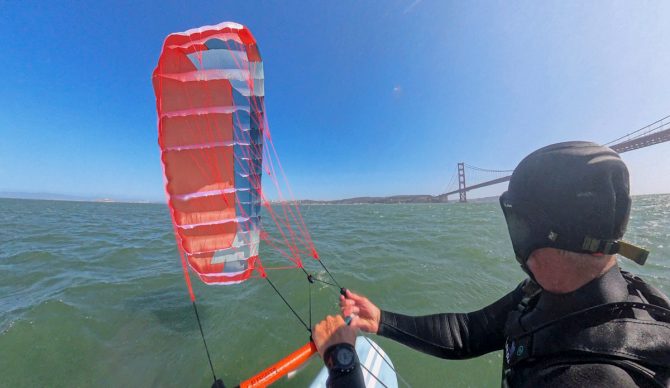
The Flysurfer POW is another top-tier choice when it comes to upwind stability. Photo: Bowen Dwelle//The Inertia
Stability
Some parawings jump around a lot and/or flap the leading edge or wingtips when heavily powered, and some just pull – stable and quiet. In our testing, the most stable parawings were the F-One Quest, Ozone PRV2, BRM S3, and Triple Seven wings.
Agility
Shorter lines on a parawing make it possible to do some things (sharper turns, quick stow-and-deploys) that aren’t possible with longer lines, but then again, you can whip some of the more kite-like parawings around in ways that you can’t with shorter lines. Canopy shape and depower-ability matter here as well. Similarly, some parawings can be flown upside down, backwards, and sideways, while others pretty much want to stay upright. Some of the most agile parawings we’ve tested include the F-One Frigate/Quest, BRM Kanaha/Ka’a and S3, and Triple Seven LTX.
Stowability/Packability
Basically, simpler, lighter construction and shorter lines makes a parawing more packable, and in this area, the BRM S3 and Triple Seven Skin/Hybrid/LTX take the win.

Short lines and a lightweight, minimal canopy construction make for great packability with the BRM Kanaha. Photo: Bowen Dwelle//The Inertia
Upwind Ability
When parawings came out, the first question everyone had was: ‘Do they go upwind?’ If it’s not already obvious, they certainly do go upwind, in some cases even better than inflatable wings – but of course, there’s still some variation in how well. The Triple Seven P.T. Hybrid, BRM Paia and S3, F-One Frigate, and Ozone Pocket Rocket take the win here with max VMG (the combination of upwind angle and speed).
Parawing Sizing/Quiver Building
As Tucker from MAC Kiteboarding lays out in this video, parawings “don’t deliver big low-end grunt like some traditional wings. They come alive once you’re moving and start building apparent wind, but they’re not going to yank you onto foil from a dead stop. Sizing for enough usable power is extra important – especially when you’re just learning.”
As for how the sizing compares, at this point, we’re seeing that the sizing for the leading parawings is roughly comparable to inflatable wing sizing, and perhaps even a little smaller. There were days during our testing when we were on 3m parawings and most wingers were on 3.6m wings, and days when we were overpowered on 3m parawings, and wingers were good on 3m wings. That said, we’re also following our own advice and riding bigger boards and foils than we would use for winging.
With the above notes about board and foil size in mind, you’re probably going to end up with more or less the same size of parawing as an inflatable wing, for a given wind strength. Let’s say, for example, that you’re comfortable on a 75-liter board, 700cm foil, and a 4m inflatable wing in roughly 20 knots at your local spot. In these same conditions, you would want something like a 90-100 liter board, 850-1000cm foil, and a 4m parawing, at least for getting started. Advanced parawing riders have been able to step down to boards roughly comparable to their weight and foils maybe one size up from what they would typically use with an inflatable wing.
We also agree that for most people, one or two parawings is the right number to start with, unlike the standard three-wing and three- or even four-kite quiver. We’re still very early in the development of parawings, and so it probably doesn’t make sense to invest in a ton of different sizes right off the bat, since new designs will come out in quick succession. Our recommendation is to start with one or two sizes: a 3m and 4m if you live in a windier area, or a 4m and 5m if you’re bigger and/or live in a less windy area. You’re not going to need a 2m parawing anytime soon unless you live in Maui, Hood River, northern Brazil, or some other places where it really nukes.
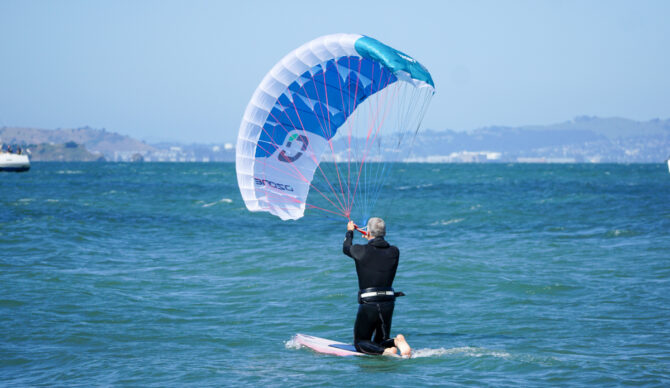
V1 parawings like the Ozone Pocket Rocket V1 are still worthy options on the used market. Photo: Will Sileo//The Inertia
Cost and Resale Value
When parawings first emerged, there was a fair bit of chatter from folks who thought they were expensive or that they should be cheaper than inflatable wings. Now that more of them are in people’s hands, it’s 100% clear that parawings are just as much of a complex, highly developed product as any other part of our wind- and foil-sports gear.
Our position is that, in general, manufacturers do their best to bring quality products to market and to price them competitively while maintaining their ability to make a reasonable profit, and that is what we see in the parawing market today. Since we’re still early in parawinging, new designs and product versions will be coming out in quick succession. At this point, don’t expect used parawings to hold their value very well. If your budget is limited, there are already plenty of used parawings on the market.
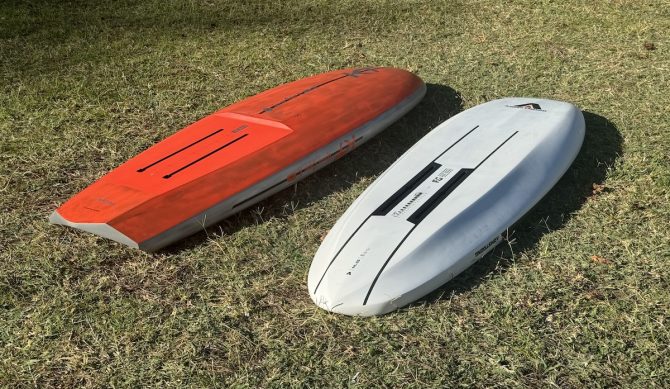
Midlength designs tend to be a great choice for most all-around parawinging. Photo: Will Sileo//The Inertia
Boards for Parawinging
In 2026, parawing low-end power has improved enough that many advanced riders are moving back to smaller “sinker” boards of 80-90% of their body weight, especially with modern, highly efficient foils that generate a ton of lift at low speeds without sacrificing glide and speed. That said, our guidance remains that for most riders – especially beginners and those wanting to make things easier on themselves – the ideal board size for parawinging is still going to be bigger than your typical wingfoil board.
Aside from the simple fact that a bigger board makes everything easier, the counterintuitive reason that’s specific to parawinging is that you don’t need the larger board while you’re going upwind; you need the larger board to get up on foil with a small enough parawing that you won’t be overpowered going upwind.
- Beginners: 110-120% of bodyweight in liters
- Intermediates / less athletic riders: 100% of bodyweight in liters
- Advanced / experts: 80-90% of bodyweight in liters
As for board shape, the mid-length trend for wingfoil boards that has emerged over the past couple of years will serve you well as you get into parawinging, since a longer waterline will allow you to generate board speed and get on foil more easily.
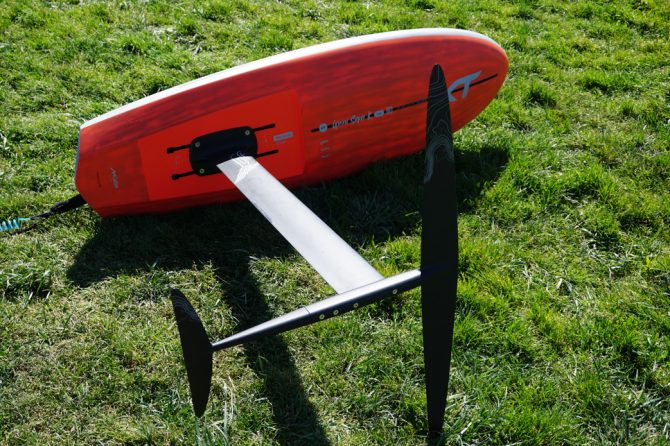
Surfy, controllable foils with plenty of glide, like the Lift Florence 130X, are great for parawinging. Photo: Will Sileo//The Inertia
Foils for Parawinging
As with winging, almost any foil can be made to work with a parawing, but in general and especially as you’re learning, you’re going to want something a bit larger than whatever your go-to is for wing foiling. The usable wind range of a parawing is highly affected by the board and foil you’re using. The harder it is to get up on foil, the more power you’ll need in the parawing, which in turn makes it more likely that you’ll be overpowered. Our overall guidance is to go with a foil that’s one size up from whatever you might use for wingfoiling.
See our Foil Buyers Guide for more details on selecting foils.
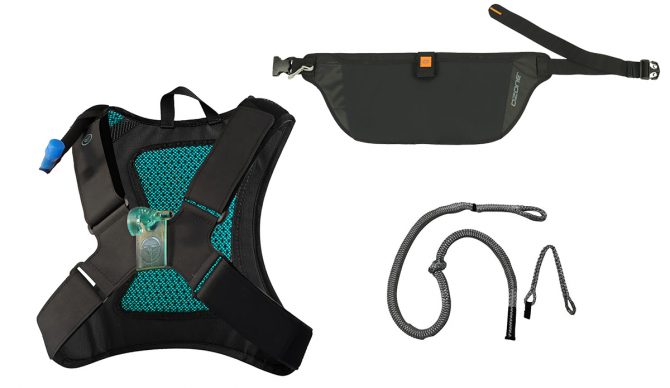
Left to right: Ride Engine Chest Harness, Ozone Parawing Stash Belt, Ozone Wing Harness Line.
Accessories
Harness/Belt
A harness (aka “belt”) or backpack can be useful for two reasons: 1) to hook in going upwind and 2) to stow your parawing during downwind riding and/or carry a second parawing or other gear. It can be useful to have a second size with you on the water since the wind range is so narrow, and it’s easy enough to switch wings on the water if you have one packed away in a belt or backpack.
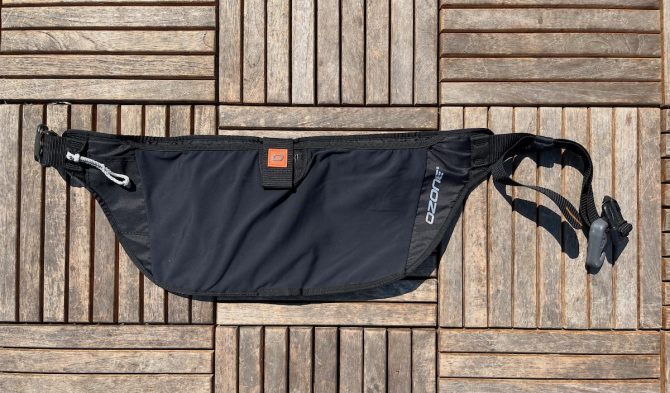
Ozone’s Parawing Stash Belt is one of our favorite parawing belts that we’ve tested. Photo: Bowen Dwelle//The Inertia
We recommend using a harness to hook in for repeated upwind/downwind laps or free-riding that involves a lot of upwind work. As with an inflatable wing, the bar pressure on a well-designed parawing is reasonable enough that you can go upwind without a harness, even heavily powered. Although the Ozone and BRM belts are designed to be used as harnesses, you might also take a look at the Ride Engine Free Float Chest Harness, which gets the harness hook up above the redeploy zone, and also makes it easier to fly the parawing low in the window when going upwind.
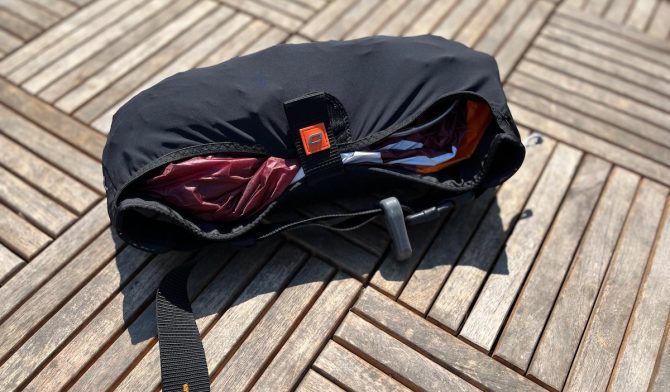
Ozone Stash Belt with a parawing stashed inside. Photo: Bowen Dwelle//The Inertia
Downwind: storage/equipment storage needed, but no harness/line/hook
Waves: nothing required, keep it clean to avoid tangles
Upwind: no storage needed (but can be useful to carry another size), harness highly recommended
Free Riding: wing storage and harness optional
There are already a ton of parawing harness options on the market, and we’ve tried a couple, but we’re going to withhold judgment until we’ve tried some more options. One trend that is emerging is the need for true harness-like support. You can also use a wingfoil harness; just keep in mind that you’ll be climbing on the board more often (especially at the beginning), and so you’ll want to be careful with the harness hook and/or use a soft or folding hook.
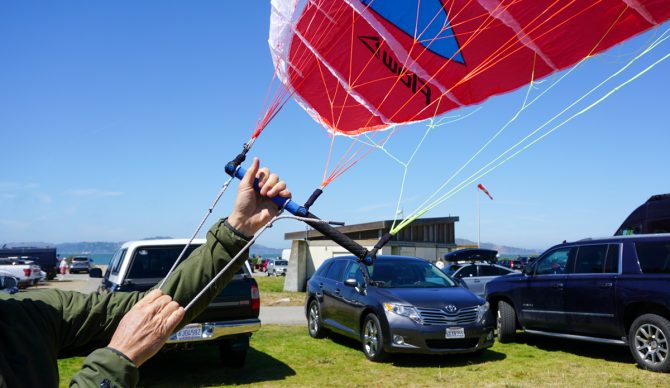
The Ozone harness line on the Flow D-Wing. Photo: Will Sileo//The Inertia
Harness Line
If your riding situation calls for a harness, you’re going to need a harness line – and since almost all riders are going to want to go upwind, almost all riders are going to need a harness line. These days, most parawings ship with a harness line, which just goes to show how all-important they really are. Here’s a nice little video about setting up your harness line and leash.
There’s a bit of a debate going on between stretchy harness lines and fixed harness lines. Fixed harness lines are easier to swing into your harness hook, especially when riding one-handed, whereas stretchy harness lines can help you stay locked in more securely and are arguably lower profile.
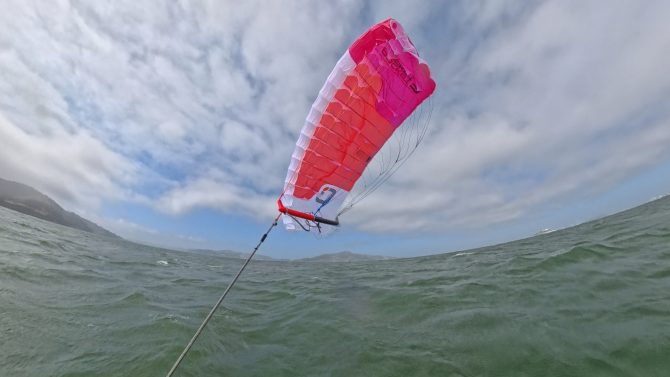
A parawing leash isn’t necessary, but it’s nice to be able to let go of your parawing without fear of tangles, especially as you’re learning. Photo: Will Sileo//The Inertia
Parawing Leash
Opinions differ about whether to use a leash for the parawing itself. Most people agree that you don’t need a leash because if you let go of a parawing, it will simply fall in the water and not drift far. Not having a leash certainly keeps your setup cleaner, and so if you are dousing the wing frequently, especially in waves, we recommend not using a leash.
On the other hand, using a leash gives you the option of letting go of the bar to give yourself a rest, and stops the bar from getting tangled in its own lines when you let go of it, if rigged properly. It may also give you an extra level of security or comfort, especially while learning to parawing.
Some parawing bars, like on the Ozone and Ensis Roger, have a built-in way to attach a leash directly. Otherwise, just put a pigtail around the front or back end of the bar and attach a short Dyneema shock cord leash from the pigtail on the bar to the front of your harness.
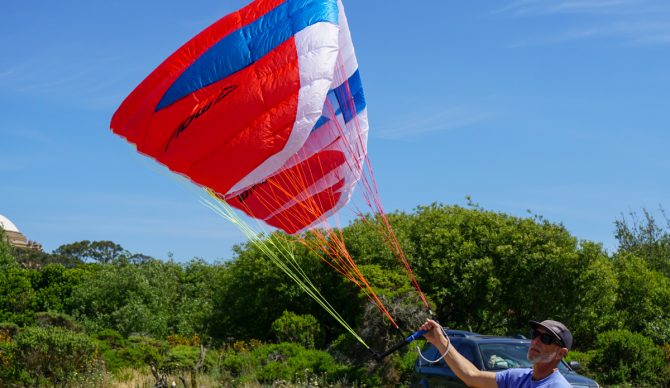
We highly recommend dialing in your parawing handling skills on land before hitting the water. Photo: Will Sileo//The Inertia
Learning to Parawing
Jump To: Top Picks | Comparison Table | How We Tested | Buyer’s Guide
Experienced wingers and kite-foil riders will generally get up on their first few attempts at parawinging. While parawings are entering the third generation of product development, overall, they are still a bit more difficult to use than inflatable wings (or kites). Prior experience winging, kiting, or foiling will help a lot. Either way, if you’re learning to parawing, make sure you have a larger board with a longer (midlength) shape, a big, user-friendly foil, and a place to learn with strong, steady wind.
While everyone who’s heard about parawinging is excited about packing the wing away while downwinding, for most average riders, that’s going to be a long time coming. In reality, the most important new skill in parawinging is learning to pump the board and foil to get up. While inflatable wings can be pumped very effectively to get going at the low end of their wind range, pumping the wing doesn’t work nearly as well with parawings. Instead, you have to pump the board and foil – and since you’ll hardly be moving when you start, the technique is much more like a flat-water stand-up paddle foil start. We’ve found a front footstrap to be helpful, but it’s certainly not necessary. We’ll be honest: it can be very challenging at first, and it’s more athletic than pumping to get up with an inflatable wing.
If you’ve never foiled before, we’d recommend you give winging with an inflatable wing a try first. That said, parawings kind of fly themselves, and they are so much lighter than inflatable wings that with the right gear, there’s no reason not to go straight to the parawing if that’s what your heart is set on!
Parawing Skill Progression
There are plenty of tutorials out there on the interwebs about all of these already, but here are our thoughts and some key tips.
Ground Handling
Something that really helps with learning all of these nuances, as well as all the maneuvers such as gybing, tacking, and all the rest, is to practice “ground handling” the parawing on the beach. Any good paraglider pilot will tell you that time spent ground handling is paid back 10x once in the air—or, in our case, on the water.
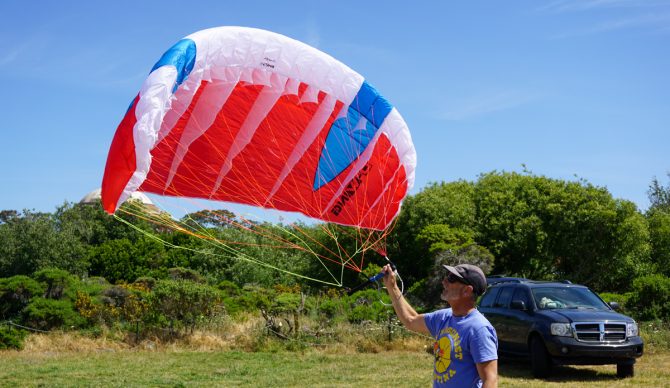
Spend some time on land getting a sense of how your parawing reacts to sheeting in and trimming with the control bar. Photo: Will Sileo//The Inertia
The Wind Window – Sheeting/Trimming the Parawing
Because parawings fly on lines, they’re able to move around more in three dimensions than inflatable wings, and a bit more like kites. Higher-aspect wings fly farther forward in what’s known as the “wind window,” generating more lift, and lower-aspect wings fly farther back, doing more pulling than lifting. Parawings also tend to be more sensitive to sheeting angle; you’re going to want to sheet in slightly for power, but it’s easy to oversheet and stall a parawing, which kills the lift and drops it back in the window. It’s useful to understand the concept of the wind window as you learn how any particular wing works and dial in where it makes power.
In general, steering a parawing is more or less like steering a kite; you just apply a subtle twist to the bar. It’s fairly intuitive, although you need to have the wing powered up to fly and turn easily. If it’s underpowered, the wing will drop back in the window and be very sluggish to turn.
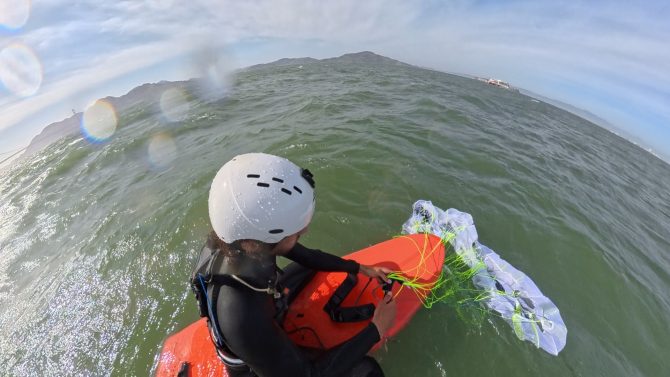
Tangles happen. A calm approach and a little patience go a long way. Photo: Will Sileo//The Inertia
Water Relaunch
When you crash, sit on your board and take your time to sort the parawing out and make sure the lines are untangled and the leading edge of the wing is upwards. Having a wing with a color-coded leading edge and lines helps a lot here. Once you have it ready to go, what works best for me is to pick up the center section of the leading edge and toss it gently into the wind, or just place it in that position on my board or in the water. That way, the wind can gradually fill the wing from the center and get it flying again.
Proper water relaunch technique is much more important with double-skin and hybrid parawings, and usually involves relaunching “manually” with one hand about halfway down the leading edge from the center of the wing.
Using Gusts
The importance of gust management in parawinging cannot be understated, and can very well be the difference between getting up on foil or not. In underpowered conditions, get your wing in the air, get into a kneeling position on your board, and watch the water upwind of you for a gust. When it comes, use the extra energy to get to your feet and start some forward momentum. If the gust holds, use it to get up on foil. If it doesn’t, try to keep your momentum and taxi on the water until the next one.
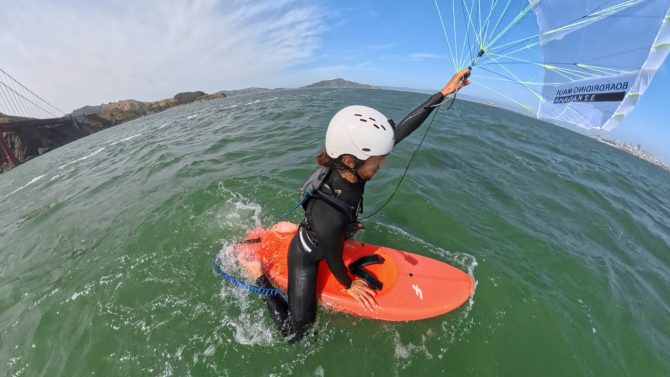
The “frog leg” technique. Photo: Will Sileo//The Inertia
Getting To Your Feet
Getting to your feet can be tricky with a parawing. When you fall, if you need to relaunch your parawing, it’s often easiest to do so from a seated position. This also lets you drag your feet in the water to keep yourself from being blown downwind and onto your parawing as it sits in the water. Once launched, you’ll need to get to your knees and then your feet, all while keeping the parawing aloft. This requires a one-handed pop-up.
We’ve seen a number of different methods. Greg Drexler, in this video here, uses more of a seated, leaning-back position with one arm planted on the board behind him for support, and brings his legs up in front of him. Another method we’ve had success with is “frog-legging,” or using one hand in front and gripping the rails of the board with your thighs, while bringing your feet onto the deck of the board behind you. This is all much easier with a strong, steady breeze giving you support and lift from the parawing.
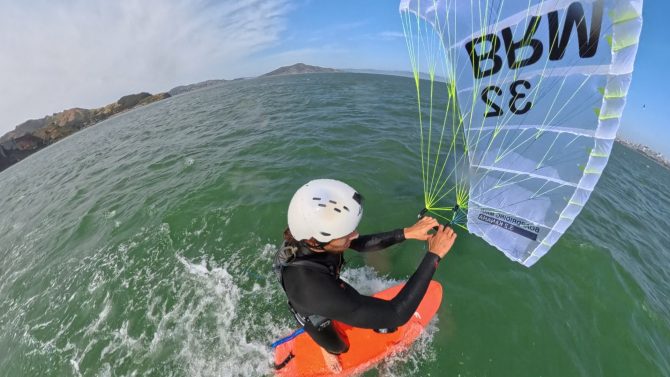
Instead of pumping the wing and board at the same time, try an alternating pattern. Photo: Will Sileo//The Inertia
Pumping
As mentioned elsewhere in this guide, for people coming to parawinging from wingfoiling and kite-foiling who don’t already have SUP foil experience, the most important skill is learning to pump the board and foil. Pumping is relevant first of all for getting on foil, but as you progress, it of course comes very much into play when you start to try to do any “downwinding,” or riding with the parawing doused/packed away. The better you get at pumping efficiently, the better your parawing experience is going to be.
The best way we’ve heard the technique described is to pump the board down and then pump the wing as the board comes back up and releases from the water, repeating the cycle of pumping board-wing-board-wing-board-wing in an alternating fashion. Don’t try to pump them both at the same time!

Sheeted in on the F-One Frigate. Photo: Bowen Dwelle//The Inertia
Sheeting/Trimming and Going Upwind
Trimming the wing is another key skill, probably more than for LEI wings, because of the lack of rigidity and narrow powerband of parawings. Finding the sweet spot can be tricky, and it takes some time to dial in, depending on the wing you’re using.
Staying upwind on a parawing is easy enough for anyone with prior wing- or kite-foil experience. The new part is learning how to generate maximum upwind angle and speed by building apparent wind using the narrow powerband of the parawing, and then pushing the power of the parawing through to the foil without stalling either the parawing or the foil. When I first began parawinging, I was able to go upwind, but slowly. A bit of practice led me to find another gear, ripping upwind at the same angles and speeds that I’m used to from wingfoiling.
Especially for those of us with muscle memory from windsurfing and wingfoiling that has us using the back hand to control angle of attack and even to steer, parawings require learning a new technique for optimal upwind performance. As Greg at BRM told me – which, by the way, we’ve also heard about the Ozones – you have to “let the wing breathe,” so that it can find its own best trim position, with minimal pressure from the back hand. I found that at first I was over-piloting the Kanaha, resulting in a relatively narrow sweet spot and the wing being a bit too easy to back-stall. Once I let up on my back hand, the wing flew further forward in the window and found the seam in the wind on its own. Ozone riders have reported much the same. Let up on the back hand and let it fly!
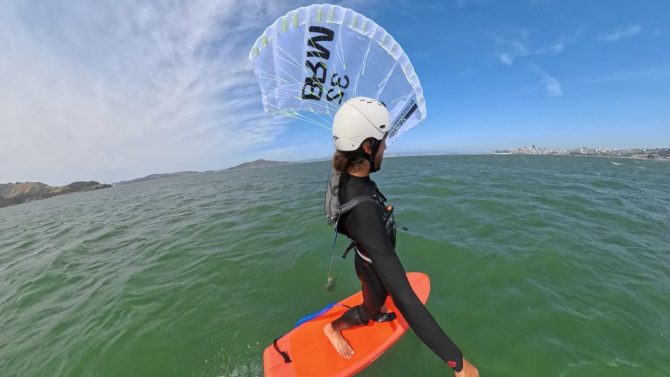
Downwind turns (gybes) are much easier to learn on the parawing to begin with. Photo: Will Sileo//The Inertia
Gybing and Tacking
Obviously, transitions are a big part of riding directional boards. In general, gybing and tacking parawings is somewhere in between gybes and tacks on kites and inflatable wings. Gybes are certainly the easier form of turning with a parawing, so we’d recommend you start there. One tip that’s handy early on is to turn the wing before you turn the board when gybing, so that you don’t outrun it. This is especially important in light winds, as outrunning the wing means the lines going slack and the whole thing collapsing without strong enough wind to keep it aloft, and a possible crash-landing.
As you progress with gybes, you may want to look at a downloop gybe, just as we did with kiting. Scott Drexler demonstrates the downloop here, and Ken Adgate discusses his downloop technique here. Tacking is also a bit like kiting in that the bar is free as opposed to fixed, like it is on an inflatable wing.
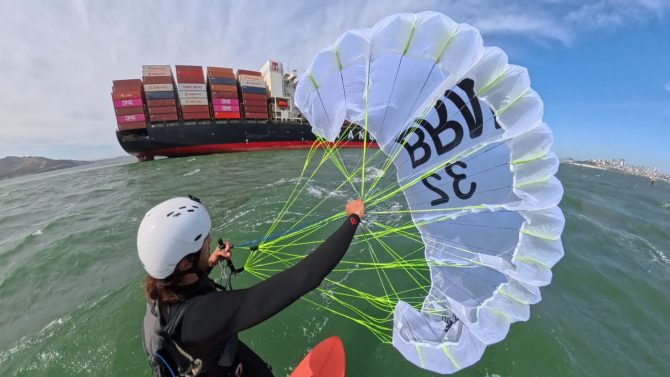
Collapsing (dousing) the BRM Kanaha by gathering the A lines. Photo: Will Sileo//The Inertia
Collapsing/Retracting/Snuffing/Dousing/Wadding
The main point of the parawing is to be able to ride on foil without any power source, so whether you ever pack the parawing away, collapsing, retracting, snuffing, dousing, or wadding and then deploying the wing is a key skill that anyone riding a parawing is going to want to learn straight away. One tip that we’ve found helpful is to turn downwind immediately before grabbing the lines to snuff the wing – this will depower the parawing and make it much easier to gather up on the lines. Another tip here is to just gather up the A lines at the top or front of the bar, rather than trying to gather them all.
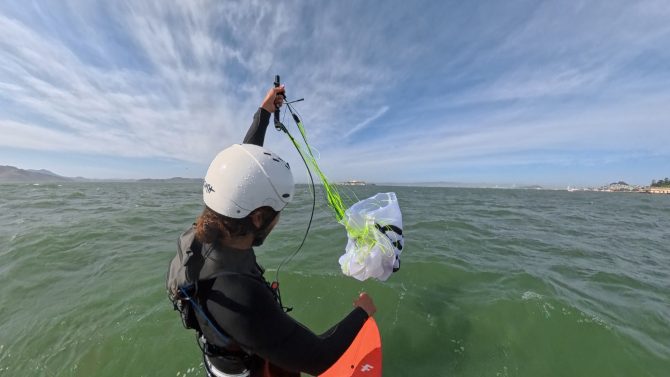
Not what you want to see as you toss your parawing out to relaunch – taking the time to shake out the parawing by hand before relaunching can help tremendously here. Photo: Will Sileo//The Inertia
Relaunching While Riding
Of course, once you’ve collapsed, snuffed, doused, or wadded up the wing, at some point you’re going to need to relaunch it. The key tip here is to dangle the unfolded parawing below the bar, let the wind catch it, and fill it with air. As this happens, it will naturally tend to steer itself back into the power window.
Packing and Stowing
If you’re doing real downwind runs, at some point you’re going to want to realize the full potential of the parawing and pack it away. Packing up the wing and stowing it while on foil is a real brain-teaser that requires delicate balance, dedication, and the ability to walk, chew gum, brush your hair, and tie your shoelaces – all while tiptoeing on a balance beam. It’s a real challenge – but so worth it when you get there!
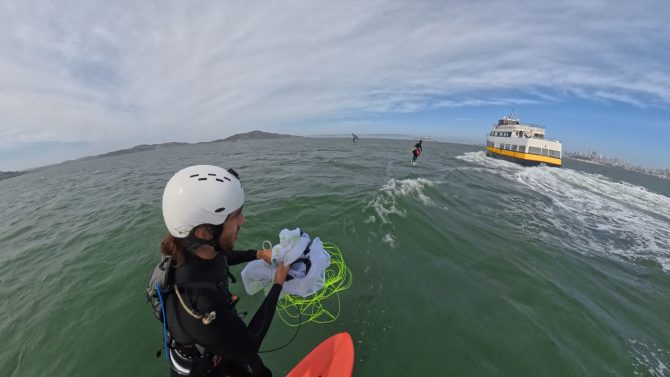
Packing up the Kanaha for a long ride downwind. Photo: Will Sileo//The Inertia
Safety
While parawinging, winging, kitesurfing, and other action sports are often considered “extreme” sports, we prefer not to use that term. Instead, we offer a conscious perspective on safety and relative risk. For one thing, any sport or activity that relies primarily on your own skill, judgment, and physical movements involves less risk than anything where you are subject to the unpredictable actions of others, for example, cycling or driving.
Aside from strain injuries, the primary objective risk in parawinging, aside from the fact that hydrofoils are quite pointy and the edges can be very sharp, is getting the lines tangled. Especially from a safety point of view, getting the lines tangled around your head does present some real risk, although the power of the parawings is relatively low.
Try to avoid attaching anything to your helmet (like a camera), as that will increase the chances of line tangles on your head. Especially if you’re riding in surf or big swell, it’s a good idea to ride with a hook knife in case of a dangerous tangle with the bridle lines. We also recommend that you wear flotation and consider carrying a backup parawing of a different size.
As always, pay attention to your intuition, use your own best judgment, and push the envelope of your skill gradually.
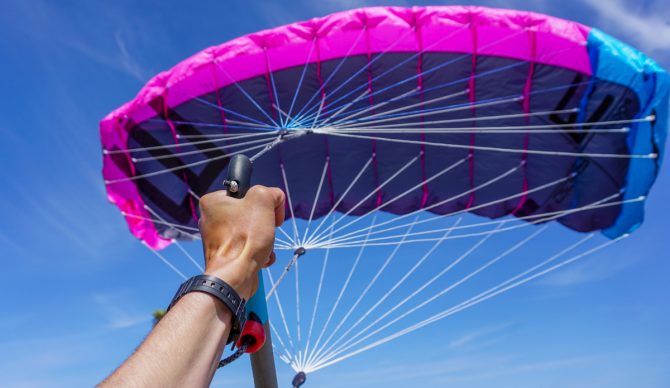
From the top down, A, B, and C bridles on the Ensis Roger V1. Photo: Will Sileo//The Inertia
Parawing Technical Details
Bridles and Lines
Unlike a kite with an inflated leading edge, a parafoil wing needs multiple sets of bridle lines to support the structure and transmit the power of the wing to the bar and rider. Just as with parafoil kites, on parawings, the lines are organized into rows named A/B/C for the front/middle/back line sets. Most parawings have three line sets.
In terms of line length, there is some trade-off between longer lines providing cleaner airflow and shorter lines being more nimble and easier to pack away. Given our most common use cases for parawings here in the Bay of dousing the parawing and redeploying after a short ride, we’ve tended to prefer shorter lines. See the chart above for a comparison of front-line length.
As for line material, we also like the solid-surface line that BRM, F-One, and others use better than softer lines, which are more prone to knots and tangles.
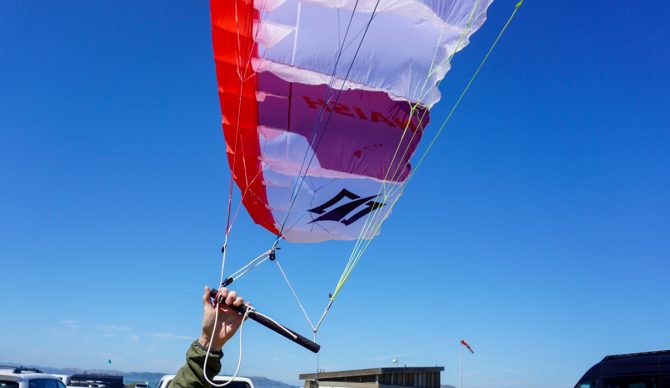
Pulley system on the Naish Morph. Photo: Will Sileo//The Inertia
Pulleys
As Matt Hoffman, the designer of the Naish Morph, put it, ‘The main purpose of the pulley system is to change the profile of the wing to add more reflex as you sheet out and depower, and add camber as you sheet in for more power. The secondary benefit is that as the pulley moves front to back, the power delivery and where the wing wants to sit in the window change, because the middle lines pull on the center portion of the wing, which affects the draft.”
The overall effect of this is to increase the effective wind range of the wing, but as Ozone Pocket Rocket designer Dom Zimmerman states in an interview on the Lab Rat Foiler podcast, they tested pulley designs, but in the end, Ozone was able to achieve their desired performance without pulleys. The trade-off is that while pulleys may increase the effective wind range, they also add complexity and can make flying and controlling the wing less direct or less intuitive. Of course, there’s also some small amount of additional weight and connection points, and the chance of snags.
All that said, we’ve tested the design of the Flysurfer POW, and were very impressed with the pulley system they have concocted there. Not only does their J-bar keep the pulley system clean and away from the rider’s hands, but it also vastly improves the wing’s range, as evidenced by the brand’s very wide spacing between sizes of 1.7 / 2.5 / 4m. However, we’ve noticed that the POW2 does not have the pulley system.

The 777 P.T. was the first double-skin parawing to hit the market. Photo: Bowen Dwelle//The Inertia
Single vs Double Skin
Most parawings use a single-skin design. As incredible as it may seem that something so simple and thin can fly at all, let alone efficiently, single-skin parafoils actually generate more power for a given area than double-skin wings because they are lighter, fly at higher angles of attack, inflate faster, and lose less energy to internal pressure maintenance. At least in theory, double-skin wings generate less drag, go upwind better, but also make less power, weigh more, and are less compact, more complicated, more expensive to produce—and, at least so far, tend to be harder to fly. Hybrids are some combination of single- and double-skin construction, and as the Triple Seven P.T. Hybrid and LTX have proven, offer some of the benefits of both designs.
Surface Area (Size)
The “size” of a parawing refers to the total surface area of the wing (or sail), typically measured in square meters (m² or sq mt).
Although the power a wing (or sail) generates increases exponentially with wind speed, at a constant wind speed, power scales linearly with area, so for a given wind speed, a 4 m² wing generates roughly 33% more power than a 3 m² wing, and a 5 m² wing generates roughly 66% more power than a 3 m² wing.
Compared to inflatable wings, which pump up, spread out, and are nearly rigid, a parawing of the same size in terms of surface area has less projected area – that is, the area the parawing actually presents to the air in flight, accounting for its three-dimensional shape and arc. This is a big part of the reason that a 4m parawing generates less low-end power than a 4m inflatable wing.
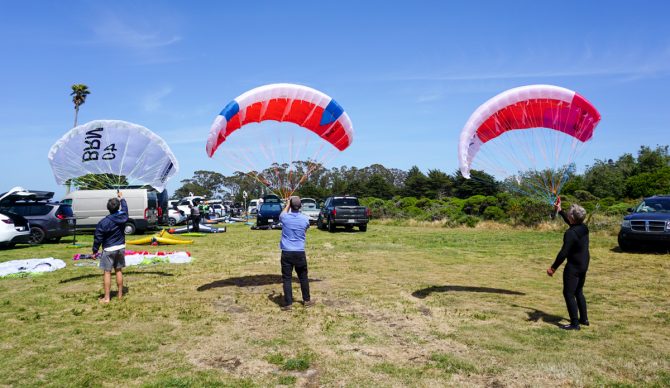
Aspect ratio has a big impact on a parawing’s low-end power and upwind efficiency. Photo: Will Sileo//The Inertia
Aspect Ratio (AR)
The ratio of the wing’s span (width) to its surface area. Because wings are complex shapes, we use the following formula to calculate AR: AR = (wingspan²) / (area).
Visually, lower-AR wings are fatter and more rectangular/square looking, while higher-AR wings like the Ozone Pocket Rocket are narrower. In general, higher-aspect wings (of all kinds) fly faster and more efficiently, go upwind better, but can be less nimble and have less low-end power, while lower-aspect wings like the North Ranger, for example, may turn more quickly and offer more low-end power, but are less efficient going upwind.
Angle of Attack (AOA)
Angle of attack (AoA) is the angle between the chord line (a straight line from the leading edge to the trailing edge) and the relative airflow (i.e., the direction the air is moving relative to the wing). In parawings, AOA is controlled first of all by sheeting the bar, but wings with pulleys or yokes can also vary the AOA as the bar is sheeted.

In this diagram from 777, you can see how, when the rear of the bar is sheeted in, the pulley system adjusts to add more camber to the wing, improving lift. Photo: 777 Kites
Camber
“Camber” refers to the curvature of a wing’s airfoil profile—specifically, the curvature of the mean line (the line halfway between the upper and lower surfaces of the wing). More camber means the mean line curves more away from a theoretical straight line. Most parawings have a static camber, but wings with pulleys or yokes can vary the camber as the bar is sheeted.
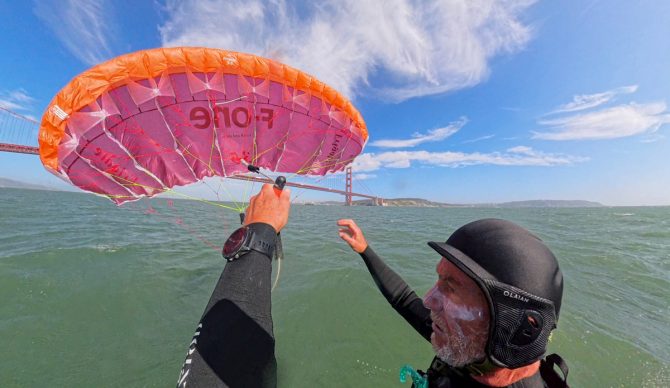
Gybing the F-One Frigate. Photo: Bowen Dwelle//The Inertia
Reflex
You may hear some parawings being referred to as having “reflex” in their wing profile. Reflex refers to a specific shape of the wing’s airfoil profile where the trailing edge curves upward instead of downward (as in a typical cambered airfoil). Reflex is generally added in an attempt to increase stability and usable wind range.
Return To: Top Picks | Comparison Table | How We Tested | Buyer’s Guide
Related: Best Foils | Best Wingfoil Boards | More Foil Reviews

