
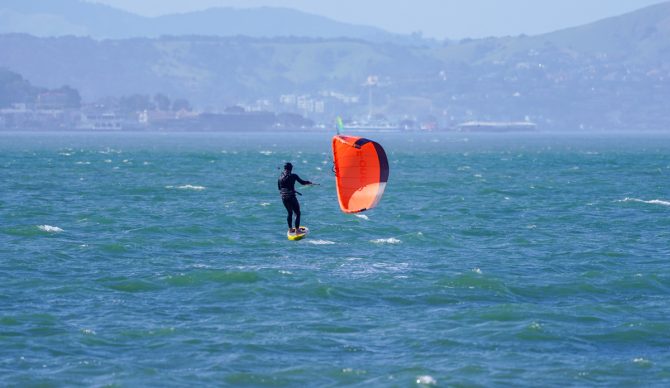
Bowen Dwelle on the 4.2m Plume K-Wing in the San Francisco Bay. Photo: Nicolas Ostermann

It’s fair to say that nobody expected a tiny little LEI kite to appear as an alternative to the first full season of parawings exploding all around us – but F-One had a surprise up their sleeve, and the Plume K-Wing is pretty magical!
I’ve flown just about every kind of kite, wing, sail, and parawing out there so far – as well as quite a few paragliders – and the K-Wing is something new and different. While there’s no doubt that everyone is super excited about parawings, those of us that have been experimenting with them these past few months have also faced the reality that most of them still have a narrower wind range than inflatable wings – and it can feel pretty exposed being out on the open water with nothing but a tiny single-skin parawing as a power source. With that in mind, I was psyched to have the perfect opportunity to check out the F-One Plume right in the middle of comparing all of the new parawings out this season for The Inertia’s Parawing Buyers Guide.
Related: Best Parawings | Best Foils | Best Wingfoil Boards | More Foiling Reviews
Bottom Line: As the first example of what just might become a new “K-Wing” category of kite-wings, the Plume blazes upwind like an inflatable wing, reaches free and easy like a strutless kite, flags out downwind in the bumps even better than a wing, and offers incredible top-end handling and upwind ability. While sacrificing the unique stowability of a parawing, the Plume offers greater security and stability – and comes in at half the weight of most inflatable wings.
See the Plume on MacKite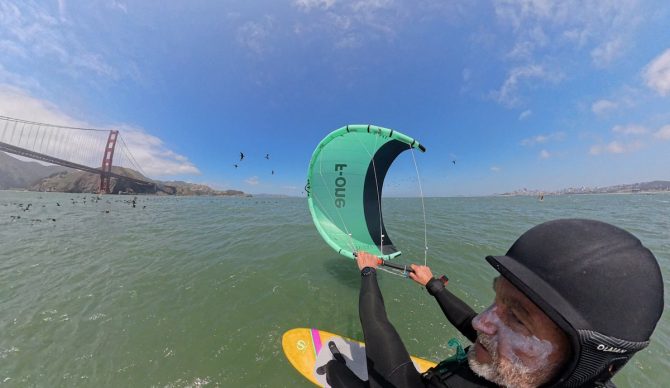
Bowen Dwelle flying the 5m F-One Plume on the San Francisco Bay. Photo: Bowen Dwelle//The Inertia
First Impressions
Named for the fact that it’s a hybrid between a kite and a wing, this “K-Wing” is a small, low-aspect leading-edge inflatable kite flown on very short ~1.5m lines. You can’t pack it away while riding like a parawing, but the Plume is much lighter and less cumbersome when flagged out behind you like an inflatable wing. The Plume provides some of the functionality as parawings, while being more accessible, stable, comfortable, and secure – especially for anyone who has ever flown an LEI kite.
For all their advantages, there’s something about the complete lack of structure in parawings that makes some riders feel kinda sketchy, and the first thing that I noticed about the Plume is that having an inflated leading edge feels like a security blanket, making this wing easier to fly and to relaunch.
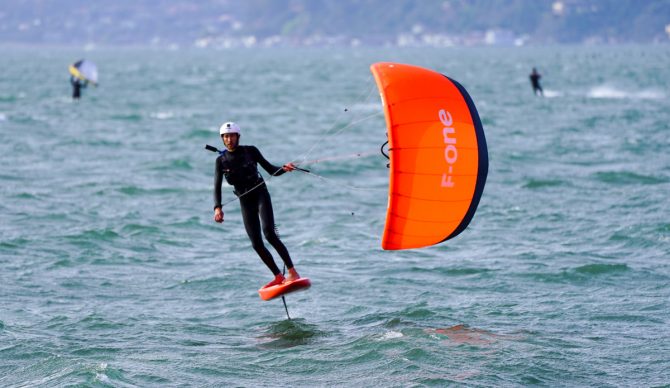
The Plume makes one-handed riding super easy and accessible. Photo: Nicolas Ostermann
My first few rides on the Plume were super easy and a ton of fun. I was impressed with how easily the K-Wing flies, how easy it is to relaunch, and perhaps most of all, the seemingly unlimited top end. While there isn’t much low-end, I wasn’t really able to get the 4.2 to feel overpowered, even in nearly 30 knots of wind. What this means is that while parawings have a narrower powerband than inflatable wings, the Plume has as much, if not more, total range than an inflatable wing due to the unreal top-end, although we recommend that you go up one full size from whatever inflatable wing size you would usually use for the wind strength given the decreased low-end.
And – I could see again! One of the things that I love about kiting is how you can see everything around you, and when I shifted to winging, I was bummed that my vision is always blocked by the wing. Like with a parawing, because the Plume sits out away from you on short lines, your field of view is much more open to the world.
Notable Features
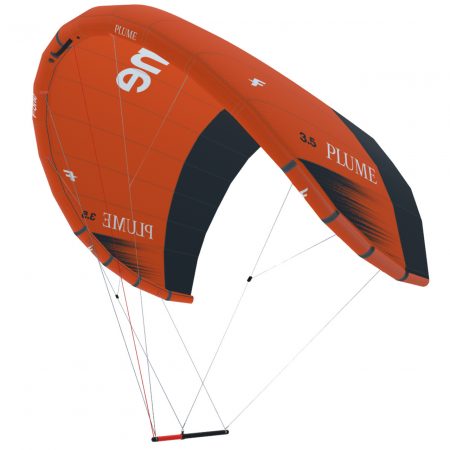
Available In: 2.5m / 3m / 3.5m / 4.2m / 5m
Sizes Tested: 4.2m / 5m
Weight (4.2m): 1kg / 2.2 lb
Price (4.2m): $1,049
Best For: Cruising, riding swells, upwind/downwind, learning to parawing
Defining Characteristics: A tiny inflatable kite (K-Wing) on very short lines that works a lot like a parawing
Pros: User-friendly, very stable, incredible top end and range, half the weight of an inflatable wing
Cons: Not much low end, can’t pack down and stow like a parawing
The Plume isn’t intended for hardcore downwind foilers who want to pack a parawing away for long runs. But for everyday riders, this small, stable, intuitive inflatable wing may be very attractive as a stepping stone – or a full-on parawing alternative. It’s less technical to fly and handles the top end of the wind range better than most parawings. And it absolutely rips upwind.
On the other hand, it’s about twice the weight of a true parawing, and you can’t collapse and pack it away – but you can grab the leading edge and flag it out for fully depowered foiling in bumps and swell. Check out this reel of Keahi De Aboitiz showing off the wave-riding capabilities of the Plume.
The bar pressure on the Plume is so light that, for the most part, you don’t need to use a harness, but in my testing, I felt like a harness would be useful when I was heavily powered. I rigged the Ozone Wing Harness Line, which worked well, but F-One has their own single-point harness line out now (pictured below on their Frigate parawing), and that would probably work even better.
See the Plume on MacKite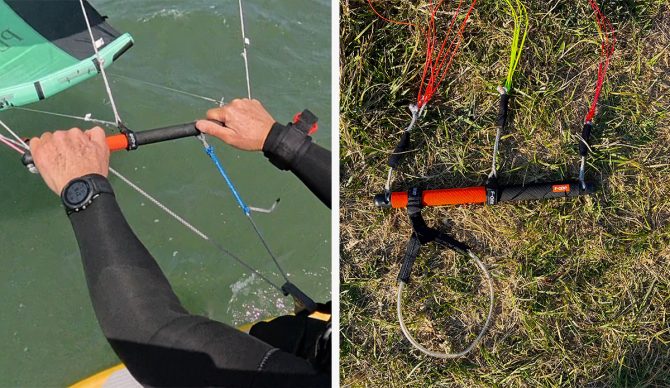
Ozone wing harness line on the 5m F-One Plume (left), and F-One single-point harness line on the Frigate pocket wing bar (right). Photo: Bowen Dwelle//The Inertia
Wind Range
Since there’s a range between the sweet spot or ideal wind range and truly “overpowered,” a wing is still usable when heavily powered. Because of the rigid leading edge, in general, inflatable wings and kites handle being heavily powered much better than parawings, and, because of the combination of the particularly thin leading edge and the kite-like sheeting, the Plume K-wing handles being heavily powered better than anything else I’ve ever flown.
Most parawings of the current generation become less stable and much less pleasant to fly when truly overpowered, and the Plume blows them out of the water with its seemingly unlimited high-end. That said, the low end of the Plume is very limited, so you should size up with the Plume relative to whatever size of inflatable wing you would normally use.

Photo: Bowen Dwelle//The Inertia
The diagram above is a rough illustration of the relative powerband of parawings, the K-Wing, and inflatable wings, given the same rider, board, and foil. To be clear, what we mean here by these ranges is:
- Under: can’t get on foil, or only with great difficulty
- Ideal: most comfortable, light bar pressure
- Heavy: less comfortable, heavier bar pressure, less than ideal wing behavior
- Over: no longer fun, can’t stay on the desired course, potentially dangerous
Here’s our estimated top end for the various sizes of the Plume:
2.5m = 40+ knots
3m = 35+ knots
3.5m = 35+ knots
4.2m = 30+ knots
5m = 25+ knots
In terms of building a quiver, given the relatively large wind range of the Plume, for most people, one or two K-Wings is the right number to start with, unlike the standard three-wing and three- or even four-kite quiver. Start with one or two sizes: a 3.5m and 4.2m if you live in a windier area, or a 4.2m and 5m if you’re bigger and/or live in a less windy area. You’re not going to need a 3m Plume unless you live in Maui, Hood River, northern Brazil, or some other place where it really nukes.
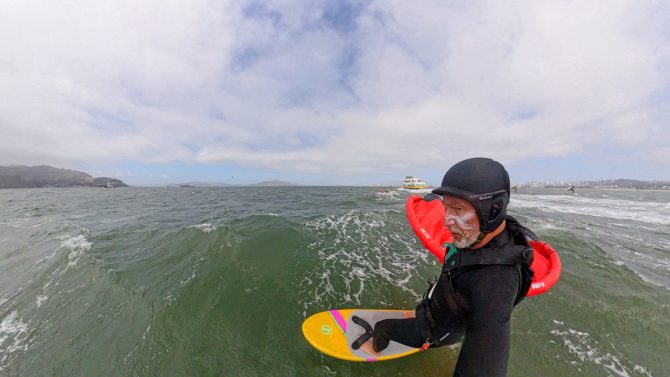
Bowen Dwelle carving a turn on a ferry wake with the 4.2m F-One Plume flagged out. Photo: Bowen Dwelle//The Inertia
Swell, Bumps, and Wakes
The Plume’s sweet spot is mini-downwinders and laps on rolling swell, bumps, and boat wakes where you can flag the wing out behind you and then easily refly it. In these conditions the K-Wing beats an inflatable wing for luffed performance because it’s lighter and less cumbersome when flagged out, and some riders will prefer the Plume over a parawing because it can feel more stable, is more resistant to tangles, has a wider wind range, and might be more intuitive, perhaps especially for people coming from kite foiling who have never windsurfed or wing-foiled.
Dousing, flagging, and relaunching the Plume is pretty straightforward – check out these videos showing how it’s done, from F-One and Gav at Hydrofoil.
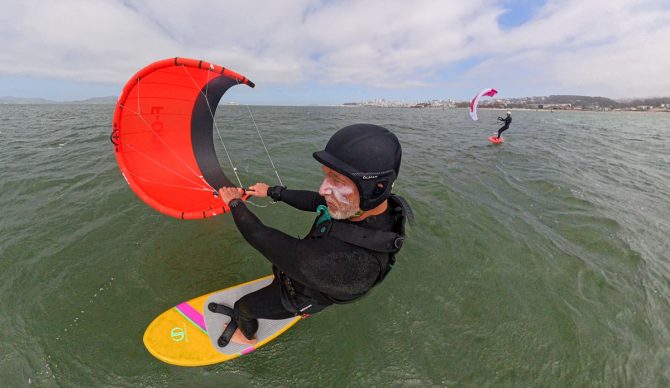
When it comes to upwind angles, the Plume Photo: Bowen Dwelle//The Inertia
Free Riding and Cruising
The Plume is so easy to use, it’s super fun for free riding. The advantage over an inflatable wing in these conditions is that the K-Wing flies farther from your body, giving you an almost unobstructed field of view, while offering a more intimate feeling of control compared to a kite. On the other hand, you can’t pump it like a wing, nor whip it around in the sky like a kite. For some riders, the Plume will be a better tool than a parawing for free riding and cruising, because of its ease of handling and wider wind range. And when it comes to upwind riding, as long as it’s really powered up, the Plume can achieve upwind angles (VMG) at least as good as most inflatable wings, and better than most parawings.
Downwind
You can certainly use the Plume for long-distance foil downwinders, but the feeling won’t be as free as with a packed-away parawing. On the other hand, it’s nice to have the security of the inflated leading edge and to be able to grab a little power now and then whenever you need it.
Waves
While I’m sure that some people will use the Plume in breaking waves, the lack of low-end power and the fact that the bridles can get wrapped around you make me feel that this isn’t the best application for the K-Wing, unless you’re a very advanced rider. However, the fact that it won’t sink, which a parawing is at risk of in breaking waves, is definitely a bonus.
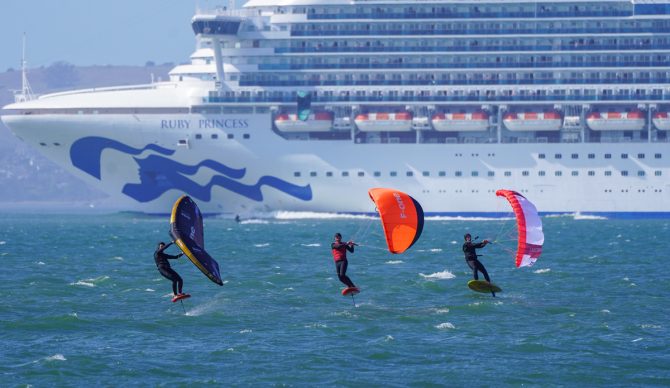
An inflatable wing, Plume K-Wing, and a parawing flying together in San Francisco Bay. Photo: Nicolas Ostermann
Comparison with Parawings and Inflatable Wings
Some of the early reviews of the Plume suggested that its application is mostly for learning to parawing, but I wouldn’t be so quick to put it in that limited category. I think the Plume is great for anyone who wants to ride swell, bumps, and wakes with much less canopy flagged out behind them than an inflatable wing, with more high-end and gentler bar pressure than a parawing. If you’re not going on big downwind missions, the Plume gives you a lot of the freedom of a parawing with the security and stability of an inflated leading edge.
F-One themselves have a great rundown comparing their Frigate parawing and the Plume here:
https://www.f-one.world/news/k-wing/plume-or-frigate/
“The PLUME is ideal for riders of all levels. Its user-friendly design makes it accessible to beginners while offering a new dimension for experienced riders. If you’re drawn to freefly sensations or looking for a versatile tool for downwinding and freeriding, the PLUME is for you.
The FRIGATE is best suited for intermediate to advanced downwind riders seeking high performance. Although still very comfortable, it is a bit more technical to handle and is therefore perfect for those who prioritize freedom of movement during the downwind run. We would advise riders to take a pocket wing only if they are already able to freefly for a few hundred meters without powering their wing.”
See our Parawing Buyer’s Guide below for a more detailed comparison between the Plume, parawings, and inflatable wings across a number of different criteria.
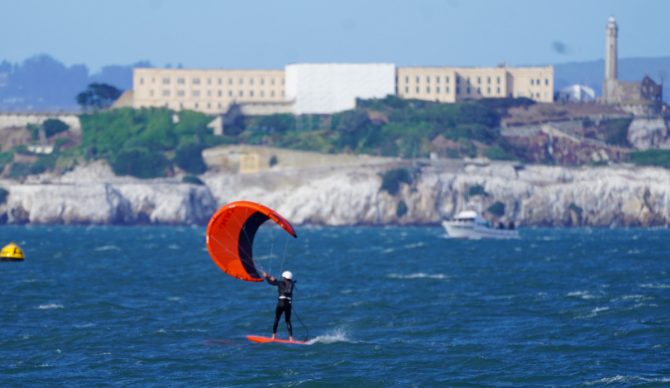
Photo: Nicolas Ostermann
Drawbacks
Even more than most parawings, the Plume lacks low-end grunt. The Plume handles the high end better, and so if you size up you gain back some of that missing low end, but even so, you’re not going to feel the same sort of power from the wing getting going on a K-Wing as you would with an inflatable wing or a kite, which means that you’ll likely want a bigger, more efficient board and/or foil.
Obviously, you can’t pack and stow the Plume like a parawing. Before you dismiss it on that basis, consider whether your own riding is going to involve downwinders long enough to require the packability of a parawing. One other minor quibble is that as the Plume gets more and more powered up, the bar is forced into a more diagonal position.
Finally, and this isn’t really a drawback, but since there isn’t any competition yet for the Plume, it’s the only K-Wing on the market, and so there’s nothing to compare it to directly. It remains to be seen whether other manufacturers will follow suit with offerings in this new category, or if the Plume will remain a one-off.
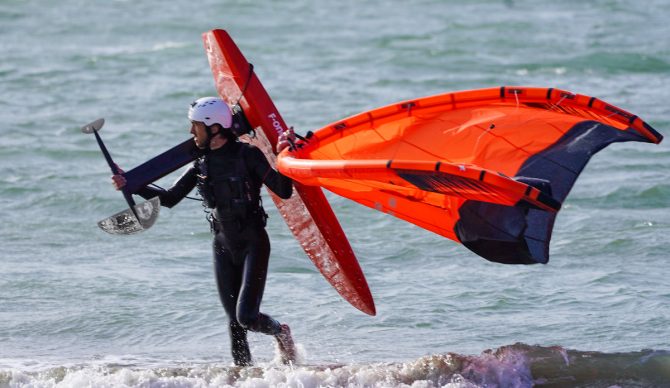
Will Sileo emerges from the water after a successful testing session. Photo: Nicolas Ostermann
Final Thoughts
My testing showed that the Plume does exactly what it says on the box. It’s an innovative tool that will work well for a lot of riders for its unique combination of kite, wing, and parawing-style riding. Especially if you’re getting the itch to stay up longer on swells, bumps, and wakes using just the power of your foil, and you like the idea of the more rigid Plume as opposed to the barely-there parawing, give it a shot – I bet you’ll be pleasantly surprised!
See the Plume on MacKiteRelated: Best Parawings | Best Foils | Best Wingfoil Boards | More Foiling Reviews
Editor’s Note: For more gear reviews and features on The Inertia, click here.

