
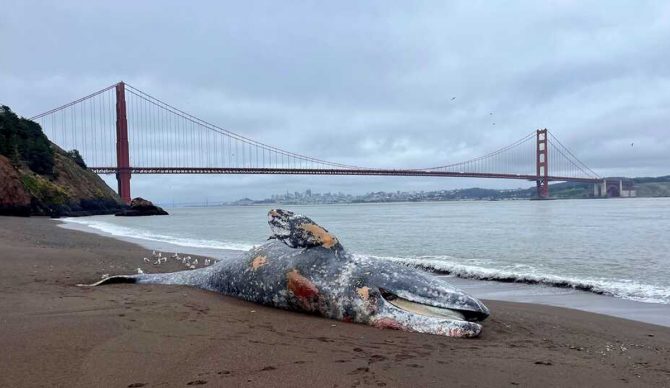
Photo: Marjorie Cox // The Marine Mammal Center

Whales are dying in the San Francisco Bay area at an unprecedented rate. Scientists recently confirmed an unusual amount of whale deaths for 2025, with the cause remaining unclear.
The California Academy of Sciences and partners at The Marine Mammal Center published a press release Monday, confirming that 24 whales have died in the wider San Francisco Bay Area region in 2025. The deaths comprised of 21 gray whales, two unidentified baleen whales, and one minke whale. Eight of the gray whale deaths were caused by suspected or probable vessel strikes.
This amount of whale deaths is unusually high – only six died in 2024. The 2025 number even tops the numbers at the height of the “Unusual Mortality Event” in 2019 and 2021, in which 14 and 15 whales died, respectively.
All this is happening in the wake of drastically decreased whale populations. The aforementioned Unusual Mortality Event saw a population loss of roughly 45 percent of North Pacific gray whales.
“It shows signs of concern for this population as it moves forward into the future,” Kathi George, director of cetacean conservation biology at the Marine Mammal Center in Sausalito, told ABC News. “We know that climate change is changing ocean conditions and changing prey availability for these whales in the Arctic.”
As to why this is happening: part of it is just because there have been more whales in the area in general. The Center’s Cetacean Conservation Biology Team has confirmed over 30 individual gray whale sightings, compared to only six in 2024.
That uptick is backed up by the personal experience of The Inertia’s Will Sileo, who has seen the creatures much more often on recent foiling sessions. “Whereas it is normally quite rare to see these majestic creatures actually venture inside the bay, this year there have been more days than I can count of seeing whales in the bay while out foiling, mostly from the Golden Gate bridge, down to around Alcatraz,” he wrote. “Some days, I would even count four or five individual whales within the bay, easily spotted by their spouts as they come up to breathe.”
However, there is still no definitive cause for the higher whale numbers. “The reason or potential reasons behind the massive spike in sightings this year are still being investigated by researchers,” wrote the Academy. “It is expected that gray whales will be in the bay for another one to two weeks before continuing their annual northern migration to arctic feeding grounds.”

