
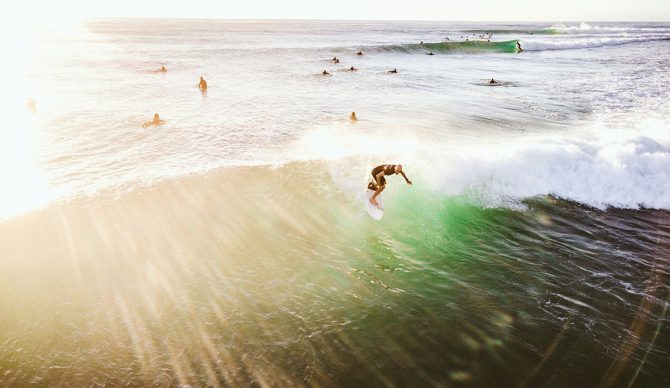
Even crowded Burleigh Heads can be beautiful. Photo: Josh Withers

As I drive my Jeep down the 101, podcaster Michael Frampton’s crisp New Zealand accent rattles the speakers. “Surfing is more an art form than a sport,” he remarks.
I park and pull on my wetsuit, ruminating on the question: is surfing a sport or a form of art? Both? Neither? The evergreen debate is interminably linked to the last few years of my surfing journey and my own quest to create. But is there an answer?
When I speak to Frampton it becomes clear that the intersection between art and surfing is something he considers often. “It’s a curly topic,” he quips, and one that he takes up with many guests, from author Aaron James to shaper Donald Brink. Brink, who also paints and makes furniture, takes the abstract approach that “the whole thing is art…because you can’t find the words to explain something to somebody else that meant so much to you.” He focuses on the “indescribable” sensations riding waves provides — feelings that perhaps go beyond those found in the field or stadium.
For James, who teaches philosophy at UC Irvine, surfing is also more about appreciation and attunement than sport. In an interview with SURFER in 2024, he describes surfing as “…a harmonious relationship with what lies beyond the self, and feeling grateful or fortunate to be alive…” Surfers often talk about being “in the zone,” and for James that means “skillfully [doing] the right thing at each right time as the wave’s sections come to you…” One could posit that top baseball and football players do the same; but for James, the distinction is what riding waves provides us: “a way of being right with the world…at least for the moment.”
But does every surfer draw graceful, “harmonious” lines? My conversation with Frampton keys in on a few of surfing’s elite: Occy, Slater, Mikey February, Devon Howard and Machado — who Frampton says, “dances on the wave.” Brink’s assertion that “all surfing is art” may well ring true when considering the surfing of Tom Curren or Stephanie Gilmore, but has anyone seen a band of beginners thrashing through the whitewater and been moved?
Skill level, therefore, must play a role in both practicing stylish surfing and creating striking art. As I’ve devoted myself to surfing more fully over the last few years, I’ve gone from the weekend warrior simply trying to score a long ride to the daily driver who — on good days — finds a sense of flow. In turn, surfing sometimes provides transformative moments. But does that mean I’m creating art?
“I think it depends on your intention,” Frampton says, giving the example of a novice painter who is learning new techniques and emulating predecessors. They may not yet be creating art, but their goal is to express themselves. He continues: “As a surfer you might have this vision of surfing a six-foot wave as Kelly Slater does it, so beautifully…so you have this conception or want to be an artist as a surfer,” even if you’re not able to yet. On the other hand, the long-time surf coach acknowledges that some surfers are more competitive and goal-oriented than others. “The Aussie grom who wants to win a world title” and who focuses on “ripping waves, joining surfing clubs, and three to the beach,” may be more in pursuit of sporting glory.
Talent, however, may differentiate surfers emulating style from those who possess an inherent sense of it. We’ve all seen the surfer — or musician, painter, or basketball player — who picks up the board, guitar, brush or ball and effortlessly creates something unique. Are those with talent more inclined to become artistic based on natural capabilities? Frampton argues that top surfers like John John Florence, for example, “are creating art” even when competing in top contests. Interestingly enough, when veteran surfer Tony Roberts visits Surf Mastery, the veteran surfer insists that while surfing may be an “artistic sport” it is “never an art;” but instead all about peak performance and endless practice.
In these conversations, comparisons between surfing and music surface often. To order from Brink Surf, surfers are even encouraged to suggest an album to inspire the “aesthetic” of the board. “Surfing is closer to music than tennis,” Frampton says, bringing up the image of a beginner guitarist striking away at tentative chords. “Are they not” he asks, a sunny glint in his eyes, “practicing the art of guitar?” I’m not sure if the beginner creates art, but legendary musicians connect with audiences because, regardless of level of sophistication, their emotions and soul shows through their performances. Top surfers, one could argue, do the same.
Another thing surfing has in common with other creative pursuits is the emphasis on choice. As a writer, every stroke of the keyboard warrants a decision, just as a wave offers breakneck choices to the rider while unfurling. Brink describes working on projects with “parameters” on what he can or cannot create as helpful to his artistic process. Surprisingly, the shaper also sees the surf contest as a helpful parameter to create better surfing, in the same way that confining a painter to just a few colors, or a musician to a cheap plastic guitar a la early Jack White, (a former furniture maker himself), can create original, powerful performances.
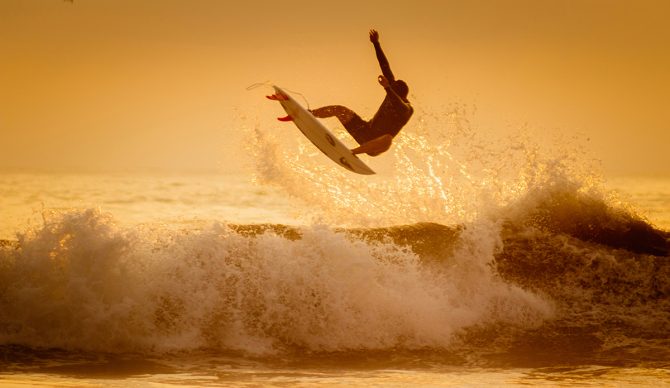
For some, art is in the rail. For others, it’s in the air. Photo: Fernando Munoz
We should also consider “the deeper philosophical pursuit of surfing,” Frampton suggests, how enlightening it is to immerse ourselves in nature and disconnect from all else. Some surfers, of course, may just be upping their wave count, but for most of us, surfing is, on some level, spiritual and powerful enough to stream into other parts of our lives.
Perhaps that’s why for talented surfers, style is innate, a tapestry of their surfing and life experience that unfolds as they fly across the face. This sense of reciprocal connection to the ocean shows through our surfing in the same way that writing or painting reveals an artist’s deep-set emotions and personal journeys. This is also true for other athletes, such as elite soccer players who play “the beautiful game” with style and inspire fans as they dance across the field.
When asked if he thinks surfing becomes more of an art as the rider becomes more experienced, Brink says, “If surfing is an art, then your creative body of work is really your surfing life, your surfing lifestyle…and how you responsibly cultivate that relationship with surfing.” Therefore, as we evolve as surfers, and our lives evolve, our ability to express ourselves artistically grows. This idea resonates, because for most of us, surfing is far more than a sport or hobby. Surfing helps us see the world around us in different ways. As my fiancé said to me the other day: (perhaps shaking her head), “your life revolves around surfing.”
“It’s all art, or none of it is,” Brink said. “There’s art in everything…and therefore, surfing is art.” Frampton doesn’t go quite as far, but muses that “for most of us, surfing is an art.”
Of course, part of the debate hinges on the type of surfing, and art, that each of us finds revelatory. For me, inspiring surfing stems from both technique and imagination, and it can be form of artistic expression. But not all surfers are able to — or lucky enough — to reach the level where their surfing can universally be considered art.
Maybe someday, right?

