
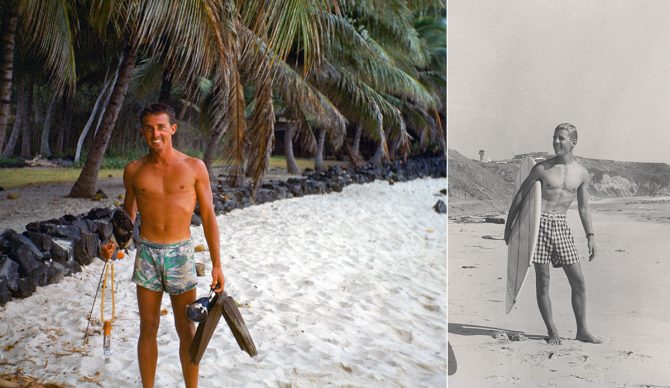
Dick Metz and Mike Hynson forged a relationship that shaped modern day surfing. Photos: Ron Stoner//SHACC

Mike Hynson called Dick Metz right before the world theater premiere of Birth of The Endless Summer at Encinitas’ historic La Paloma cinema back in the summer of 2023. He pleaded with Dick not to steal his credit for being the first to surf the “perfect wave” of Cape St. Francis, South Africa. Bruce Brown had always convinced viewers that he, Robert August, and Mike Hynson had made this discovery together, as documented in Brown’s The Endless Summer, coming upon the reeling right-hand surf of Cape St. Francis after summiting a massive dune as if it had appeared magically.
But Hynson, who told me in his interview for my Emmy nominated film Birth of The Endless Summer, released worldwide this summer, that he and Robert were surfing at a different spot when he noticed a wave breaking up the beach in the distance. The scene on the dune had been a fabrication. When Mike paddled over, he found the most perfect right-hand reef break he’d ever seen or imagined. Once he experienced the exhilaration of what would soon be known as “The Perfect Wave,” he naturally thought he was the first in his group and the world to ride it.
But as it turns out, Hynson was about four years late. That night of Birth Of The Endless Summer‘s premiere in Encinitas, Dick’s untold story was about to meet the world, revealing that Metz had been to Cape St. Francis twice before Bruce Brown, Hynson, and August ever got there. When describing what life was like as the world’s first surf pioneer in Birth of The Endless Summer Dick Metz said, “There was no SURFER magazine. There were no surf films — none of it.”
Of course, there was Bud Browne, a man who many would consider the first surf filmmaker. He was honing his craft on Oahu in the 1950s. Virtually no one else, however, was holding a camera to document what came before Bruce Brown’s work in 16mm film, and that’s why we are left with Dick Metz to fill in these early blanks.
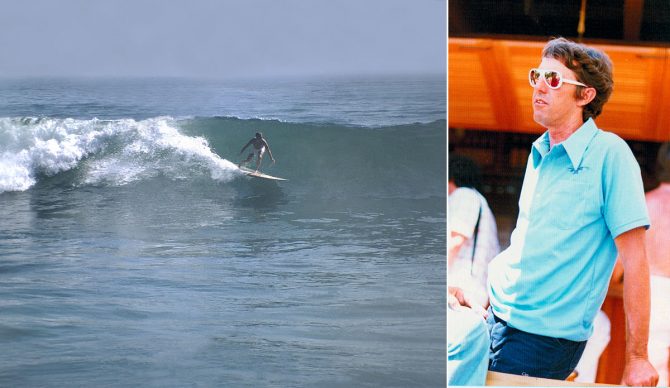
Dick Metz likely had more surf travel stories than just about anyone else. Photos: Ron Stoner//SHACC
What’s perhaps more surprising about this new film, made in association with Bruce Brown Films and documenting Dick Metz’s vagabond travels from 1958 to 1961, is that it doesn’t steal any thunder from Hynson, August, and Brown’s iconic surf scene in The Endless Summer. That was likely why Hynson was smiling ear-to-ear as the credits rolled on Birth of The Endless Summer that night of the premiere in Encinitas.
When viewed through the lens of Dick’s story, the surf that Mike Hynson and Robert August rode on that historic day in South Africa is magnified. It was a turning point for the birth of the modern sport of surfing as we know it, and Dick Metz plays the central character in that story, although the legendary surf break at Cape St. Francis will forever be known as, “Bruce’s Beauties,” and, “The Home of the Perfect Wave.”
Dick’s decades-long relationship with Mike Hynson goes back to the mid-1960s, around the time of the release of The Endless Summer, the iconic Bruce Brown film that made his slicked-back blonde hair known from Cape Town to Kansas. “He was a top surfer for sure,” said Metz, but of all the cool guys, “Mike was the coolest.”
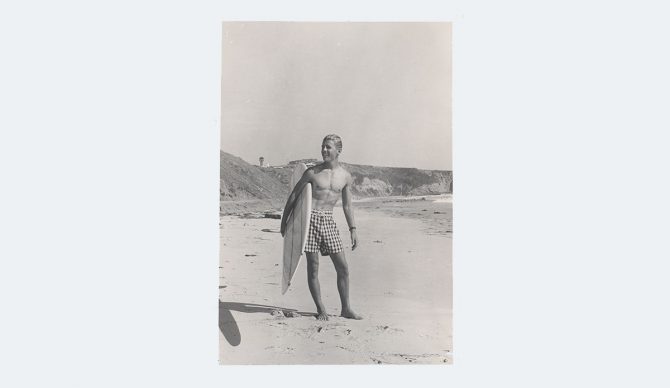
An iconic man with an iconic hairstyle, Mike Hynson. Photo: Ron Stoner//SHACC
Dick Metz opened Hawaii’s first surf shop in 1961 — the Hobie shop in Honolulu — and was in tight with Waikiki’s Beach Boys like Rabbit Kekai, Sam “Steamboat” Mokuahi, and James “Jammer” Keanu, whose nickname was later shortened to “Jama.” Dick ran the Hobie team there, too. Dick supplied Eddie Aikau his famous red Hobie gun, which became ubiquitous in big wave shots of Eddie during the early days of surfing on the North Shore.
Metz explained that Hynson would fly into Hawaii and ask Dick if he could crash on the floor of his house. Apparently, in those days, Hynson brought a few boards to Hawaii, and you could fly with your 9’6″ Hobie signature model in the aisle. Dick would pick Hynson up at the Honolulu airport and stop at the Hobie store downtown so Hynson could store his extra boards in the shop.
In my recent interview with Dick Metz, he called Hynson “high strung,” but Dick didn’t let Hynson stress him because they were compatible. “He cleaned up after himself,” explained Dick. Also, Metz was older, had spent years in Hawaii, and was already established in the inner circles of surfing royalty. Metz was close with the Aikau Family, Duke Kahanamoku, and other Hawaiians who held the keys to things Hynson wanted to be a part of and admired.
“Mike always, all the way to the very end, wanted to be a part of the surfing community,” said Metz. Hynson was a frequent visitor to events put on by the museum Dick Metz founded, Surfing Heritage and Culture Center, or SHACC. During Hynson’s early 1960s visits in Hawaii with Metz, Hynson was lucky enough to go to the local luaus — some of the most talked about were held at the Aikau’s compound at the Punchbowl crater in Honolulu. Hynson, despite being a young haole who was hungry for waves, would get the invite because of Dick, and this would have left a big impression on Mike.
Over Hynson’s time spent with Dick in Hawaii, he learned about Dick’s amazing travel stories. He already knew about his status among the Hawaiian surfers and early California-Hawaiian pioneers like Flippy and Walter Hoffman, Buzzy Trent, Ricky Grigg, Peter Cole, and others. Like Dick, they were the first to surf the big waves of Makaha on Oahu’s west coast.
Mike also had an interest in surfboard shaping. Dick mentioned that Hynson would have spent one spring helping shape the Hobie inventory before the rush of summer orders. There was no question in Hynson’s mind that Dick was someone he could look up to. While Dick was running a Hobie shop, Hynson was more likely to be cleaning it up. “Dick was the man — he had some crazy stories,” Hynson said with a “you-won’t-believe-it” wave of the hand in Birth of The Endless Summer.
Hynson was referring to Dick’s gifts as a storyteller, and most specifically to his legendary around-the-world travels from 1958 to 1961, which took him through the South Pacific and across India, and eventually landed him in Kenya by way of Mombasa. Metz had conned his way onto ships, jumped trains, and hitchhiked his way to Africa, next vagabonding his way to the beaches of Cape Town, South Africa, where he discovered a nascent surf culture and met John Whitmore.
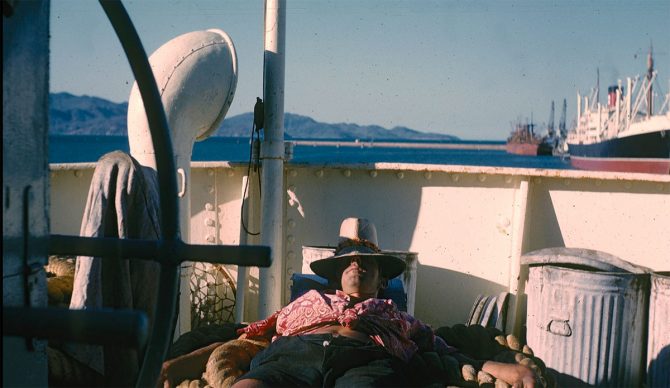
Metz was a passionate explorer. Photo: Courtesy of Bruce Brown Films
It would be Whitmore who gave Metz the tip to look for surf in Cape St. Francis Bay on the Eastern Cape of South Africa, on his way from Cape Town to Durban. At Cape St. Francis, Dick met the owner of the Cape St. Francis Fishing Camp and general store, Leighton Hulett. Hulett drove Dick around Cape St. Francis in his four-wheel drive wagon. That’s when he first got a glimpse of surf rolling perfectly around the point into a small bay, breaking into a beautiful, pristine, San Onofre-style wave called Hulett’s Reef. Hulett’s was not far down the beach from the very spot Hynson said he was the first to notice on that epic day at Cape St. Francis — now known as “Bruce’s Beauties,” and originally called “First Bush” by the locals who were first to surf there.
Those waves Metz witnessed in South Africa would be seared into his memory — a vision he would bring home to his friend and filmmaker Bruce Brown. The rest would become history when Brown returned to meet up with Whitmore and eventually filmed “The Perfect Wave” at Cape St. Francis. This surf scene, all of it shot before Hynson and Robert August staged their entry by descending the massive dune, is the most celebrated visual in surf film history. Fabricated or not, we will always believe it. It will forever be part of our collective subconscious. The six-hour surf session that Robert August and Mike Hynson shared was one that Hynson described in an interview for Birth of The Endless Summer. He was breathless and giddy, recounting that day as if he had just stepped out of the water in 1963.
Behind the scenes of Bruce Brown’s “discovery” of perfect surf in South Africa was a local surf culture and national sport being built by John Whitmore. That’s why Whitmore would be called “The Oom” (or Uncle) of South African surfing by every surfer around him and every one who would follow. Dick Metz will tell you the story of John Whitmore shaping what Metz called an “ugly surfboard” based on images he saw of surfers on Waikiki Beach from a Pan Am calendar. They were wrapped in canvas, shellacked on styrofoam, and had no fin. It was something that stuck in Hynson’s mind too. There was no other way for a surfboard to be made in the furthest reaches of Africa until Dick arrived with his knowledge of shaping balsa surfboards in Laguna Beach, California with Hobie Alter, and his years surfing in Hawaii.
“Here you’ve got this guy in Africa making surfboards,” said Hynson with a laugh. This was why it was so mind-blowing to Whitmore, and a defining moment for surf history, when Dick had arrived in Cape Town to share with him all he knew about surfing. That one meeting would be the beginning of surfing’s growth from a Hawaii and California thing to a global sport and culture. Later when he returned home in 1961, Dick would send down a container of Clark foam blanks, resin, and Hobie templates to Whitmore. Severson would ship him SURFER magazines, and Bruce Brown would send his films so Whitmore could present them at South African theaters, like Cape Town’s The Labia, where The Endless Summer would later have its roaring, sold-out, South African premiere.
Dick will remember Hynson most for his Red Fin model surfboard back in the ’60s. This was a signature model, and the first of its kind to feature a fin with its back cut out. The board also had three stringers and 10-ounce volan cloth for extra strength. It was a craft built for any wave and any type of beating, and just like the man himself, it looked super stylish just sitting there.
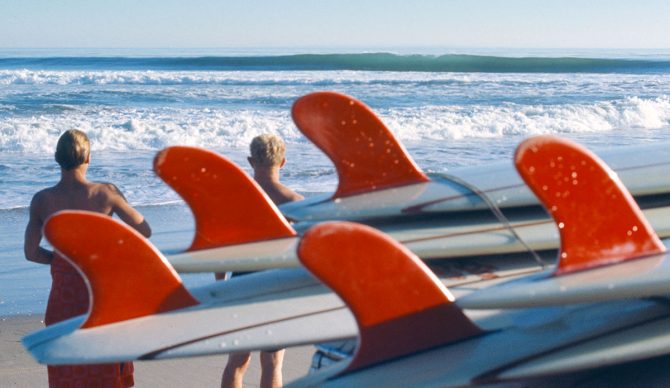
The Red Fin model, “a craft built for any wave and any type of beating.” Photo: Ron Stoner//SHACC
Dick Metz also said of Hynson that he “wanted to be recognized.” Hynson’s contributions were as a surfer in films like The Endless Summer, and later for surfboard innovations like the tucked under rail, or “downrail” – a breakthrough that Gerry Lopez said was critical for the short board revolution and his tube-riding progression. All of this would be plenty for Hynson to leave an indelible mark. Hey, when Dick Metz says you’re “the coolest”—since he was there first — who’s going to argue with that?
Editor’s Note: Birth of the Endless Summer is now available worldwide on Amazon, Apple TV, Google Play, YouTube Movies, Fandango, and Vimeo on Demand.

