
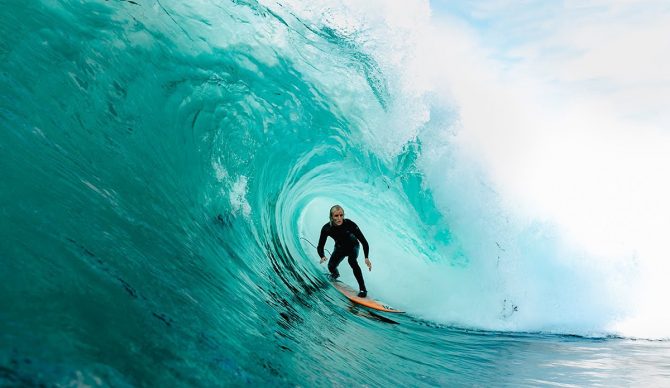
Comfort in gigantic tubes – it’s definitely an acquired skill. Photo: Via RussRussell Bierke//Youtube

Russell Bierke is a slab connoisseur, charging the type of heavy water you’d file somewhere between the “nightmare” and “only in dreams” chamber of the mind. The Australian burst onto the scene in 2016 when he won the fabled Red Bull Cape Fear contest held at Shipstern Bluff, Tasmania. From there, Russell qualified for the Big Wave Tour, as the youngest surfer on it.
The rest is history. He’s been doing the whole big wave thing ever since, riding for O’Neill and making a living in the tube. I sat down with Russell to learn more about his surfing life and his approach to big wave surfing.
How did you get into big wave surfing?
My dad has always loved surfing big waves and shaping boards for them. As a kid, I would always want to join him, and as I got older and more capable in the water I started tagging along.
My first time in big surf was at Bells when I was 12 years old, it was about 10 feet and stormy. I remember being terrified and regretting paddling out, until I wore a big wash-through on the head and it was nowhere near as bad as I was expecting. It gave me the confidence to take off on a wave. I stuck the drop, got caught behind the section and washed to the beach. That session gave me a taste for big waves and I was hooked.
How does board selection differ for big waves compared to performance surfing in “smaller” stuff?
The main difference between small and big waves is speed. If you look at grovel boards for tiny waves, they’re all about generating speed, as the wave quality and size goes up, boards become more refined to handle the extra power.
With big waves you need to generate enough speed to catch the wave, but after that you’re trying to control and harness the speed the wave gives you. I’m lucky to have my dad, Kirk, shape all my boards. Over the years we’ve really worked on that balance between control and performance, it’s something that will always be evolving and improving which I find pretty exciting.
I’m going to name three waves – Shipstern, Maverick’s, and Nazaré – rank them from favorite to least and what makes each one its own beast?
For me the best part about surfing is paddling into barrels, and Shipsterns is one of my favorite places to do that. It’s such a unique wave with the step into a giant barrel. There’s not many waves in the world that give you a paddle-in entry into a pit that big and wide.
I’ve only surfed Maverick’s a few times. It’s a super heavy wave with a slab takeoff and a deep, long hold down. On the right day, there’s an opportunity to paddle a huge barrel out there, as Peter Mel did. I’d love to go back and give it a go on a big and clean day.
Nazaré is super different to most other big waves. I’ve had some epic paddle sessions out there, but to me towing it huge doesn’t really justify the risk. It’s gigantic, but it’s also generally super bumpy and unpredictable, you can do everything right and still kick out to a 60-foot wave on the head. If you scaled Jaws down into a four-foot wave it would still be epic to surf, but with Nazaré the wave quality isn’t the same, it’s just huge. I had one of my worst beatings ever towing out there, but if I made the wave, the personal reward wouldn’t come close to rides I’ve had at other locations
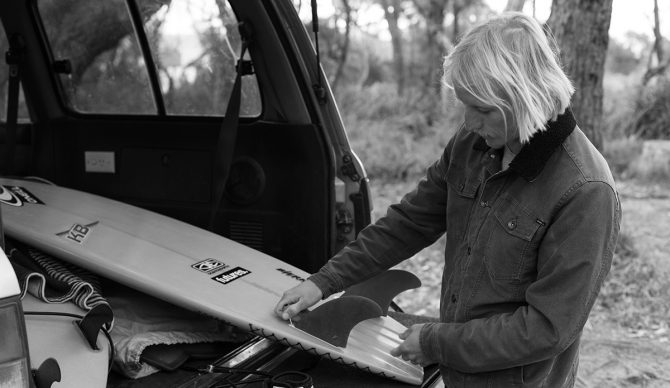
Russell Bierke tuning equipment for a less-than-terrifying day. Photo: Andrew Kaineder// Red Bull Content Pool
Is big wave surfing mostly balls and commitment?
It definitely requires balls and commitment, but if you only rely on that I’m not sure how long you’ll last. Along with having a solid surfing foundation, I think the most important thing would be to ease into bigger waves and slowly gain experience rather than throw yourself into the deep end straight away.
What skills separate big wave surfers from the rest?
It definitely requires a unique skill set, obviously there’s having the skill set to ride the waves and survive a beating, but a lot of it comes down to patience and experience. So much of big wave surfing is about positioning and choosing the right wave. I guess that’s why some of the all time greats like Dorian, Twiggy and Greg Long have ridden their best waves well past the age of what’s considered “peak performance” in small wave surfing.
How do you cope with injuries?
It’s funny, most of my injuries haven’t happened on crazy days, I guess maybe because I’m more relaxed and not expecting it.
Keeping my body in check, and making sure I rehab old injuries are definitely key to staying in the water. I wear impact suits a lot of the time. They’re great for a little bit of float when you need it and have saved me from the reef a couple of times.
Do you use any breathing techniques?
I freedive spearfish quite a lot and it’s really helped me become comfortable in hold downs. The most important thing is to stay as relaxed as possible. Panic burns a lot of oxygen. I often use a freedive recovery technique called “hook breaths” after a big hold down, they help replenish oxygen quickly which is great when there’s another wave looming.
Here’s a high and a low: best wave you’ve ever ridden and worst pounding ever?
I think my best ride was at Shipsterns in 2018, it came in looking so big and doubled up but at the same time – it looked perfect. I made the air drop and the barrel just kept getting bigger and faster. It felt like I was about to fall off the whole wave, I couldn’t believe it when I made it to the channel.
My worst pounding was probably at Jaws, in the 2019 Peah’i challenge. Earlier in the morning, I had ridden one of the waves of my life. In the semifinals, a similar but bigger-looking wave came in and I thought I was on for a repeat. When I got to the bottom of the wave I looked up and it wasn’t throwing super wide. I tried to pull up under the lip and it landed straight on me. it was one of the most violent thrashings I’ve ever had. I got sent to the bottom straight away and cut my foot pretty badly. I inflated my vest and it was still so violent for so long before the wave let me surface.

