
Photo: NOAA

The National Oceanic and Atmospheric Administration (NOAA) declared a La Niña watch for the upcoming 2025-2026 winter earlier this month. Forecasters also shared more details of how the (likely) upcoming La Niña may impact different parts of the United States, which shed some light on who may expect the snowiest winter (and who might get skunked).
“ENSO-neutral continued in August 2025, with near-to-below average sea surface temperatures (SSTs) observed across the central and eastern equatorial Pacific Ocean,” the NOAA outlook declared in early September. “In summary, (though) a transition from ENSO-neutral to La Niña is likely in the next couple of months, with a 71 percent chance of La Niña during October – December 2025. Thereafter, La Niña is favored but chances decrease to 54 percent in December 2025 – February 2026.″
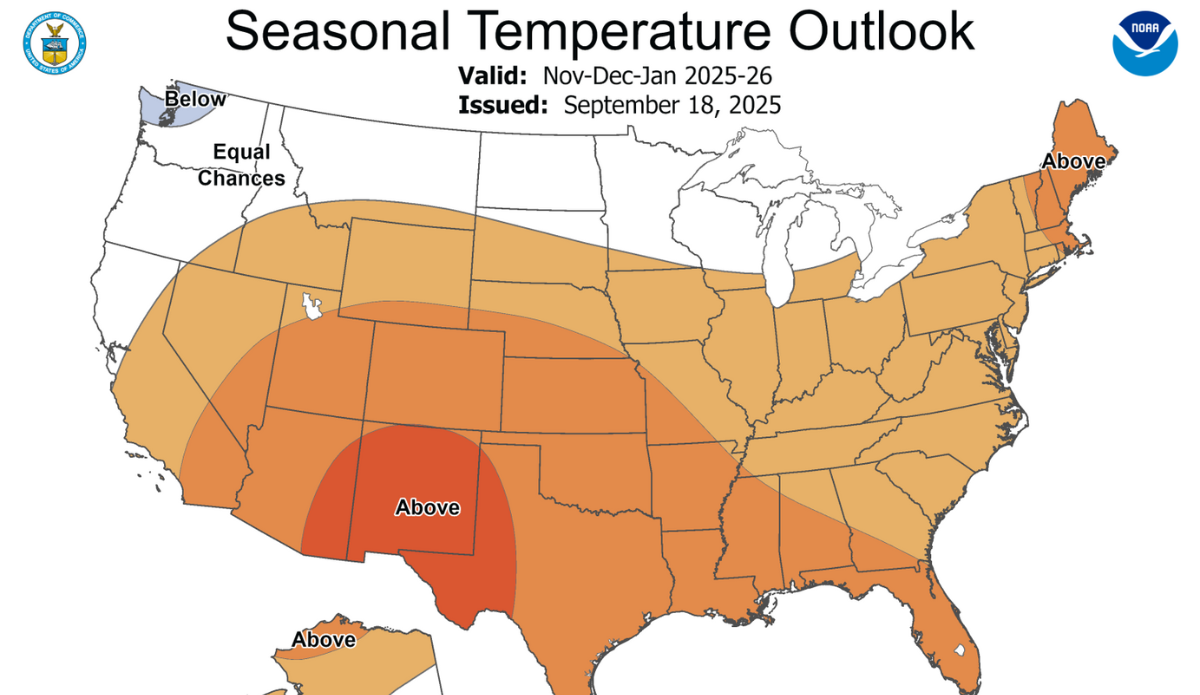
More recently, the Climate Prediction Center’s seasonal forecast discussion forecasts equal chances of above, near, and below-normal temperatures forecast from the Pacific Northwest eastward across the northern tier to the Upper Great Lakes region. They expect winter conditions to be drier and warmer in regions south of that, while the Northeast may see some heavy storms but there isn’t much confidence that snowfall will be consistent.
CPC forecasters rely on climate data from 1991-2020 to locate “normal” or expected climate conditions.
“The probability anomalies for temperature and precipitation based on these new normals better represent
shorter term climatic anomalies than the forecasts based on older normals,” said NOAA forecasters, of the three-decade timeframe from which climate data is used to inform future winter forecasts.

