

“Anything happens, I’m dead,” says Ryland Bell in the film Dig before setting off to wrangle a 4,000-foot spine wall above a heavily-crevassed Alaskan glacier.
The line looms over the base-camp where Ryland, a film crew and a few others have been hunkered down for a month, weathering a series of storms that threatened to bury everyone under nearly 30 feet of snow. But with a break in the weather, Ryland takes another stab at climbing and riding “the line of his life.”
Now, anyone familiar with Ryland’s snowboarding career should understand the gravity of such a claim. He played a huge part in Jeremy Jones’ Deeper/Further/Higher Trilogy, earning his screen time with lines that left the viewer with a dry mouth and clammy hands. The guy’s an absolute weapon in the steeps, with an ever-growing bank of experience to draw from whenever shit gets real.
“Ryland is a hardworking, deeply connected individual who lives by his values and isn’t concerned what other people are doing,” says Dendrite Studios’ Nicolas Teichrob, who filmed, directed and edited the film. “He’s someone who just operates truly to who he is. As a result, he does great things.”
Born and raised in Alaska, Ryland finances his winter adventures as a commercial fisherman and then applies that same work ethic to kicking steps up seemingly endless big mountain walls. But it’s not just the work ethic that fuels his ascents. The guy just really loves riding spines.
“Spines are the apex, like the pinnacle of the entire obsession,” says Bell in the film.
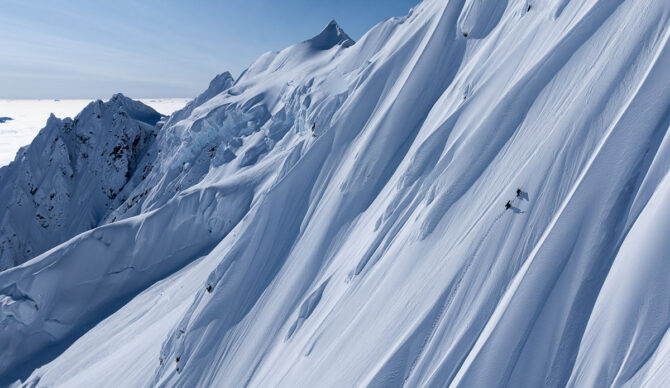
How’s that for an approach? Photo: Nicolas Teichrob
So what was it about this particular wall that caught Ryland’s eye?
“The length of the line is a big thing. It’s by far the longest spine line he has ridden or come across,” says Teichrob. “And because he’s a regular footer, he’s looking for rights and that’s pretty key. That’s a regular-footer line.”
“It’s one of the closest things there is to surfing because it’s so steep; when you get into that 60-degree range, the pull of gravity is very similar,” says Ryland in his essay about the experience, “It’s much more in the surfing mindset, of reacting to the wave as you ride down it, and very much a flow state, where I’m taking it as it comes and leaning into it, really enjoying it.”
As is the case with any action sports film, the focus is on the rider. But Ryland wasn’t the only one posted up on the glacier. His film and safety crew was there every step of the way and that working relationship really shines through in Dig. The visuals in the film are on point and it’s shot in a way that does justice to the whole experience.
Teichrob’s no stranger to the symbiotic relationship between a filmer and their subject. His 2017 film Numinous is a lesser-known masterpiece that featured Pemberton-based ski phenom, Kye Petersen. Numinous earned a host of awards and it even garnered praise from Travis Rice.
So what did it take to create such high quality content in the middle of fucking Nowhere, Alaska for Dig?
“We had solar and we had a generator,” says Teichrob. “The Genny was mostly for the RED or pretty needed for the RED, so we had that backup. And we’d run solar as much as we could, and then fire the Genny every now and then to top up the solar batteries.”
“And then sleeping with your batteries in your sleeping bag and computer and all that shit against your body, that sucks. You have all these fucking square bricks inside your sleeping bag you’re spooning with. It’s kind of ridiculous.”
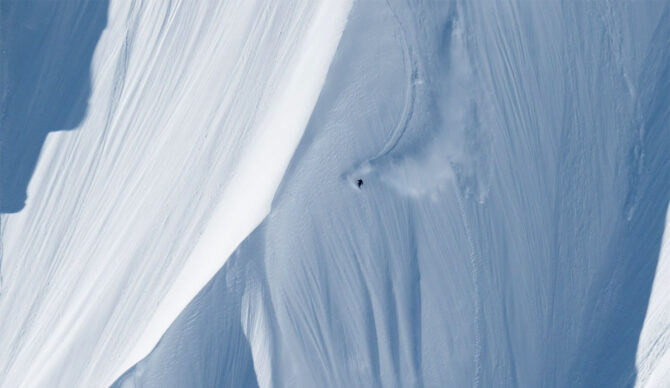
With lines like these, who needs lifts? Photo: Nicolas Teichrob
The whole process begs one question: Why would you risk getting beached on a glacier just to film a guy ride down a line?
“I’d say it’s at least threefold,” says Teichrob. “One is I get along really well with Ryland, and I’ve always wanted to share his character, who he is and his talents. So doing a film that represents him properly, I wanted to be a part of that.
“And the other reason is because I love making art and being a part of adventures and to make film and photography that share stories of adventures, being on the adventure and then capturing it. I’m just really about the whole process. I love all of it, and it’s challenging and you’re in the present.
“And then the third reason is it’s a job. It was a job ,straight up. I need to make money. We all have bills to pay. So that’s another part of it. It’s a good job to make film.”
And what about Ryland?
“In our version, he says ‘why am I doing this stuff? I dunno, man, I really don’t know. Isn’t that the question for all of humanity?’ And I think that statement shows a lot about Ryland. He’s doing this because it’s what he’s supposed to do, almost quite simply because he’s not chasing anything, he just loves fucking doing it.”
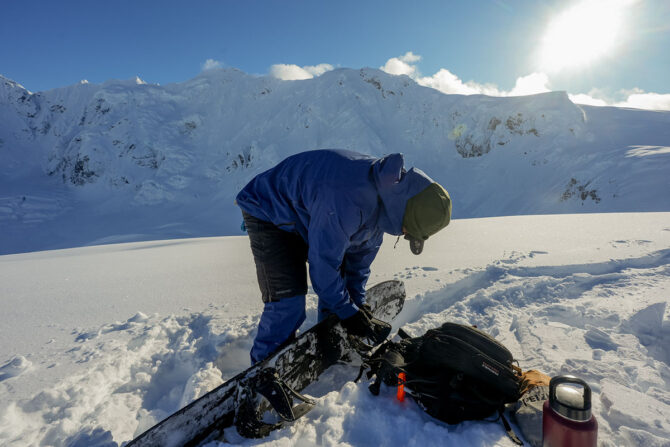
Glacier living at its finest. Photo: Nicolas Teichrob

