
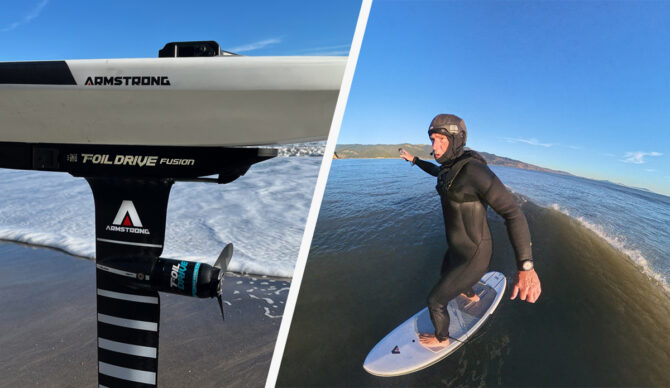
Here’s our take on the Foil Drive Fusion and Armstrong Integrated Carbon Mast, after testing in San Francisco and the Bay Area. Photo: Bowen Dwelle//The Inertia

The Fusion is Foil Drive’s latest offering, bringing additional power and run time to the most versatile e-assist foiling system out there. My testing confirmed that the Fusion system reliably delivers the juice, and the massive battery will make swaps a thing of the past for most riders – but is it worth the upgrade from the Assist MAX that we tested last year?
Perhaps the real question is: how much fun do you want to have?
Bottom Line: I’ve ridden most of the e-assist and e-foil products out there, and my on-water tests were enough to convince me that the Foil Drive Fusion deserves a spot at the top of the heap. While it is the heaviest of the Foil Drive options, it’s lighter and more versatile than surf-oriented e-foils like the LiftX and Flite UL2 – and with efficient riding, the Fusion gives you enough run time for uninterrupted 2+ hour foil sessions! If you’re looking for an electric boost for your surf foiling, and you don’t want to mess around with multiple batteries, this is a killer system with Foil Drive’s proven track record. As a bonus, it has enough power that you can also use it as an e-foil.
I tested the Fusion with the Armstrong Integrated Carbon Mast, and the intel is clear: an integrated mast is a no-brainer, near-mandatory part of a modern Foil Drive rig. Armstrong’s integrated mast is one of the best on the market, and you can’t lose by making this part of your setup. We take a look at this piece of kit as well to give you our thoughts after testing it for the past month in the Bay Area.
Shop Foil Drive Fusion Shop Armstrong Integrated MastRelated: Best E-Foils | Foil Drive Assist Max Review | FLITELab AMPJet Review | More Foil Reviews
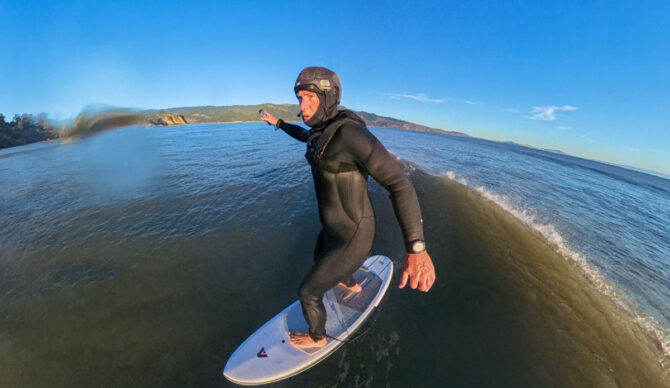
For endless turns in slow-breaking surf, the Foil Drive Fusion is unmatched. Photo: Bowen Dwelle//The Inertia
Testing the Foil Drive Fusion and Armstrong Integrated Carbon Mast in San Francisco
I grew up in San Francisco, and I’ve been on the water since I was eight years old, sailing, windsurfing, kitesurfing, kitefoiling, winging, and parawinging, as well as skateboarding, snowboarding, and even a little surfing. While I’m primarily a wind-sports guy, I’ve spent enough time in the waves to know my way around a lineup – and to know that I certainly wasn’t born a paddler. That fact is that, especially now at age 55, there’s just no way I’m going out into the waves without a motor. In other words, I’m right in the sweet spot of Foil Drive’s target market, and I have the skills to make use of a tool like this, right out of the box.
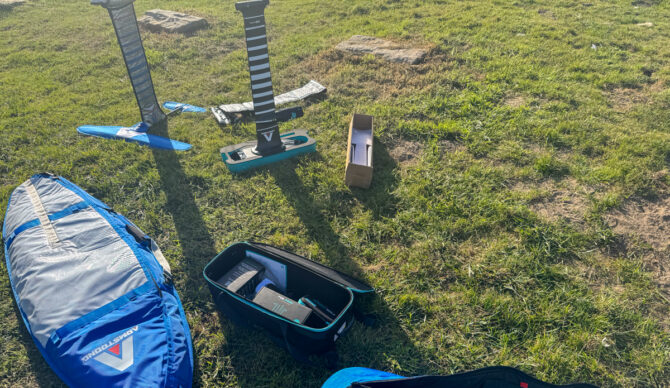
Getting ready for a foil session at Crissy Field, San Francisco. Photo: Will Sileo//The Inertia
To put the Fusion to the test, we paired it up with a full Armstrong setup, including their new Foil Assist Integrated Carbon Mast ($1,900), Ti fuse, and various foils, including the HA 780 and 880 and MA 699, 790, and 890. I tested it all with an 65 liter Armstrong board as well as a 44-liter AXIS board and hit the water at local breaks like Bolinas and Ocean Beach in a variety of conditions.
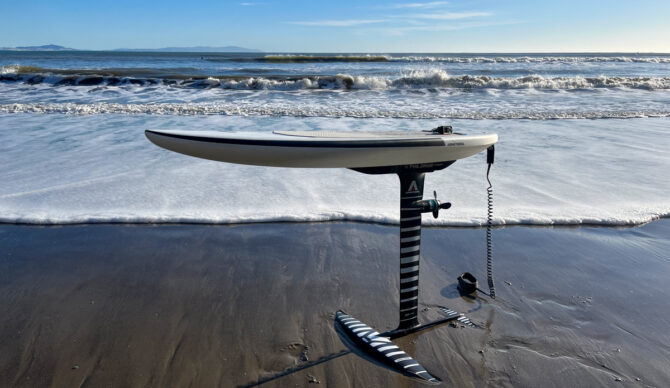
Clean lines make for high-efficiency riding. Photo: Bowen Dwelle//The Inertia
Armstrong Foil Assist Integrated Carbon Mast
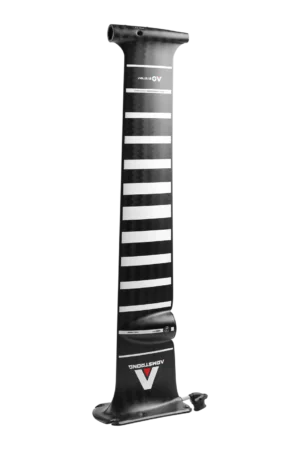
Price: $1,900
Length: 79.5 cm
Motor Pod Height: 18.5cm
Pros: very rigid, simple, cleaner setup, more efficient
Cons: requires a dedicated mast (but you’ll want one anyhow)
I’ve ridden standard and integrated masts as well as a variety of Foil Drive board setups, and it’s clear at this point that, despite all the effort that’s gone into board designs, for most people, an integrated mast makes more of a difference in efficiency than a trench board.
In my testing, the Armstrong Foil Assist Integrated Mast performed flawlessly, providing much reduced friction on motor touchdowns and ollie-ing back up onto foil. The motor pod height of 18.5cm is at the sweet spot for real surf foil conditions – it does require you to motor around with the board quite close to the surface of the water, but that’s a skill you can master with a little practice, and it means that once you ollie up and pop the motor out of the water, you have a pure, clean foiling experience.
The integrated mast also makes a noticeable difference when reengaging the prop when coming off a wave. With a little bit of technique, you can spin up the prop and then come smoothly down off the foil and back into powered drive mode, and transitions are much smoother with the integrated mast.
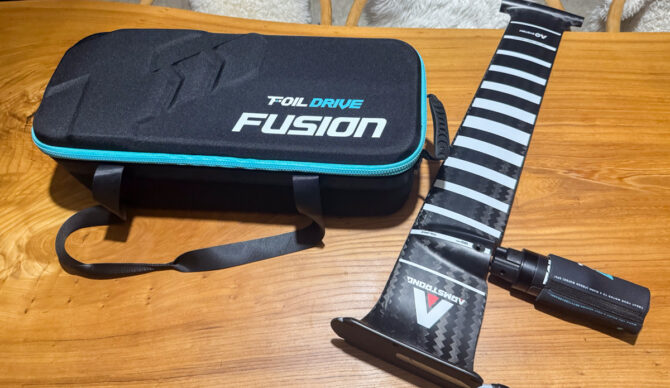
The gear we tested. Photo: Will Sileo//The Inertia
Perhaps counterintuitive is that integrated masts aren’t necessarily any more expensive than a non-integrated mast FD setup. While of course you aren’t going to use your integrated mast for anything other than Foil Drive, that’s pretty much the case with FD rigs anyhow; once you get the Foil Drive fully installed on a mast, you’re probably not going to take it off again anyhow – another reason that you should definitely go integrated at this point.
There are competing carbon Foil Drive-integrated masts out there from AXIS, North, AK, Code, and others – and they’re all in very high demand. Obviously, Armstrong’s integrated mast is for riders who want to mate up Armstrong foils with a Foil Drive – and of course, Armstrong has one of the best and most extensive foil lineups out there, as well as an outstanding reputation for quality and excellence. If you’re investing in a Fusion rig, you’re going to want an integrated mast, and Armstrong’s Foil Assist Integrated Carbon Mast is a great choice.
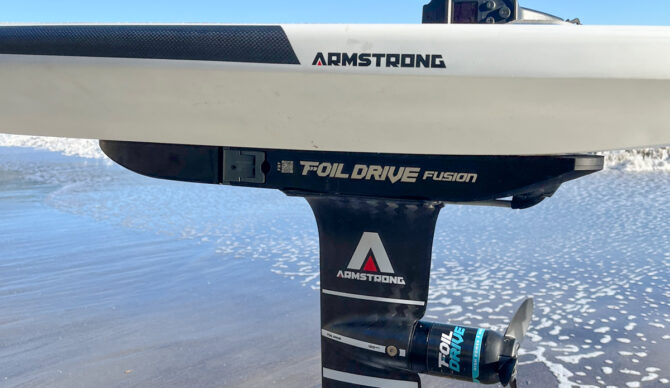
The Foil Drive Fusion package consists of the new battery housing, battery, and the new high-power motor pod. Photo: Bowen Dwelle//The Inertia
Notable Features of the Foil Drive Fusion
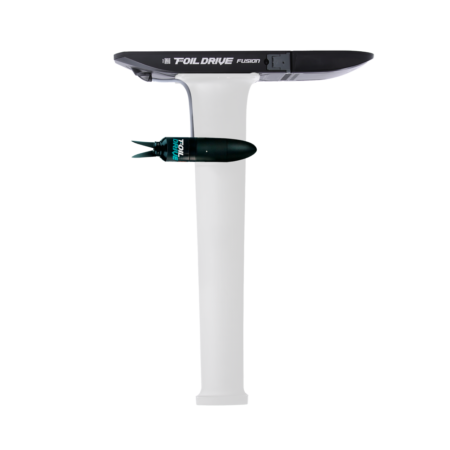
Price: $8,000 for the Fusion base unit with battery and high-power motor
Base Weight: 17.4lbs (including battery)
Weight As Tested: 36.5lbs (including board, foil, and battery)
Pros: tons of power, incredible ride time, super versatile
Cons: heavier than other Foil Drive systems
Fusion Battery & High Power Motor
If you’re tapped into Foil Drive-ing, you’ve likely heard the chatter about ‘how many batteries did you burn today?’ Well, the new 864Wh/43-volt battery changes that math. Combined with the new High Power motor, the Fusion system delivers 35-40% more raw power than the Assist Max, and the ride time is extended by at least that much. In practice, I found that the Fusion has greater max output, more torque, and a bigger short-term boost, so I can pop up faster and use less battery while I whip into wave after wave after wave. I can also motor up onto foil more easily in the flats, meaning that the increased weight of the battery is somewhat offset by being able to ride a smaller board and/or smaller foil, thanks to the extra oomph.
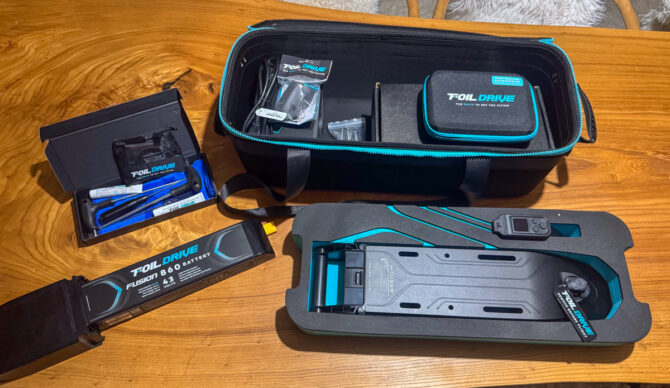
The Foil Drive Fusion ships in a nice neoprene case with all the necessary bits and bobs to get it connected to your foil setup of choice. Photo: Will Sileo//The Inertia
As for run time, I easily got 75+ minutes of constant wave riding, and that’s with a lot of motoring around. With more efficient riding – chipping into waves vs. chasing them down on the gas – this could easily be extended to the 2+ hour range. You might want a second battery while you’re learning (or for e-foiling), but once you get good at catching waves, you probably won’t need it unless you’re clocking all-day foil sessions. For me, though, especially in a cold-water environment, an hour and a half is plenty.
The Fusion battery also has a much more sophisticated battery management system (BMS), which provides an accurate readout of remaining capacity, allowing you to run it right down to the last few % with confidence. At launch, there’s just one size of Fusion battery, but it seems likely that there will be other battery sizes released in the future, for sessions where you know you won’t be out as long, or as your skill level increases and you need less juice. One other important upgrade, especially given how we keep hearing about lithium battery fires: the Fusion battery is more of a solid unit than the previous FD batteries, and should be much less prone to accidental damage.
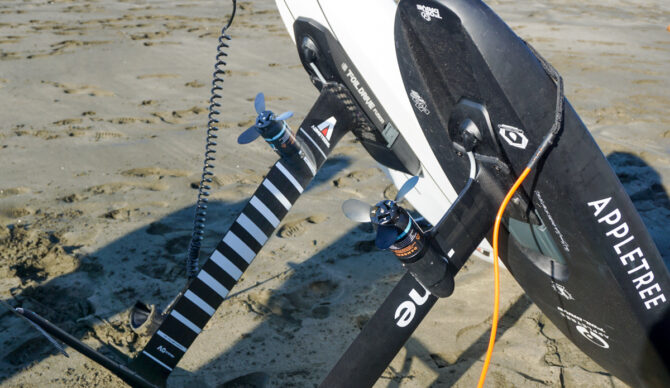
The Armstrong Integrated Carbon Mast (left) makes for a clean finish, compared to a traditional Foil Drive setup that requires using electrical tape to wrap the mast (right). Photo: Will Sileo//The Inertia
Dimensions
At 575mm long, the Fusion battery is just about the size of the Max Power battery, including the nose cone, but the Fusion base unit with the battery installed is 658mm, longer both at the front and back than the Assist Max setup. If you have a trench board, the Fusion may or may not fit, and if you’re running without a trench, the Fusion has a longer upper surface that needs to mate up to the bottom of the board. Either way, be sure to measure carefully or, ideally, test-fit a Fusion unit to your board to be sure it’ll work.

With the motor pod above the surface, resistance and drag is as minimal as your foil setup allows. Photo: Will Sileo//The Inertia
Weight
My main Fusion setup weighed 36.4 lbs all-up, including the Fusion unit itself, Armstrong Midlength FG 65 liter board, Foil Assist Integrated Carbon Mast, A+ System Ti Fuselage, MA 890 front + Surf 170 tail wing, and, of course, the battery. This is roughly 2kg/4.4lb more than the Foil Drive Assist Max Power setup that I tested last year.
We all know that lighter gear is always better, and I won’t try to tell you that you won’t feel the additional weight of the larger battery, but I can say that it didn’t affect my riding as much as I thought it would. The center of mass of the Fusion system is closer to the mast than with the Assist Max, so it’s better balanced. Also, as mentioned above, the additional power means that you will probably be able to use a smaller board, shaving some weight there. Heavier in the center, but with less swing weight, is a fair bargain for all the extra run time. Or, leverage the extra power to go down a foil size. I had good results with a 44 liter board and the Armstrong MA 790 when other guys were out on 900-950 size foils.
I actually noticed the weight most of all when I was getting in and out of the water – it’s a lot to manage in a shorebreak, for sure. It’s worth considering the inertia of a heavy rig like this, and the risk of that coming down on your head – or falling on it – especially since foil-assist can make it easy to get into situations that would otherwise be beyond your skill level.

Surfing clean lines at Ocean Beach, San Francisco. Photo: Will Sileo//The Inertia
Cost
So, how much is a Fusion setup going to set you back? Here’s how to break it down. Of course, you need the Fusion itself, a board, and a full foil setup. While you can use an existing board and foil, most people are going to want an integrated mast and a dedicated board – and although it’s theoretically possible to take a Foil Drive on and off so you could continue to use the mast and/or board without it, in practice, I know precisely zero people who do that.
With these facts in hand, a Fusion setup with a carbon integrated mast will run you about $12,500 if you buy everything new. On the other hand, if you already have a board and foil to use, you can just get the Fusion unit itself for about $8K and bolt that up. For comparison, the Fusion costs roughly $1,500 more than the Assist MAX – but most MAX riders I know have at least one extra $750 battery, if not two or three.
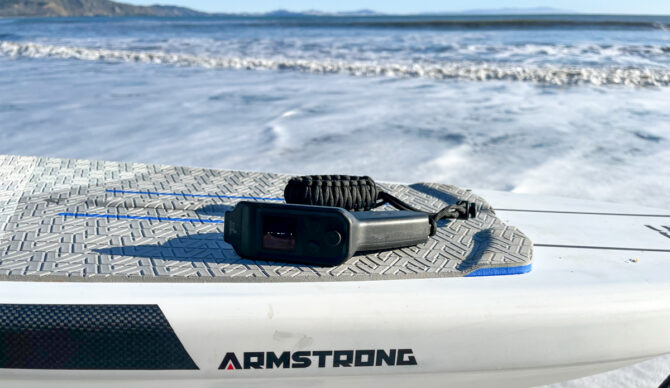
The controller is much improved, but we’d like to see some easier charging. Photo: Bowen Dwelle//The Inertia
V3 Controller, App, and Battery Caddy
The Fusion comes with Foil Drive’s latest v3 controller, which has a (removable) trigger guard, improved button setup, GPS-based session stat tracking, and a few other features. While the controller does not currently provide GPS session tracks, we imagine that will be easy enough to add with a software update and hope to see it in the near future.
You can connect the Foil Drive app to the Fusion base unit, controller, and the new battery to customize all the settings. The Fusion also comes with a nifty new battery caddy, which provides a way to safely store and carry the battery, as well as charge and discharge the battery to ideal levels for longer-term storage – and you can use it as a USB battery bank!
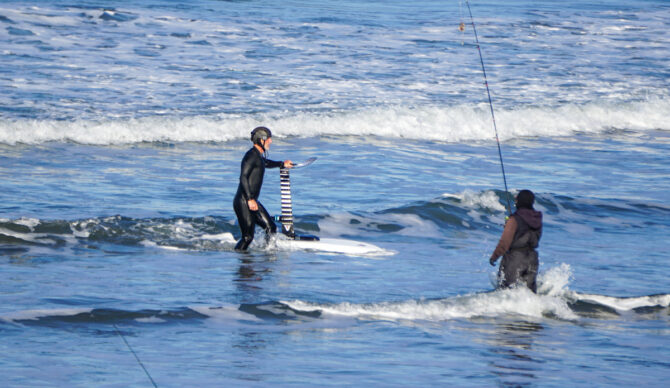
Navigating the shorebreak with a heavy battery can be a challenge. Photo: Will Sileo//The Inertia
Drawbacks
When I reviewed the Assist MAX last year, I was pretty hung up on how a Foil Drive setup requires a ton of parts, bolts, connectors, wires – even electrical tape. The Fusion definitely improves on this, especially with an integrated mast – and, to be honest, once you’ve done the initial assembly and figured out your mast position, you’re probably not going to fiddle with much at all, so, overall, not as much of a factor this time around. It’s no longer strictly a system for the tinkerer type, but FoilDrive is still somewhat of a gearhead setup. If you’re averse to having a lot of little parts floating around, you might consider a fully integrated e-foil type system.
A smaller complaint is that the controller still can only be charged on the wireless pad, which itself uses an old-school micro-USB to USB-A cable. I understand the practical reason they stuck with wireless induction charging – it eliminates a charging port on the controller, which is a vulnerability for water entry, but hey, if Insta360 can put a USB-C port on their cameras, I would think that FD could do the same. You can get a charging cradle that makes mobile charging possible, but it’s pretty awkward compared to just plugging something in. Lastly, the instructions say that you have to remove the controller from the charging pad once it’s charged, lest it heat up or get damaged… but how are you going to do that when you put it there to charge at the end of the day, and then hit the sack? These things need to be designed for real-world use.
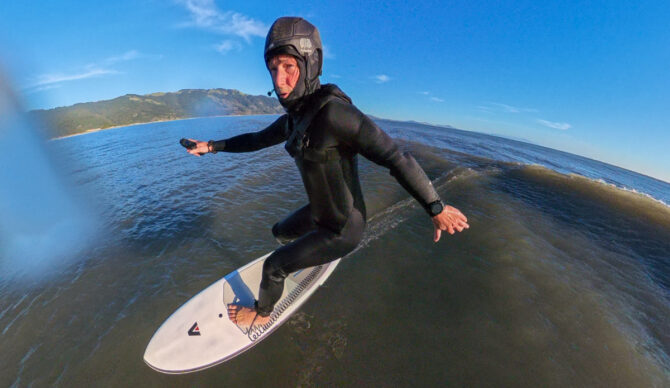
It isn’t the workout of paddling, but efoiling is certainly more athletic than not foiling at all. Photo: Bowen Dwelle//The Inertia
As for athleticism, as I put it last year, there’s no doubt that pulling the trigger on a remote isn’t as athletic as paddling – but it’s certainly more athletic than not going foiling at all, and for those of us that have already passed the point of no return in terms of our ability or willingness to paddle into waves, it’s simple: e-assist gets us on the water.
Really, the main drawback of the system is only that it’s a motor, and it costs money – but you knew that already!

There are a lot of electric-foil products on the market these days. The question is, what is the right fit for how you want to ride? Photo: Will Sileo//The Inertia
The Competition – Foil assist vs E-Foil?
My take is that while there are some really nice surf-oriented e-foils out there, it’s much harder to justify a dedicated surf e-foil like the Lift X or Flite UL2 with a proprietary board, mast, and foil system than a modular system like Foil Drive that lets you leverage your previous investment in a foil system. The Flitelab AMPJet is super rad too, but it’s only going to work for people who only need a boost while paddling in a prone foil situation. If you’re cool with flapping your arms, great, but if not, you need more power, and you need to be able to access that power while on-foil. There are also other modular e-assist products out there, like the Manta Takeoff and Stoke Foilboost, but I’ve never seen either in the wild, nor have I been able to get my hands on them for a review.
For me, the runner-up is really something entirely different – the Zerotow Boogie, which offers mega runtime and no alteration of your foil setup at all. That said, I can’t see the self-propelled Boogie tow unit appealing to anywhere near as many people as a self-contained system. As for the Foil Drive systems with smaller batteries, if you’re already a skilled prone foiler and lighter weight is a priority, you might consider picking up an Assist MAX or Slim (maybe lightly used), but if you’re buying new and you’re not already an expert, it makes sense to get latest system with the biggest battery capacity – and that’s the Fusion.
| Product | All-in Cost (approx) | All-in weight (lbs) | Boards/ foils | Motor positions | Battery/runtime | Notes |
| FD Fusion | $12,500 | 35-38 | Any board or foil | 2 positions: High (surf) or low (efoil) | One battery size (864Wh/43v). 1.5-2.5 hr effective run time based on riding/ usage. Additional Fusion battery sizes TBD. | ~2kg heavier than Assist MAX but no more battery swaps 👍 |
| FD Assist MAX | $10,500 | 28-33 | Any board or foil | 5 positions/ cable lengths | Three sizes (594, 499, 333Wh/40v) + travel batteries. | Great system, but battery swaps are de rigeur. See our review. |
| FD Assist Slim | $9,500 | 22-25 | Any board or foil | 5 positions/ cable lengths | Two sizes (242Wh/28v, 166Wh/40v) + travel batteries. | Much lighter, but only suitable for skilled riders who don’t use much battery. |
| Flite UL2 | $15,795 | 40-45 | Proprietary board, mast, and foils. | Low (efoil) motor position only. | Two battery sizes: Sport 1600 Wh/52v and Nano 806 Wh/52v | Slick design…and, the most expensive. See our e-foil review. |
| LiftX | $14,500 | 45-50 | Proprietary board, mast, and foils. | Dedicated masts with high or low motor position. | One battery size (0.9 kWh). | Very slick design. Lift Connect mounting system means no bolts or screws. See our e-foil review. |
| Flitelab AMPJet & AMPMast | $11,769 | not available | Proprietary board. Any foil. | Dedicated masts with high or low motor position. | Fits one or two 142Wh/50v batteries. | Jet drive means no prop—but you still have to paddle. See our review. |
| Zerotow Boogie | $12,500 (incl. board and foil) | zero* | Any board or foil | No motor on your mast or board at all | One battery size (3024Wh/50v). 2+ hours run time. | The Boogie is a self-propelled tow ‘drone’ that tows you up on your existing foil. It doesn’t add any weight to your foil setup, but it’s not self-contained—and can be very difficult to get out through shorebreak. |

A clean kick-out means an easy reset for the next wave. Photo: Will Sileo//The Inertia
Final Thoughts — Who Is The Fusion Best For?
The main thing that stokes me out about the Fusion is the ability to stay out in the water for a full session without worrying about running out of battery. The extended ride time also opens up the possibility of certain riding spots that can only be accessed with a long motor out and back, and the additional power lets me size down on board and foil. Of course, the big battery isn’t going to be the right thing for everyone—but personally, the Fusion is what I would choose over the other e-assist and e-foil alternatives, because it delivers the riding time I want in a package that still weighs less than surf-oriented e-foils—and offers exceptional versatility. Go get some!
Shop Foil Drive Fusion Shop Armstrong Integrated MastRelated: Best E-Foils | Foil Drive Assist Max review | FLITELab AMPJet review

