
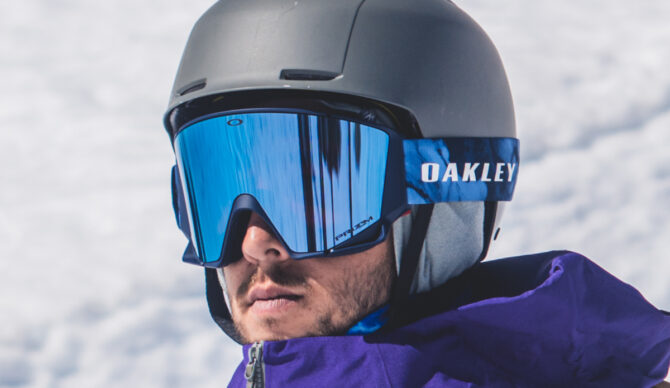
Oakley’s new Flow Scape goggles deliver the widest field of view that we’ve tested thus far. Photo: Skyler Fitzmaurice//The Inertia

Seeing clearly is one of the most pivotal abilities to enjoying your time on the mountain. Not just in the obvious straight-ahead sense, but also down at your feet, and out in your peripherals. Goggles have always had a blind-spot problem, narrowing the wearer’s field of view, and for years, most skiers and snowboarders just accepted it. Then Smith released the 4D Mag and reset expectations for what a field of view could look like. Once you’ve ridden in a goggle that actually shows you more of the mountain, it’s hard to go back.
Oakley has long been a leader in the snow-goggles space, thanks to the brand’s top-tier lens technology, called Prizm, and a wide range of goggle shapes aimed at providing top-tier field of view. However, the past few years have seen rival brand Smith topping the podium when it comes to field of view, with the innovative Smith 4D Mag design that vastly improves downwards-facing field of view with a unique D-shaped lens. The Oakley Flow Scape ($417) is the brand’s response to the Smith 4D Mag, taking the concept of an extended field of view in a distinctly Oakley direction.
Bottom Line: The Flow Scape delivers. The goggle has a very slight edge over the Smith 4D Mag on that critical field-of-view metric, and will be more comfortable for a wider range of face shapes. Combine that with some interesting “new” lens design and a bio-based frame material, and you’ve got one of the most advanced snow goggles on the market. The catch? It’s very pricey. Is it worth it? Well, what’s the fun in telling you now? See below for the full review.
Editor’s Note: At the time of publishing, the Flow Scape is heavily discounted for spring sales to $250 or less on REI.
Check Price for Flow Scape L on REI Check Price for Flow Scape M on REI
Related: Best Snowboard Goggles | Best Snowboard Helmets | More Ski and Snowboard Reviews
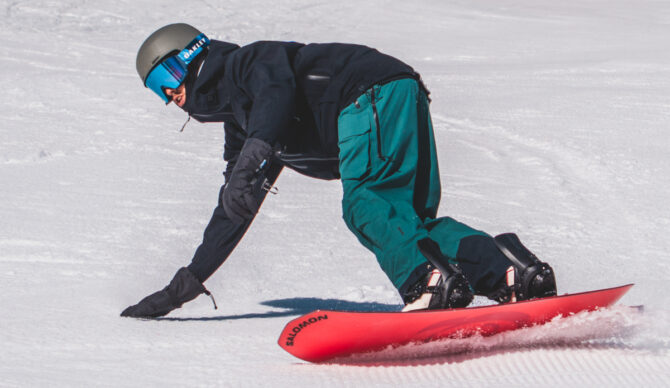
From mid-winter powder to spring slush, both skiing and snowboarding, I’ve put these goggles to the test. Photo: Skyler Fitzmaurice//The Inertia
Testing
I’ve spent the past season, since the release of the Flow Scape, putting it to the test. I’ve tested both the smaller-sized M and the larger/”regular” sized L. In addition to a low-bridge fit option for both sizes, these are the only variations currently available for the Flow Scape.
I spent the past winter skiing and snowboarding in Lake Tahoe, primarily at Palisades Tahoe, as well as in the backcountry, and also took a trip to Japan in late January, where I scored over 100 inches of powder in a week – and the Flow Scape saw me through all of it with aplomb.
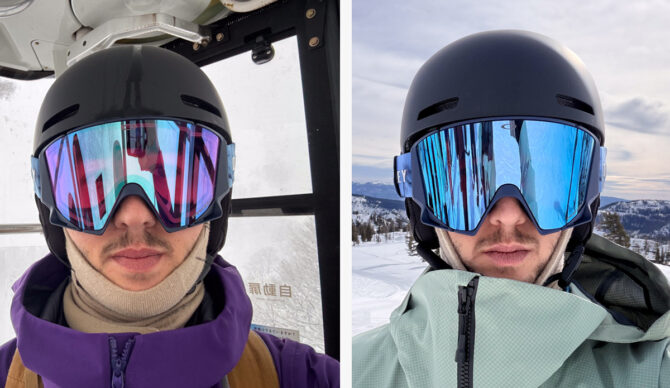
Comparing the smaller-sized M (left) and L (right). Photo: Will Sileo//The Inertia
Notable Features
Oakley Flow Scape ($417)
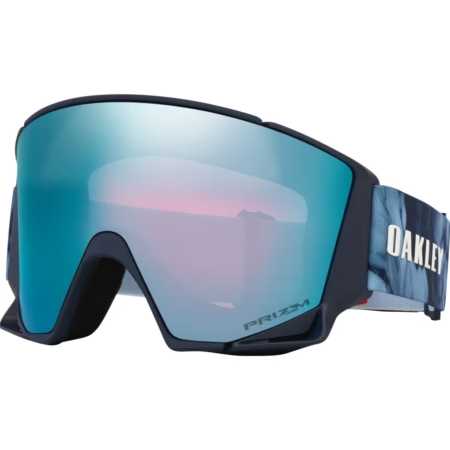
Size/Fit Options: M, L
Lens Shape: Conical
Pros: Incredible field of view with the new Conical lens shape, top-tier Prizm lenses
Cons: Undeniably expensive, single-pane lens is a fog risk, but a dual-pane storm ski lens is included
New Lens Design
Obviously, we’ve got to start with the overall shape and design here. Oakley introduces a new lens shape, which they call “conical,” that sits slightly further from your face at the top and tapers as it moves down toward the nose. This helps bring the lens closer to your face where it matters – at the bottom of your field of view – helping you see downward without the foam or frame of the goggle obstructing your vision. Oakley claims that this new design gives a 60% increase in field of view compared to the brand’s classic Line Miner shape. And in fact, the design earned an ISPO award in 2024 when the goggle was first announced, though it wouldn’t be until the fall of 2025 when the goggle first became available.
In testing, I found these claims to be accurate. The Flow Scape truly does have one of the best fields of view that I’ve ever seen in a goggle. It’s a very, very close call between the Flow Scape and the Smith 4D Mag – but the Flow Scape has a slight edge in terms of overall FOV, and it does not suffer from the same distortion at the bottom of the lens as the 4D Mag (the D-shaped lens produces a bit of distortion at the bottom where it curves, but only if you’re really looking for it. Overall, it’s easy to ignore). But these are differences that I was only able to notice in running back-to-back tests of both goggles – the average user likely won’t be able to tell the difference in either field of view or the distortion of the 4D’s lens.
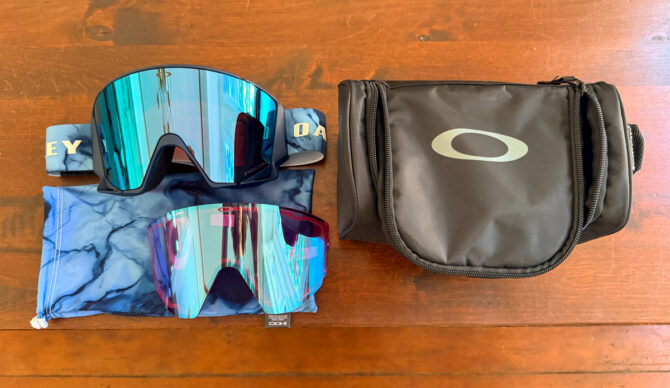
Each pair of goggles comes with a second low-light lens, a case, and a thin bag. Photo: Will Sileo//The Inertia
In addition to this new lens shape, Oakley also does something different in the lens construction itself – the main lens is a single-pane design, whereas double-pane lenses have been the industry standard for years at this point. The tradeoff here is anti-fog up against visual distortion. Dual-pane lenses do better at thermal regulation, acting like a double-pane window to create a thermal barrier between the cold outside air and the warm air coming off your face. This helps prevent fogging, at the cost of some visual clarity – two lenses means more surfaces for light to bounce off of, refract, and distort.
The Flow Scape, in using a single-pane design for the main lens, attains better visual clarity, with a slightly increased risk of fogging. The lens does have a more robust anti-fog coating than most, but that just can’t beat a double-pane construction.
All that said, the included low-light/”storm skiing” lens is the more classic double-pane design. So when you’re skiing in conditions that are prone to causing fogging, you’ll benefit from that double-pane thermal barrier. On bluebird days, when you’d be wearing the higher-light lens, fogging is much less of an issue, and the robust anti-fog coating on the single-pane lens will be more than enough to take care of your needs in that scenario.
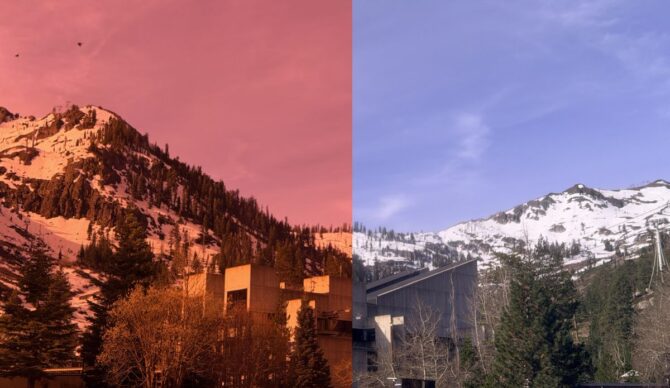
Oakley Prizm (left), and Smith ChromaPop (right). Photo: Will Sileo//The Inertia
Oakley Prizm
A quick note on Oakley’s Prizm technology, which boosts contrast so you can better see the variations in the snow beneath your feet. Every major goggle company has a similar technology or tint – Smith’s is called ChromaPop, Anon’s is called Perceive, and Glade just introduced their own this year, called Reveal 4k.
All of these do a great job of enhancing visual clarity in snow environments, and without a doubt, Oakley’s Prizm is at the top of the pack, along with Smith’s ChromaPop. Worth noting, Prizm has a distinctly orange tint to it, which some aren’t the biggest fans of. Personally, I don’t have an issue with it, and in fact, somewhat prefer it in low-light compared to goggles that try to render the mountain exactly as your naked eye would see it.
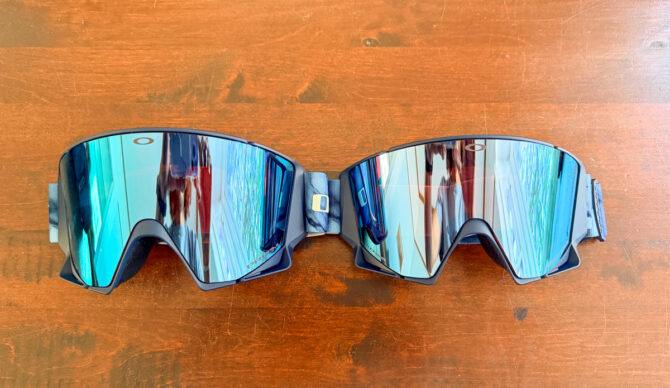
L (left) and M (right). Photo: Will Sileo//The Inertia
Fit and Sizing
The Flow Scape comes in two sizes, Medium and Large (as well as a low-bridge fit for both sizes). The Large is going to be the best choice for most faces, and despite the FoV-focused design, I didn’t feel like it was swallowing my face, which tends to prefer medium-large goggles instead of truly oversized ones. The Medium size is best for those with actually small faces – from those who just barely fit into a medium-sized helmet, down to those who use small or extra small helmets.
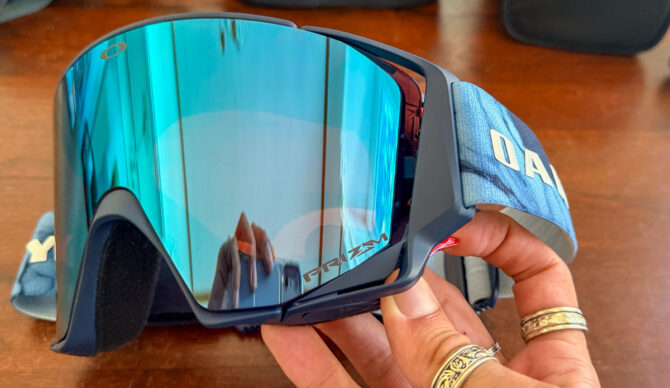
A hidden tab opens up the frame of the goggle, letting you swap lenses. Photo: Will Sileo//The Inertia
Locking Mechanism
The goggles have a quick-swap lens mechanism, consisting of a hidden tab (red) on the left side of the frame, which pops open a piece of the frame to release the lens. Functional, but a little fiddly. Since the strap attaches to the section of the frame that lifts away, it’s hard to do with the goggles still on your face.

In snowy conditions, just make sure you’ve got that storm lens in for maximum fog prevention. Photo: Will Sileo//The Inertia
Drawbacks
Price. No doubt, the price is another level up here. At $417, the Flow Scape is the most expensive goggle I’ve seen to hit the market. Even the Smith 4D Mag, previously the most expensive mass-market goggle, is “just” $348. At that lofty price, I’d love to see some more extras here, maybe a hardshell extra-lens case, or some other meaningful quality-of-life upgrade.
The single-pane lens offers trade-offs, with a slightly increased risk of fogging in exchange for sharper optical clarity. It’s not so much a drawback as it is something to keep in mind. As long as you make sure to use the right goggles for the conditions, you should be fine.
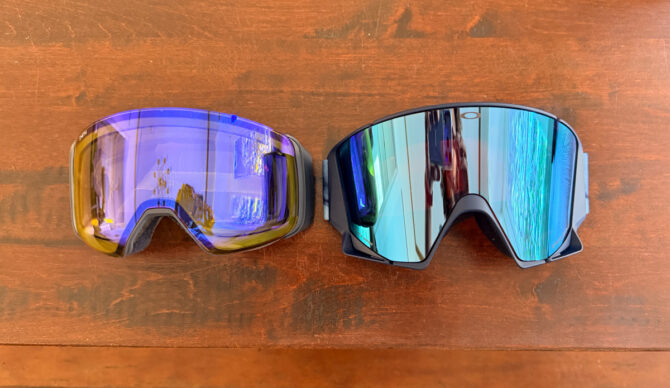
The Smith 4D Mag (left) has a smaller profile than the Flow Scape (right). Photo: Will Sileo//The Inertia
The Competition
Smith 4D Mag
It’s impossible to have a conversation about goggles these days without mentioning the Smith 4D Mag, all the more so when you’re discussing the Flow Scape, Oakley’s long-awaited response to Smith’s groundbreaking design. How do they compare? Well, to sum things up, the Flow Scape has the edge in terms of field of view and optical clarity, and a better fit for more faces. The 4D Mag has a lower price, proven dual-pane lens construction on all of its lenses, more styles and size options to choose from (for now), and a slightly better lens-swap mechanism.
In either case, you’re getting one of the two best goggles on the market. The question is whether that edge in field of view and fit justifies the extra $60, and whether you’re willing to trade away the 4D Mag’s more refined lens-swap and dual-pane construction to get it.
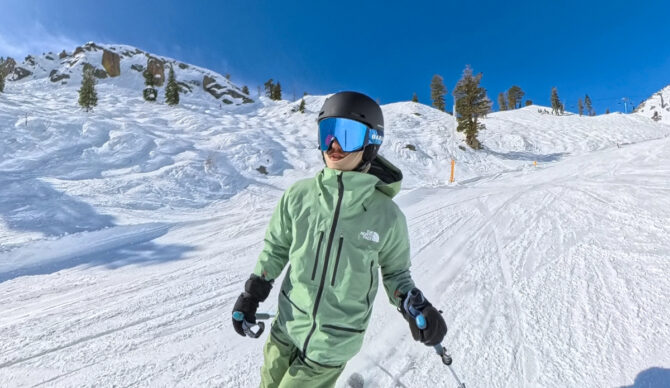
Putting the Flow Scape goggles to the test in bluebird conditions at Palisades Tahoe. Photo: Will Sileo//The Inertia
Final Thoughts
Overall, the Flow Scape is a worthy step forward in the game of high-performance snowsports goggles, narrowly taking the crown from the Smith 4D Mag as the best field-of-view goggle on the market. The gap in raw FOV isn’t dramatic, but it’s real, and you’ll feel it, and the complete package is hard to argue with: a frame that fits more faces, zero distortion at the bottom of the lens, and an innovative single-pane construction that genuinely improves optical clarity.
The $417 price tag is steep, full stop. If you’re struggling to justify the price, you likely will be happier with the Smith 4D Mag or a goggle like the Glade Adapt 2 that has a great field of view and a much more approachable price point. But if you’re someone who demands the best and is willing to pay for it, you won’t be disappointed. And if you jump on it now, you can probably score a solid end-of-season discount before these disappear for the summer.
Check Price for Flow Scape L on REI Check Price for Flow Scape M on REI
Related: Best Snowboard Goggles | Best Snowboard Helmets | More Ski and Snowboard Reviews
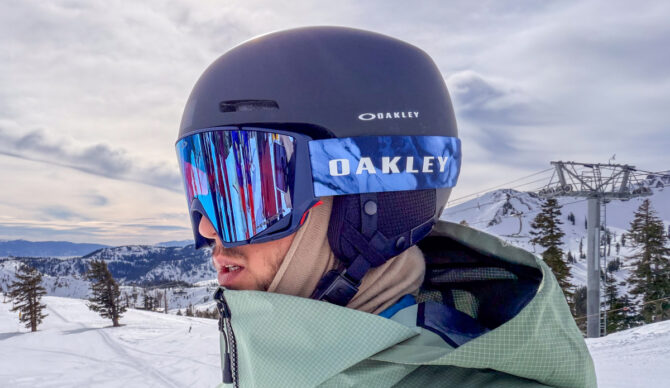
Photo: Will Sileo//The Inertia

