
Mika Baumeister/Unsplash

The World Meteorological Organization (WMO) says that 2015-2025 were the hottest 11 years on record. The organization’s announcement came via a press release Monday, sharing several observations and data points about the changing climate which the organization says is fueled by an ocean that continues to warm and absorb carbon dioxide.
“The State of the Global Climate is in a state of emergency. Planet Earth is being pushed beyond its limits. Every key climate indicator is flashing red,” said UN Secretary-General António Guterres. “Humanity has just endured the eleven hottest years on record. When history repeats itself eleven times, it is no longer a coincidence. It is a call to act.”
The WMO’s report also touched on the “Earth’s energy imbalance,” which measures the rate at which energy enters and leaves the Earth’s system. The report says incoming energy from the sun would be “about the same” as outgoing energy under a stable climate. Greenhouse gases are creating an imbalance currently, with less solar energy leaving the Earth than what is incoming. That excess energy is what accumulates around Earth. Ninety-one percent of that excess energy is stored in the ocean. Each year has set a new record for ocean heat content over the past nine years, the report says, and 2024 was the warmest year for global mean near-surface temperatures, at about 1.55 °C above the 1850–1900 average.
“This matters because over three-billion people depend on these marine and coastal resources for their livelihoods. They’re living off the ocean, and nearly 11 percent of the global population live on low-lying coasts directly exposed to coastal hazards,” says WMO scientist John Kennedy.
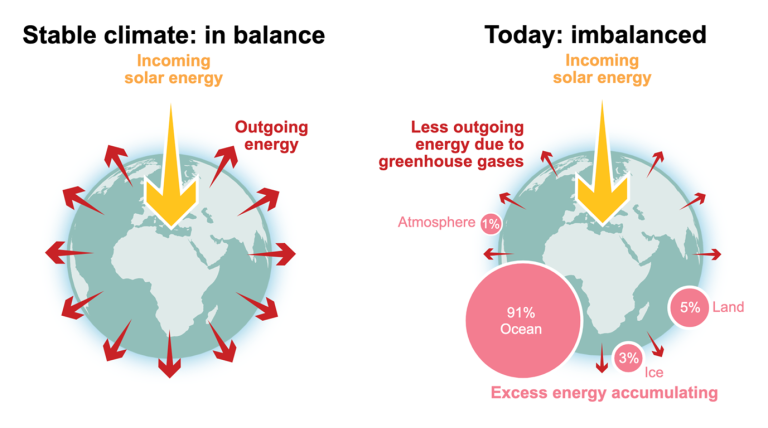
Earth’s energy balance and imbalance. Photo: WMO
“Scientific advances have improved our understanding of the Earth’s energy imbalance and of the reality facing our planet and our climate right now,” said WMO Secretary-General Celeste Saulo. “Human activities are increasingly disrupting the natural equilibrium and we will live with these consequences for hundreds and thousands of years,” adding that “on a day-to-day basis, our weather has become more extreme. In 2025, heatwaves, wildfires, drought, tropical cyclones, storms and flooding caused thousands of deaths, impacted millions of people and caused billions in economic losses.”
The WMO has issued these annual climate updates for more than three decades and the past decade saw a noticeable increase in record figures.

