
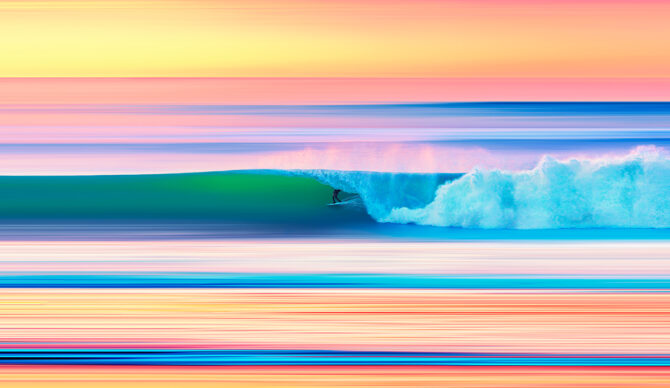
Aguas de Marco. Photo: Thomas Fotomas

Thomas Fotomas isn’t your typical surf photographer. His Instagram is a stream of candy-coated waves that illustrate just how consistently the fine art photographer blurs the line between imagination and reality.
Based in the Médoc region of France, Thomas has been experimenting with his particular brand of surf photography for nearly 10 years. Thomas enhances conventionally shot surf photos through careful digital illustration and compositing, crafting a body of work rich in bold, fluorescent colors and horizontal lines that melt into the surrounding landscape as if they were always meant to be there.
We reached out to Thomas to learn more about his process. He discussed everything from the way France’s cold waters and choppy waves birth raw, core surfers to his passion for the environment, and the perils of overconsumption. Though his photo work may have already betrayed this, Thomas is a true artist, who writes and thinks like a poet.
Answers translated from French by Kathleen Barkats.
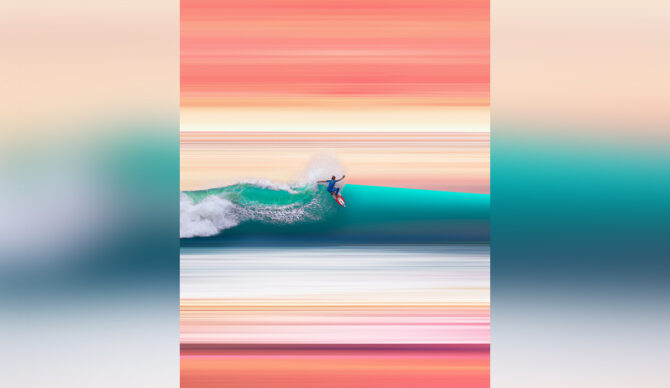
Clemence Schorsch. Photo: Thomas Fotomas
How long have you been surfing?
I tried surfing for the first time in 2008 in Hossegor. I borrowed a Mini Malibu from my then-girlfriend, who was using it as decor in her apartment, and I broke it after dropping in on some guy’s wave.
At first, I didn’t know anything about it. I’d wanted to try, because I always skateboarded and I was snowboarding a lot at the time. Even though my first attempts were made easier by other boardsports I did, I wasn’t hooked right away. I found the ride too short-lived, plus it was impossible to do 360s or grabs. I didn’t get the hype. But then, when I moved to Capbreton in 2010, I was all in.
What do you love about photography?
Above all, feeling the camera and the lens in my hands, looking through it, and finding an interesting angle so I don’t have to crop much in post. It’s really important to keep good image quality. The way weather plays into everything is also so interesting to me, it adds this uncontrollable element, which adds appeal.
What kind of camera do you shoot on and what software do you use to make your pieces?
I use a Canon 5D Mark IV with a Tamron 100×400 mm G2 zoom. I also used a Canon 5D Mark II with a 70×300 USM for a long time. I work exclusively in Camera Raw and Photoshop.
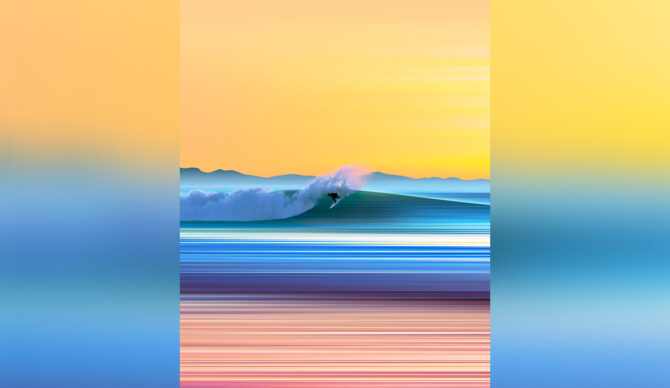
David Berengere. Photo: Thomas Fotomas
How do you know which colors to bring into a piece? Do the colors come to you as you sit down to workshop a photograph, or do you think about the colors you’ll add later before you even take a shot?
My color process is fairly flexible, although I focus on two themes. One with a series of photos taken with the sun really high, and one with photos taken during golden hour.
The colors evolve on their own based on the photos. If it doesn’t work, I switch gears and start working on something else. It’s pretty instinctual. I also have my previous collections that I can refer to, if necessary, to maintain a visual theme. I’ll also draw inspiration from seasonal colors.
What are your favorite places to travel to, both for surfing and photography?
I don’t travel for surfing or for photography. It’s not in my plans anytime soon. But I’d love to visit Portugal and Morocco, or Australia and Hawaii. Then again, you could travel two hours just to find crappy waves, so traveling the world just to find flat water or to surf a few overcrowded waves just to say I’ve surfed here or there is something I could care less about.
Surf travel is too much of a capitalist craze. It’s too far from the values that drew me to surfing in the first place. Yes, traveling is amazing, and it’s great to have unique experiences, but I think that too many people treat taking a plane like taking the metro. If you’re a surfer and environmentally conscious, there should be a baseline level of intention behind your actions, and in my opinion, you need to live in harmony with your values.
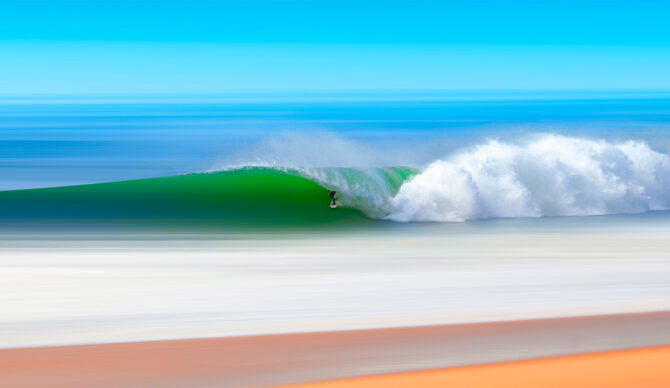
Patrick Beven. Photo: Thomas Fotomas
How do you draw inspiration from nature, both in your art/photography, and in your life?
I’ve always been really sensitive to the environment in which I’ve lived, which has always impacted my art. In the Parisian region, I was into graffiti and making techno music, which was perfectly in sync with the urban landscape. Paintings livened up gray walls, and vibrant, colorful rave parties on the weekends brought life to dirty, abandoned warehouses.
After a few years in Savoie, where I worked in the winter, I got closer to nature, realizing its positive impact on my mind and body. While visiting friends who were doing a season in Hossegor, I discovered the warmth of the southwest, the wetland landscapes of the Atlantic, and the local customs.
When I moved there permanently, I changed my artistic practices little by little and my lifestyle adapted to my new living environment. I became really minimalist. Surfing, photography and healthy food. I was still doing a little music, but shooting quickly became my sole means of artistic expression. My graphics skills, which I picked up through various computer graphics jobs, easily fused with photography, and my practice quickly shifted towards experimentation through various tools.
Then I got interested in surf photography because of the exceptional skill of the locals and the beauty of the area’s barreling waves. I needed to make perfect images, and I wanted professional-quality results like I’d seen in magazines.
I wanted pro-level output, but when I succeeded, I finally realized that everyone was doing those kinds of photos, and there was nothing original about it. So, I tried out several concepts and figured out my own style.
Nature inspires me so much. The seasons, the wind, the moon, and the crepuscular rays all harmonize with the surfers and the movement of the waves. It’s a fertile landscape for my imagination.
You can find more of Thomas Fotomas’ work here.

