
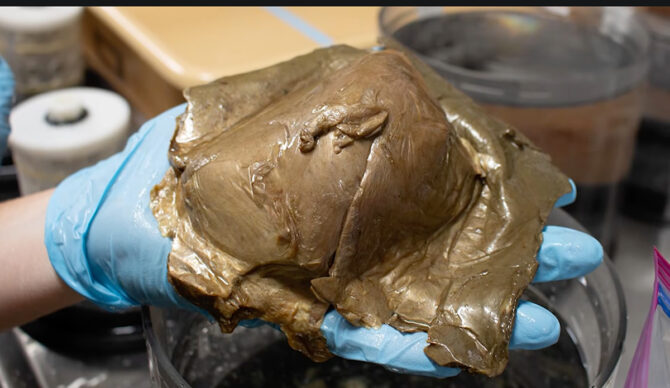
It turns out this wasn’t the beginning of a horror movie. Photo: NOAA

Scientists have finally solved a deep-sea mystery that has been unsolved for years: What the hell was that “fleshy, golden orb” they found on the ocean floor in Alaska?
The object was originally discovered on August 30, 2023 during a live stream of NOAA’s Seascape Alaska 5 expedition. The fleshy, shining mass immediately captivated the scientists narrating the stream, and like probably most of us, their first response was to poke it – and hope that nothing came out. It was a moment that one scientist described as “like the beginning of a horror movie.” Soon after, the scientists successfully collected the orb and brought it to the surface for testing.
But what the hell was it? Undiscovered flora? Ocean detritus? Alien egg?
The answer to that question was surprisingly difficult to come by, taking years to understand. “We work on hundreds of different samples and I suspected that our routine processes would clarify the mystery,” explained NOAA Fisheries’ National Systematics Laboratory director Allen Collins. “But this turned into a special case that required focused efforts and expertise of several different individuals. This was a complex mystery that required morphological, genetic, deep-sea and bioinformatics expertise to solve.”
When scientists examined the structure of the object, they found it to be a fibrous material full of stinging cells called cnidocytes. This suggested that it was some sort of cnidarian (the phylum to which coral and anemones belong). Through extensive DNA testing, they found that the mitochondrial DNA of the object was virtually identical to a species of cnidarian called Relicanthus daphneae.
And with that, the mystery was solved. The “golden orb” was, in fact, a remnant of a deep-sea anenome.
“So often in deep ocean exploration, we find these captivating mysteries, like the ‘golden orb’. With advanced techniques like DNA sequencing, we are able to solve more and more of them,” said acting director of NOAA Ocean Exploration William Mowitt. “This is why we keep exploring — to unlock the secrets of the deep and better understand how the ocean and its resources can drive economic growth, strengthen our national security, and sustain our planet.”

