
Photo: Manav Parekh//Unsplash

The season pass model Vail Resorts introduced to the ski industry in 2008 was meant to sustain season-to-season fluctuations. A bad winter didn’t have to mean ski resorts suffered financially. This past winter was exactly that for many resorts owned by the corporation, but as mentioned, the season pass has long become a weapon against those conditions when it came to balance sheets. Vail’s Q3 report, however, revealed this week that might not be holding up. At least that’s how Vail Resorts is describing the drop in sales in 2026.
“Weather conditions remained extremely unfavorable in the third quarter, adding to what had already been one of the most challenging winters in history across the western U.S., driving continued pressure on visitation and revenue in the quarter,” Vail CEO Rob Katz said in a statement. The report revealed that Vail Resorts has seen a decrease of about 10 percent this year, which is the largest drop in pass sales since introducing the program almost 20 years ago. “While we’re clearly not satisfied with any decline in pass sales, the outcome is not necessarily surprising given the severity of the conditions we just experienced this past season and the massive growth we saw in past sales in the previous five years. We believe the challenging conditions have delayed purchase decisions, creating the opportunity for improved pass performance in the fall selling season and/or ultimately through lift ticket purchases during next season.”
While the corporation seems to be pinning the current downturn in pass sales on a weak 2025-2026 snowpack, Katz did also note that a bounce back has been seen in the past when that weak season is followed by at least average or normal conditions. Naturally, the expectation of a strong El Niño through the upcoming winter of 2026-2027 would be expected to surpass “normal conditions,” and visitation and pass sales would likely contribute to padding Vail’s bottom line as a result.
But the ski industry doesn’t exist in a vacuum. Skiing and snowboarding are not essential expenses, and consumer confidence isn’t exactly high in the current world economy. A consumer analysis report from McKinsey & Company just two weeks ago painted a domestic picture in which everyday consumers are pulling back spending across most discretionary categories.
“The pullback was most pronounced among low-income consumers, though even higher-income consumers said they may cut back on ‘nice to haves,'” the analysis reads. The report went on to outline that rising prices in the cost of living are dominating the outlook of consumers.
“We’ve had to make some tough choices. The family vacation is on hold, eating out is a rare treat, and I can’t remember the last time I bought something just for myself. It’s all about needs, not wants, right now,” the report quotes one millennial from Oregon.
A poor winter is in the rearview mirror, a promising one lies ahead. Only time will tell which one weighs as a larger factor against an economy experiencing growth (technically), but fighting dropping consumer confidence.
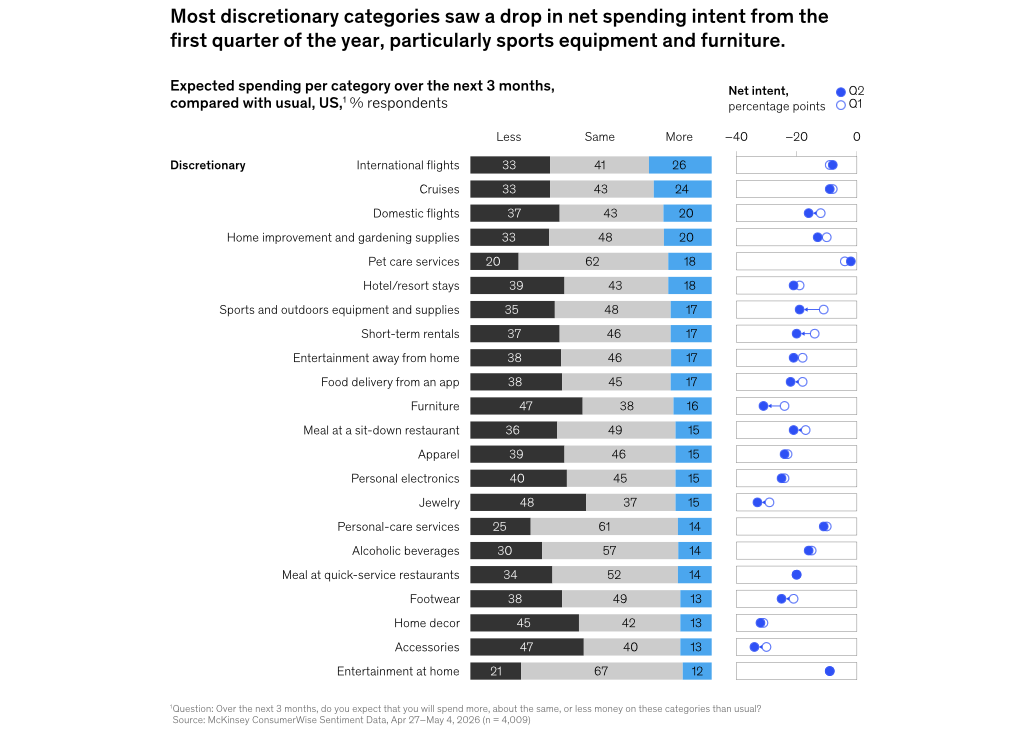
A chart outlines expected spending across multiple categories, including international and domestic flights, hotel and resort stays, and sports and outdoor equipment supplies. Photo: McKinsey & Company

