
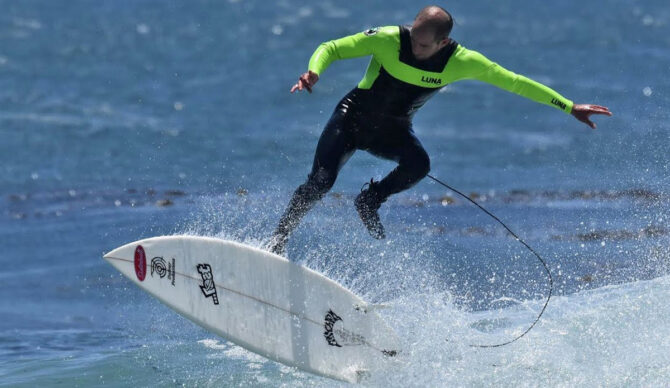
Zoltan knows: kickflips can beat the hell out of your body. Photo: YouTube//Screenshot

Magic and surfing. These are the things that make Zoltan Torkos a legend. When he combined the two, and did surfing’s first (official) kickflip back in 2011, he proved the maxim that if you work hard enough and have the imagination, anything is possible. Zoltan claimed Volcom’s prize of $10k four years after the company put a bounty out on surfing’s first kickflip. Since then, he’s been doing his thing.
I sat down with Zoltan to get a glimpse into his unique surfing life.
How did Santa Cruz shape you as a surfer?
It was such a collectively weird place, and I grew up in a magic family. When I was a little kid, my family moved across the street from a bunch of pro surfers. Richard Schmidt lived there, and Shawn “Barney” Barron lived a few streets over. My older brother got me into surfing, and it was crazy because these people were doing cartwheels and handstands off roofs, dressing like Spider Man, and just living differently. It inspired me to be different and to try things that maybe weren’t textbook surfing — or even appreciated at the time. Thinking differently was a big part of the culture I grew up in. I was always surrounded by creativity.
Barney lived just a couple of houses down, and we also had the infamous King of Steamer Lane, Vince Collier. Steamer Lane—”the Lane”—was my home break growing up. Vince made my boards when I was little, and my first board was actually one of Barney’s old boards. My brother ripped the fiberglass off it, shaped it into my first little board, and took me surfing. I somehow magically moved right into the epicenter of pro surfing, and there were so many great surfers on that street. I don’t want to leave anyone out, because all of them played a part in influencing different styles in my surfing.
Did you do any other boardsports growing up?
I grew up skateboarding first with my older brother. I followed him around and tried to skateboard with him. Our friend had a vert quarter pipe in his front yard, and they were always skating it. It was a big deal because not a lot of people could ride it. As a little kid, I felt like that was a huge challenge because I had to try to skate this vert ramp that went all the way up the side of a garage. A lot of older guys couldn’t even skate it, so it started influencing me to push myself into some pretty crazy places with my skateboarding. I also used to ride my bike and pretend it was a surfboard. I was into BMX, but really I was always imagining I was surfing. It was a lot of fun.
You’re a fourth-generation magician.
My great-grandfather came over from Italy by himself when he was 12. He was already doing magic when he arrived, and it helped him survive. He went on to perform and share magic with people all over Boston. My father was also a great magician. He passed down the tradition of magic to my mother, who passed it on to me and my brother. We were performing every weekend from the time I was two years old all the way into my twenties. We competed in a lot of magic competitions, and being featured in Magic Magazine was kind of like being featured in SURFER. It was a childhood that was very different from most people’s.
We would go to all these people’s houses, and it was kind of funny because sometimes they’d write you off when you first showed up. They’d think, “Okay, we’ll see.” You know how people sometimes look at magicians. But by the end of the show, they’d want to feed you, give you everything, and tell you how amazing it was. It was a really unique experience and very different from any other job.
In Monterey Bay, we’d end up performing for all kinds of people you wouldn’t expect — from Hollywood stars to princesses and people with armed guards. My mom and I would be carrying our equipment into these huge houses, practically castles and mansions, and putting on magic shows. It often felt like something straight out of a movie. At the time, it was hard because I just wanted to be in the ocean. Looking back now, though, I’m really grateful for it. It gave me a childhood unlike anyone else’s, and it was a really interesting way to grow up.
Do you feel like you perform magic on a surfboard?
I wouldn’t want to be the person who claims that I do magic on a surfboard, but I would definitely say that surfing is magical, and that I love surfing for all of its magic and beauty. I also feel like that’s been a question in my life: should I go be a magician and stay on land, maybe go to Las Vegas and do that whole thing? That’s what you have to do if you want to make it big in magic. But growing up in Santa Cruz, I wanted to go surfing.
At the same time, I had a childhood of entertaining people, so I was drawn to doing moves that might be a little flashy or fun to watch, especially for people who aren’t surfers. I feel like some of the tricks I do are kind of for everyone, because everyone knows what a kickflip is and things like that.
What’s your favorite magic trick?
One of my favorite magic tricks is the one where you have a pan, light it on fire, cover it with a lid, and then open it up and pull a white dove out of the fire. It’s pretty amazing. My mom used to do that trick when we performed. We did shows everywhere — nursing homes and all kinds of different places. Like I said, we were performing every weekend. One time, my mom appeared the dove during a show, and a lady who hadn’t talked for something like 20 years spoke for the first time. So magic is really special when it’s done to make people happy. I think it brings out some really positive things in people. It’s something that’s always felt very special to me.
Do you have another job, or is surfing also a career?
I’ve had lots of great luck in my life, and I’ve had lots of good sponsors off and on. In skateboarding, I’ve been sponsored. And then also in wakesurfing, because I was lucky enough to do the first kickflip in wakesurfing. So I’ve had boat sponsors a few times. Right now, I’m working surf lessons. You can contact me through my Instagram, and I’m working through Richard Schmidt Surf School in collaboration.I also work at Freeline Surf Shop a couple days a week. Just working and surfing, and I have a few sponsors. So I’m really grateful right now for everything that I’ve got. I’m a lucky man.
Everyone wants to know about the kickflip.
So I had actually been doing skate tricks and trying kickflips for many years. It all started maybe 20 years ago. I was in the original Vans Air Show Tour surf and air contests, and people were already trying stuff like that. I was pretty much doing them all the time and kind of landing them way back then, but never on video. In fact, I never really liked surfing on video or trying to be filmed. I surf to get away from people. The whole thing about being filmed and all of that — you lose yourself back into nature and become a creature of wildness again. You know, the call of the wild. So, I went surfing as much as possible to get away from people.
That’s kind of when I was surfing with all these eclectic people I mentioned before, including my friend Carl. He was one of my best friends and just a standout character. He was working hard to put his girlfriend through college, surfing the Lane every day, training hard, fighting in the Martinez Fight Club, and doing all these cool things. He was really putting his energy into the right places. He was always bummed out that I wasn’t taking my surfing career seriously. That’s still hard for me to even think about now — sponsors, being famous, any of that stuff. But he would tell me, “You should have always been a pro surfer. You should be a pro surfer again. You should do it now.”
At the time, I was working at a supermarket as a butcher, and I had a family. But he kept telling me, “You need the kickflip. It’s going to change your life.” He really got in my face about it. What’s still hard for me is that he got shot and killed that day. After that, I made it my goal to get the kickflip on video and win the contest because of him. That’s why I’m screaming during that first one. Everyone thinks I’m cheering for myself, but I was screaming Carl’s name. I was screaming for Carl.
I truly owe it to my friend for believing in me — that I could do the kickflip — and to my older brother, for filming the first kickflip and making my dream possible. It took about three years after all of that happened with my friend to get it on video.
Any bumps or bruises along the way?
There’s a lot of danger involved with the kickflip. I got 10 stitches in my head from a fin and 10 stitches in my arm. I broke three ribs. I also broke a lot of boards on my face.
Instead of credit-carding myself, I usually cover my balls, and then the board bounces up and hits me in the face. But that’s part of it. I was going to say skateboarding, but really it’s part of surfing. Like anything, if you’re going to ride the bull, you’re going to get hit with the horns. Why do you do it? Because you love it. That’s a big part of it for me. It’s fun, and it’s exciting.
Let’s talk magic boards.
The board that works best for me is just a standard 6’0″ surfboard, or maybe a 5’10”, because that’s what I grew up riding. It’s kind of like a skateboard deck — you get used to something as a kid and want to ride something similar.
That’s the hard part sometimes. I’ll get used to a board, then break it, and then get a board from a different shaper — which is awesome — but it might not be the same board. It takes time to get used to it because it’s a little different. I think every surfer tries to find something that works easily and then get boards that are very similar to the last one. But I do have some innovation on the way, and I’m trying to come up with some new creative ideas.
How does it feel to land a kick flip in liquid?
There was nothing like landing that first kickflip. When I was going down the wave, it was like the sound dropped out of the universe. I was flying down the wave, jumped in the air, kickflipped, and landed on something as smooth as ice. I slid away like butter. Then I surfed all the way to the inside. Everything felt like slow motion. The sound had dropped out, and I was able to cheer for my friend as hard as I could and scream for Carl.
My brother was saying, “Hey, come on in.”
And I was like, “No, I want to go do more.”
Because it was so much fun.
And he said, “No, that’s the first one. You did it, dude.”
I was just like, wow. It was amazing. Then it got wild, and great things happened.
The best waves for doing kickflips are usually days when it’s not too windy and there’s a lot of energy in the waves. Fast waves are always the best waves for aerial maneuvers in surfing. Anytime you can go fast, you’re going to be able to fly, spin the board quicker, and things like that. I’m trying to find a fast wave. Then I’m paddling as hard as I can. You start pumping down the line like you’re pumping through a snake run at a skate park. Then, when you come up to the hip or the lip, you crack the kickflip over it, land back in the transition, and keep surfing — or skating — away. That’s probably the best way I could explain the technique so people on land can kind of understand it from water to land. The commitment is very similar to skateboarding, where you want to land it because if you don’t, you eat shit. But I would imagine there’s a little bit of hesitation because of the fins and things like that. I’ve definitely had ones where I try to jump away, or purposely kick the board away from me. I’ve even broken a fin by kicking it hard from the side to get it away from me instead of falling on it.
Why was landing the kickflip such an important moment in surfing?
Because I was always told it was impossible. It’s kind of like seeing Bigfoot for the first time and saying it’s real. There was also the huge thing that it made surfing very relatable and cool to the world, because everyone knows what a kickflip is. In skateboarding, it’s kind of your first real trick. So it would be cool if, at some point in the future, surfing got to that place too — where a kickflip is one of the first real tricks you learn and do.
Are pool waves helping progress airs in surfing?
Yes, definitely. I would love to get into more wave pools and be able to try heel flips and all kinds of stuff. I was lucky the one time I got to go — I landed a kickflip, and that was my goal. But I would love to land new tricks if I could go to wave pools more often. I could try a lot of different tricks. I definitely feel like wave pools are progressing surfing.
I feel that flip tricks in the future will be just like a 360 air, where people will be performing them on a regular basis, like it or not. Surfing will progress just like any other sport. There’s a lot of backlash because people want to keep it the way it is. But with wave pools and all these things popping up, people are going to be able to do different kinds of tricks on a consistent basis.
I feel like doing the kickflip showed people it was possible. Now kids can go and do things that are really crazy and know it’s possible. The kickflip is kind of like the sleeping giant that’s going to sneak up on the surf world. One day, everyone’s going to be doing it. When I was a kid, doing an air or a 360 air was a huge deal. Now everyone does it, including little kids in a wave pool. I think one day it’s going to be very similar with the kickflip. You’re going to see eight-year-olds and 12-year-olds performing them in wave pools and places like that on a much more consistent basis.

