
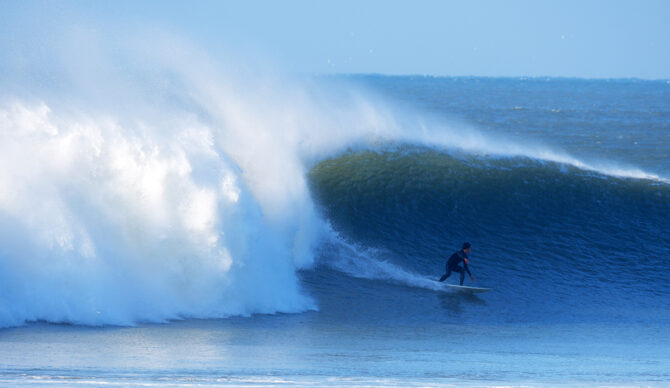
Overhead to double overhead feels different. But not that different if your head’s in the right place. Photo: Unsplash

It’s been a summer of historic south swell. I’ve surfed as much as humanly possible, tweaking my back, bruising my ribs and cracking my toe. I also realized how much my relationship with bigger surf has changed over the last five years. Here are 10 things I’ve learned over the last half decade – both during California south swells and hurricane swells back East.
The first overhead wave isn’t the intimidating part. Sitting outside waiting for the next set is.
You’re breathing hard, finally through the breakers. The swell builds in the foggy distance, and there’s something creepy about the stillness, the lack of conversation, the swoop of the gulls. The challenge is not what to do when the set comes. You know what to do. The challenge is keeping your mind still when nothing is happening. This may seem counterintuitive; but for me, if my body is still, my mind will move, so I’m paddling back and forth constantly.
Fear changes but doesn’t disappear.
It doesn’t matter if you max out in chest-high waves or triple overhead– your body and mind are going to react to perceived danger. Fear never goes away, but the meaning we attach to it changes. For me, one of the keys is to acknowledge it, breathe deep, then smile. Fear sharpens your focus until all other thoughts and concerns fade.
The hold-down is rarely worse than the one in your head.
Ensuring you know the break and nothing else goes wrong, a few more feet of wave face isn’t going to change the wash cycle. During a hold-down, counting back from 100 is what helps me now, in terms of slowing down, regulating time and keeping me locked in.
Positioning matters.
Surfing the same spots daily and really getting to know them across years has helped me pin down where to be, and when: way more important as the surf gets more serious. Trusting yourself is vital. When my local break became suddenly mobbed with new faces, I kept faith in my positioning when no one followed me. This year I also spent more time studying the surf before paddling out.
You don’t have to surf the biggest peak.
Of course, sometimes, you do. You’re feeling it and dropping into the best set wave is your goal. But for many of us, it can be just as fun to find a peak where you can work on your surfing surrounded by fewer people. If the waves are beyond your comfort zone or you’re having trouble entering the pecking order, go pick some off that are a bit smaller. You’ll leave the water stoked and probably not that upset that you didn’t ride the biggest face.
Intuitive decisions trump bravery.
On a day last year, a combination of being tired and a bit hungover, I trekked to the beach like normal. The surf wasn’t too big, but it was lonely, disorganized and blown-out. When I paddled out, both my body and mind felt really off and there was no one else around. I slunk home.
I thought I’d think about that day more, but looking back, I’m glad I didn’t push it. Confidence isn’t linear. Some days, overhead surf feels manageable based on the conditions. Some days, shoulder-high surf feels intimidating. That’s surfing.
Paddle fitness matters.
I remember, years back, checking out the surf at a spot about a mile down the beach. An older guy trotted by me. “Just paddle down,” he called out. “Easier.” At the time I couldn’t fathom paddling all that extra distance. Now I’ll happily paddle up and down the beach checking out different spots. For me, the change came not only from surfing constantly, but also working on my core and stretching and doing yoga more; as opposed to only running long distances, lifting the occasional weight, and enjoying too many fine IPAs.
Don’t dwell on wipeouts.
Playing competitive soccer when I was younger, if I started the game with a bad touch or two, it lodged in my head and was tough to get out. Years later, if I start the session off wrong, I try my best to forget about it. I think about all the talented surfers I see miss waves, or fall every session. It’s all a part of surfing, so don’t let it get in your head and hold you back: stay in the present.
Build on experience, not blind leaps.
As you become more experienced, you’ll naturally seek out bigger, faster waves. Inch up. If you’re not sure you’re ready for the size you’re in, then you’re definitely not ready for the cleanup set, or the rogue wave that clears out the lineup. Be wise to the forecast, the wind, the swell direction and period.
If you’re not ready for the biggest days of the swell, then enjoy the shoulder days that are typically mellower and less crowded. Don’t jump in thinking you’ll turn around if you’re out of your element, either: your torpedo-ride towards shore is bound to knock someone out.
The goal isn’t heroics.
Everyone wants to get out there on epic days, but don’t paddle out if you’re not 100 percent confident you can take care of yourself and your board without endangering anyone else. If you’re not sure, why not find a place where the surf is smaller, or just watch and learn?
We’ve all been out on too many days where we see people way over their heads. This creates serious problems for everyone at the break, and can have heavy, domino-effect consequences. Your limits will move, but only if you’re honest with yourself about where you are today.

