
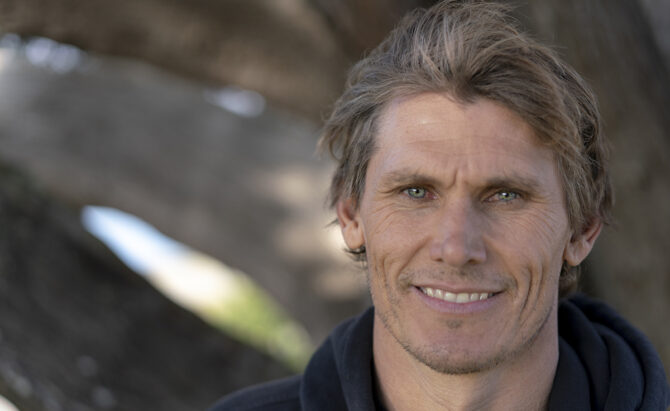
Easy, one of the best paddlers that’s ever lived. Photo: Fred Pompermayer

Shane Dorian once told me that being a waterman means, “the ocean feels like home.” Jamie Mitchell fits that definition to a tee. The kid from Coffs Harbour, Australia has made a living in the water. Heavy water. From surfing the Eddie, charging Maverick’s, and racking up double digit wins in prone paddling in the Molokai Channel, “Mitcho” is probably the most accomplished waterman on the planet. I had a chat with him to learn more about his life on the water.
How did your home break shape you as a surfer?
I was born in Coffs Harbour. It’s between the Gold Coast and Sydney. Surfing wasn’t huge for me in my earlier years. I definitely surfed, but I was more into the surf club, swimming, football, and all that sort of stuff. I would say that when I moved to the Gold Coast and was living at Burleigh Heads, that’s where my surfing was really shaped. I love those right-hand point breaks. I’m a regular-footer, and Burleigh Heads is one of my favorite waves to surf of all time. So I’d say Burleigh Heads and those right-hand point breaks were super cool.
Favorite wave and why?
I’m going to say Waimea Bay, just because of the Eddie. To be in that event… Waimea Bay is just a special place. You have unbelievable waves in the winter, and then in the summer it’s this beautiful bay where you can train, the kids can swim, and it’s just one of my favorite places on Earth. When you’re surfing out there and you look back at the church from the lineup, it’s a pretty special place. So I’m going to say Waimea Bay.
Who were your surfing idols growing up?
Tom Carroll, for sure. I loved Quiksilver as a kid growing up, and I remember Tom was at the peak of his superpowers. Tom, Ross Clarke-Jones, and then Kelly Slater as well. I was born in ’77, so those three guys were some of my favorite surfers.
How did you get an appetite for big waves?
I’d always been a kid that nothing really phased in the ocean. I loved when it got big. I loved when it got challenging. I think I’ve always had that in me. When I first started coming to Hawaii for Molokai, I got invited back to spend the winters here. I fell in love with Outer Sunset, Waimea, and the outer reefs. It just sort of progressed from there. I’ve always had a love affair with challenging myself in the ocean. Big waves weren’t something I was really scared of — I was intrigued by them and wanted to dive into them more.
What big wave shaped you most?
I can’t say just one. My three favorite waves are Waimea, Maverick’s, and Jaws. Obviously, Waimea and Jaws are warm-water right-handers, and Maverick’s is cold water. They’re all very challenging in different ways, but I feel like all three waves demand the utmost respect. The time it takes to work out the lineups, pick the right waves, and understand everything that’s going on is incredibly challenging. I just love those three waves and what they all bring to the table.
Tell us about your award-winning wave at Maverick’s in 2015.
Really, really big day. We were all on a big giant boat heading out there. There were a ton of us. Guys like Healey and Dorian were on the boat. It wasn’t a perfect day — it had a little lump to it — but it was big and breaking on the second ledge. It was actually the first day I started riding Bob Pearson’s surfboards, and he was on the boat as well. I remember I was about to jump off with a 10’11”, and he said, “Hey, just take the 10’10”.” I paddled out, and I’d only been in the water for maybe five or 10 minutes when that wave came to me. I chipped in, and it was the first wave of my day.
It was a huge wave. I got in really early, and as I was going down the double-up, I went to make my bottom turn. As I came around the bowl, I looked up and realized I was in no-man’s land. I couldn’t straighten out, and I couldn’t really pull into the barrel. It landed square on my head. I actually busted my ribs, but I had so much adrenaline that I surfed the rest of the day with broken ribs. To this day, it may still be the biggest wave I’ve ever paddled into at Maverick’s. A special wave, for sure.
What do you look for in a big-wave paddle board…what do you ride?
I ride Pearson Arrow boards by Bob Pearson from Santa Cruz. And I ride epoxy Styrofoam boards. They’re a little lighter than most guys’ boards, with a lower entry rocker. I take a lot from my paddleboarding days. My boards range from about 10’0″ when it’s really big down to around 9’4″ to 9’6″ when it’s smaller. I’ve gone a little heavier over the last few years, but I still like the feeling of a lighter board. I like being able to swing it around and get it up to speed quickly. That’s my setup.
Gnarliest wipeout?
There have been a few. Trying to pull into a backside barrel at Nazaré and breaking my back was a pretty bad one. Then breaking my sternum at Puerto Escondido, getting recycled, and nearly drowning because I couldn’t breathe was another really bad one. Those two were definitely the worst.
And all this time, paddleboarding is a huge part of your career. How’d you get into paddleboarding? How is the culture in paddleboarding different from surfing?
Like I said earlier, I was in the surf club back in Australia, so I’d been swimming and paddling since I was five years old. It was a natural transition into long-distance paddleboard racing in Hawaii. A friend of mine came over and did the race, then came back and told us all about it. I was intrigued. In 1999, I came over with a buddy and we did the Molokai teams race. It sparked my interest, and from that moment on I became obsessed. I traveled around the world doing races, and it was a super fun period of my life.
The culture in paddleboarding is definitely more mellow. There’s no judging involved. Everyone starts and finishes at the same place, and you’ve got to get there with your own two arms. No one’s telling you whether you’re winning or losing. The best paddler wins. Everyone respects each other, respects the hustle, and understands how hard these races are. There’s a lot of mutual respect. It’s definitely not as intense or as ego-driven as surfing can be.
What was your first race like on the Molokai Channel…were you nervous?
My first race at Molokai was the teams race that I did with my buddies, so that made it a lot easier. It wasn’t a solo paddle. But yeah, I was obviously nervous. You hear all these stories about the Kaʻiwi Channel, where Eddie Aikau lost his life trying to save the crew of the Hōkūleʻa. There’s this mystique about it, so you’re naturally a little nervous. But it was also super exciting for me. Standing on the beach at Molokai and looking over toward Oahu is pretty intimidating, so there were always some nerves at the start of that race.
Describe what makes the race at the Molokai Channel special.
It’s just this massive challenge. As a waterman, it’s almost a rite of passage. You have to be in incredible shape, both physically and mentally. You have to understand the wind, the currents, hydration, nutrition — there’s just so much that goes into it. It’s never a straightforward race, and you never know exactly what conditions you’re training for because they’re different every year. You’re heading into one of the most notorious stretches of water in the world. To finish that race successfully is a huge accomplishment, whether you win or come in last. My hat’s off to anyone who’s done it. It’s a really special race.
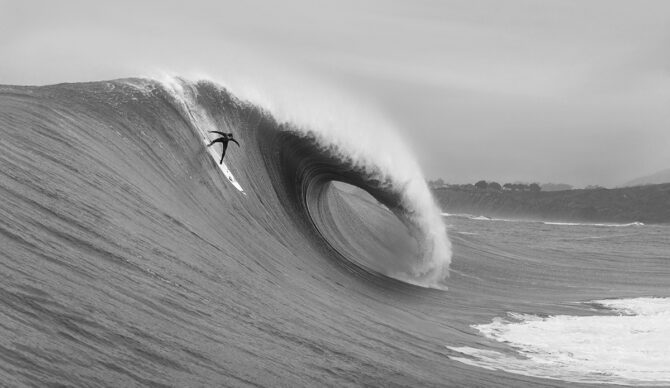
Perfection for Mr. Mitchell. Photo: Fred Pompermayer
Which win means the most to you at the Molokai Channel? Run us through how you felt and what made it memorable.
I’d have to say the first one. Everything is so foreign, and you don’t know what to expect. To get that first win is just an insane feeling. The only one that comes close is the 10th one, but that was more relief than anything else. It felt like pressure coming off my shoulders. The first one was pure joy, shock, and ecstasy.
Do you see a relationship between surfing and paddleboarding? A perfect cross training pair?
Absolutely. Surfing is about 95 percent paddling, so you become a really strong paddler. You also learn to read the ocean. When you’re paddling into huge open-ocean waves, you start seeing little entry lines that other people might not notice because of your paddleboarding experience, especially from downwind paddling.
That’s why so many big-wave surfers paddleboard in Hawaii during the summer. They train, do the races, do Molokai, stay fit for winter, and when winter comes around they’re in phenomenal shape to paddle into some of the biggest waves in the world. It’s a fantastic cross-training sport, and it’s definitely helped me.
You’re a father now, where are you in your big wave surfing career?
I’m still as passionate as ever about surfing big waves. I don’t have any sponsors or financial help these days to get to swells so I really try to prioritize the best swells of the winter. Then I focus on being home, here on the North Shore for the Eddie Aikau at Waimea. I always keep an eye on Maverick’s and Todos Santos. I competed in the Todos Santos Event last year and was invited to the Eddie and also the Pico Alto event in Peru, so if a event goes green I’ll do my best to get there and surf.
Are you disappointed with where competitive big wave surfing is at?
Absolutely disappointed where, not only competitive big wave surfing is at, but big wave surfing in general is at. We had big hopes when the WSL bought the World Tour from Gary Linden and I’m sure Gary did as well but all they really did was run it into the ground and bury it. All they have now is a tow event in Nazaré which is pretty lame. I know Gary is trying again to do something which is cool but it feels like we’re starting all over from scratch. Thank god for the Eddie Aikau event and all the other local events around the world that get put on throughout the year, so at least some competition can be run. The content is so amazing from big wave surfing and the numbers are so big from these giant swell events that it’s crazy to me that people haven’t got more creative with ways to utilize the athletes and Mother Nature. A few years ago, myself and a business partner put together the 20-foot plus program with Surfline and we thought that was going really well but they had a big change in management internally and that got shelved as well. So yeah, it’s disappointing that there is not more opportunities for all the amazing athletes, the men and women who chase these waves around the globe. Especially with El Niño brewing this year.

