
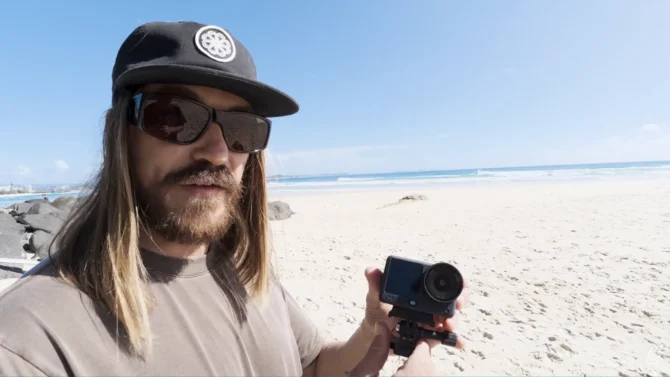
Sometimes a plug comes from the heart. Photo: Dylan Graves // YouTube

Dylan Graves is great at finding weird waves. However, all that skill wouldn’t be worth much if he wasn’t able to show them to the rest of the world.
In his latest YouTube post, he gave a breakdown of some of the ways he achieves that. Though the video seems to be a pretty clear plug for his camera of choice, the DJI Osmo Action six, it also has quite a few pearls of wisdom for those aspiring to capture their own POV footage:
Shoot square and crop later
To surf well, you don’t want to have to think about your camera the whole time, and you certainly don’t want to think about whether it’s in the proper aspect ratio. “If you want to use it for social media later you have the vertical option, and if you want to use it in landscape kind of main edit, you can use that as well,” says Graves. “You don’t really have to think too much. You just can bolt this thing where you need to and then you have all the flexibility to use it however you want to.”
Shoot flat to match other camera footage
For a full surf edit, it’s unlikely an action camera will be the only source of footage, which means being able to seamlessly switch between multiple sets of footage is important. “This shoots in D-Log, which I use on all my other cameras and other people who are on the trips with me are shooting,” he continues. “We can match the camera, whatever I’m shooting on mine, we can use the same color profile in post to match what you’re shooting.”
Use a strong mount
Of course, all that is useless if you lose the damn thing. “The magnetic mount thing for me is pretty insane, because if I want to go from the mouth mount to say a selfie stick, I can go straight from this guy like that,” he adds “It’s super strong. I haven’t lost a single camera off of any of these.”
Be able to shoot in low light
There’s a lot of obvious setbacks to trying to film surfing, but a less obvious one to the layman is the lighting. “As most surfers know, we kind of end up surfing early or late. Those are usually some really good, magical windows,” explains Graves. “I actually had a trip recently to the top of Norway, where the sun never rose, so it was just a perpetual sunrise or sunset. We didn’t really have light the whole time.”
Audio quality matters
“I end up using the mic on this more than anything,” says Dylan of the camera’s audio quality. “It all sounds really clear, even in the water, even with being in the impact zone. It still captures enough usable audio in that scenario, which is probably the hardest place to capture audio anywhere…Even if someone else is shooting the scene with shotgun mics, I’ll keep running this the whole time, so we have audio the entire time that’s usable.”
Always be prepared
In the end, the old adage holds true: the best camera is the one you have on you. “If I don’t know what I’m going to be shooting, I always put this thing in my pocket and just have something on me regardless, that way you know it’s going to deliver high quality stuff, both on the audio side and the visual side.”

