
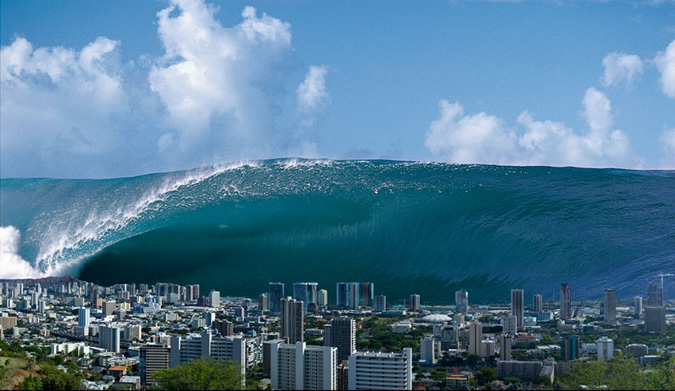
Let’s save the planet before something drastic happens. Image: Sean Davey

On September 9th, 2014, NBC news published an article from the U.N. declaring carbon dioxide levels hitting record heights for 2013. The world Meteorological Organization is reporting global levels of 396 parts per million. That is an increase of 2.9 ppm from 2012 and, even more shocking, a 42% increase from the industrial age.
Why does this matter? Increasing carbon dioxide creates heat trapping within the earth’s atmosphere causing ocean temperature increase and glacier melt. With this comes an array of disastrous consequences including sea level rise, presenting immediate danger to coastal cities. The Intergovernmental Panel on Climate Change has projected a rise in temperatures of nine degrees in the next century. At this rate, many of the world’s costal cities will be flooded. Then what?
With increasing temperatures also comes the devastation of our world’s largest ecosystems. Major imbalance of ocean temperature leads to coral reef extinction, the Great Barrier Reef to name one. Without these major ecosystems intact, the ocean and plant life become less capable of absorbing poisonous carbon dioxide emissions being released at high rates from industrial, agriculture and domestic fossil fuel operations. The excess carbon then accumulates in the atmosphere resulting in historically high amounts of greenhouse gases. Oksana Tarasova, a scientist and chief of the WMO’s Global Atmospheric Watch program, which collects data from 125 monitoring stations worldwide, stated, “If the oceans and the biosphere cannot absorb as much carbon, the effect on the atmosphere could be much worse.”
To top it off, higher levels of greenhouse gases in the atmosphere directly relates to increasing acidification of ocean water. An acidic chemical composition disrupts life cycles of many marine species and thus that of human life. Humans are dependent on the ocean as a major source of food and also for recreation, business and educational purposes. If carbon dioxide levels continue to rise at current rates the future health of our oceans and human survival is at high risk. Ocean pollution tends to be pushed in the back burner as for many it is out of sight and out of mind, but the truth of the matter is that the ocean directly correlates to our own lives, and if it goes down, we all go down.
The debate as to whether or not global warming is a natural process is ongoing. However, what about the ethical and moral debate that we are in fact poisoning that which gives us life, and thus poisoning ourselves? As humans who live on this earth, don’t we have an ethical and moral obligation to care for the environment in which we live if we want to live the healthy, prosperous and free lives that have been made possible for us?
What it takes is the conscious effort of each individual to monitor daily practices as to how one contributes to the rise of atmospheric CO2. What can each individual do to minimize his or her impact? What solutions can be implemented that can start creating positive global change right now? It’s not only the job of the engineers, scientists, and technicians to figure out but it takes the participation of each and every individual. Yes, this means drastic life changes on many levels and urgency for renewable energy and new societal structures. Structures that hold big corporations and agricultural industries responsible for their overwhelming contribution to the destruction of our earth home.
I can’t speak for everyone, but I know that I don’t want to wait around to see what happens when our oceans are pushed to the limits of CO2 absorption and acidification. I prompt readers to stop and think right now – “what can I do personally, within my community/business or on a state/national level to ensure a healthy ocean for seven generations to come?”
Respects,
Mary Flemming
Sources
1) “U.N. Report Finds Carbon Dioxide Levels Hit Record High in 2013 – NBC News.” NBC News. Ed. Associated Press. NBC World, 9 Sept. 2014. Web. 11 Sept. 2014.

