
Author’s Note: We’d like to make it clear that this article is a combination of two perspectives, hence the regular and italicized type faces. The italicized words belong to Carapace co-founder Alex Wang while the upright words belong to co-founder Andrew Park. Enjoy!
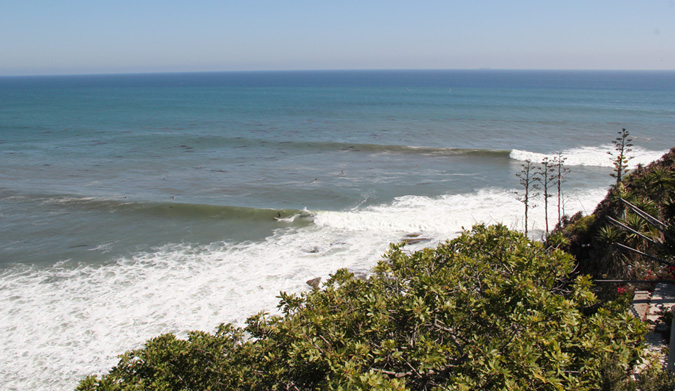
This is what we call home. Photo courtesy of Carapace Wetsuits
How the hell did it come to this? I was gathered with a group of my friends who had all come to cheer me on in a petty high school fight and my opponent was pacing back and forth about 50 feet away.
Suddenly, I saw everyone get up and start running away. “He’s got a bat!” someone shouted. That’s when I turned around and saw the menacing 220-pound, 6-foot, 5-inch figure with whom I had apparently started “beef” running at me with an aluminum baseball bat. He swung and the bat connected with my arm. I fell to the ground and began rolling around as he repeatedly swung. Luckily, my friend came and took a bat to his elbow that was otherwise intended for my head. We all got up and ran.
Earlier in the day, a few guys from Torrance had come to my school to start trouble, and I was the lucky target. We did the classic stare down thing and it quickly escalated.
Shortly thereafter, rumors swirled and it seemed like the entire South Bay was talking about the incident. Amid all the tension, Andrew showed up at our school the very next day and was falsely recognized as being part of the group of people that we’d just fought with.
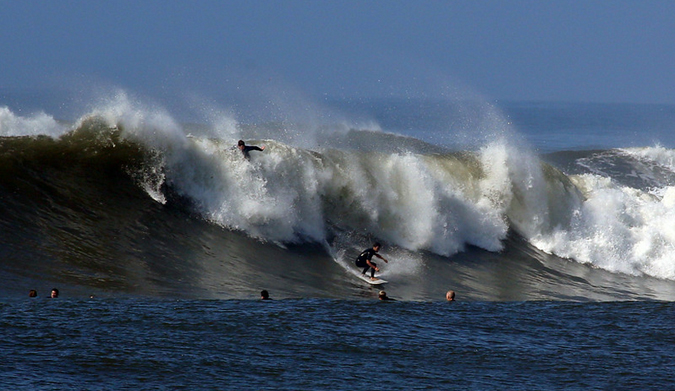
Co-founder Andrew Park at a local break. Photo courtesy of Carapace Wetsuits
I can still clearly remember my first encounter with Alex. Northwest swells were firing, and I had just finished an incredible session at a pristine pointbreak in Palos Verdes. I dropped by my girlfriend’s school, which I typically did after surfing. To my surprise, I was greeted by ten angry guys who were ready to rip my head off.
An epic surf session turned into a near ass beating. Tempers flared and accusations were thrown in my direction. I had no idea what I was going on much less what was going to happen to me next. With a bit of luck, a mutual friend of ours stepped in and thankfully broke up the confrontation. The misunderstanding was cleared up in a dramatic and timely fashion.
After that altercation, there remained a bit of tension between us. I would bump into his crowd of friends at parties, but nothing ever transpired. Certainly no fights. But high school being what it is, things got out of hand like a game of telephone and we were far from being on good terms. Regardless, we went off on our own separate, very different paths.
That incident made me seriously reprioritize things in life and I began focusing all of my energy on school and work. That summer, I received a letter of acceptance to UC Berkeley, and I charged headlong into the world of academia. Shortly after graduation, I signed onto a $20 billion commercial real estate firm. The first year, I personally brought in over $10 million worth of deals and things were going well. But as the months trickled by, I realized I wasn’t happy. I was burned out making 400-500 cold calls per week – most of the time alone at night in a cubicle, neglecting my health and relationships. To make matters worse, I came into the office one day to find one of the seniors at the firm calling my clients. Despite my personal success in the field, I began to see that it was a dog-eat-dog world and realized this probably wasn’t a place or industry I wanted to be in. Corporate real estate seemed to bring out the worst in people, including myself.
I found myself continually daydreaming about doing something completely different – collaborating with people, building something innovative. I was determined to find that.
It’s easy to see the value of traditional education, but I felt as if it had a very focused function. Some things can’t be taught let alone understood within the confines of a classroom. I wanted to see what was out there and experience the world through a different lens so after my 1st semester, I dropped out. My early 20s were spent working odd jobs – construction, painting, and photography – and surfing every break I could in Southern California. All I wanted to do was immerse myself in surfing, so I consumed everything I could about the industry and the lifestyle. I became a student of surfing.
Since I understood the ocean and surfed almost every day, I got my first real job as a beach lifeguard and was surrounded by all kinds of watermen – scuba divers, surfers, spear fishermen, and competitive paddlers – and further developed a passion for water activities, particularly in the equipment that was involved. I liked understanding what materials, construction, and design made a product perform best in the water and had hundreds of ideas on how to improve the equipment we used every day.
Everything went smoothly, but this career path wasn’t enough and I wanted to create something. I had to learn how to run a business and I decided to join my father at his company, working under him. It was there I learned how to take an idea and bring it to life.
During those seven years, I never once thought back to that high school fight. Then one day, by chance, I was introduced to a new friend because of our shared passion for surfing.
We met at Hometown Buffet, and I was shocked to see it was Andy. It had been over six years since that incident in high school. Honestly, I was wary of meeting him, but to my surprise, we hit it off immediately. Afterwards, we made plans to paddle out together. Soon, it became a regular occurrence for us to meet up for an early morning surf.
It seemed funny that surfing was the sole catalyst for our change in relationship. We went from semi-enemies to good friends within a short period of time because of it. We both understood there’s a lot to learn about someone’s character through surfing, and I learned a lot of good things about him.
After a few encounters with Alex, we started paddling out regularly. Naturally, we began talking about our gear, and time and time again, wetsuits came into the conversation as being something that could be dramatically improved. I saw functional improvements that could be made while Alex saw an opportunity to improve fit.
What was more fascinating is that we found there was a strong interest in custom-fit (a few brands even attempted it), but it had never been successfully executed due to the complexities of supply chain logistics and scalability issues. Only a few small shops in Japan and custom manufacturers made high-end, custom wetsuits, but the sky-high prices made them inaccessible to most of the surfing world. We put the pieces together and a light bulb went off. There was our opportunity.
Could we make a premium, custom-fit product at half the price of a Japanese-made wetsuit? If we went with traditional methods, the answer was no, but at this point, we were determined to find a solution. We looked to technology. We found that this could work by selling direct to consumer and using sophisticated CAD technology in place of hand-drawn patterns.
Things moved fast and we had our fair share of challenges. Every manufacturer turned us down, so we took a year to research and went through the painstaking process of learning to blind stitch sew and operate CAD software. We spent up to seven hours building each wetsuit and inhaled our fair share of chemicals we shouldn’t have inhaled before we came up with the final prototype. From there, we began discussions with Mark Malinski, GM of Body Glove, and with a bit of luck, he signed on to help us with our nascent wetsuit company. Mark guided us through this product development phase and taught us how to make a damn good wetsuit. From there, we took the leap and Carapace Wetsuits was born.
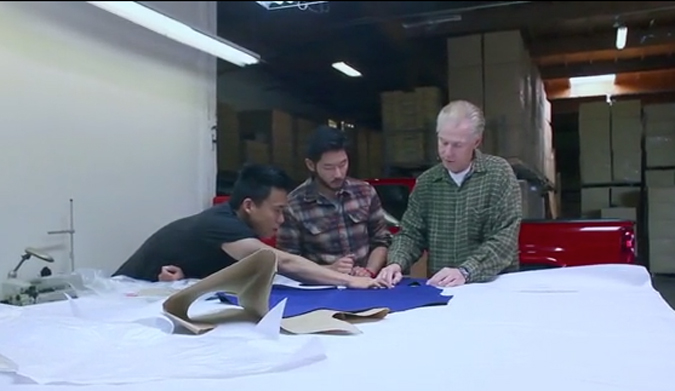
Alex (L) and Andrew (R) roll up their sleeves and get to work with Mark Malinski. Photo courtesy of Carapace Wetsuits
Just 11 months later, after successfully raising $23,510 on Kickstarter, we’ve added dozens of wetsuit products and got nods from some of the industry’s best. But what excites us most is the way our product has transcended different communities, from core purist surfers like Robert August to technology magnates, and everyone in between.
It’s crazy to reflect on my relationship with Alex. Surfing has transformed our relationship from its awkward beginnings to a friendship, and finally, business partners. The paths that brought each of us here were drastically different but contributed to our current synergy as co-founders.
To all of you, Carapace Wetsuits is a custom-fit wetsuit company. For me, Carapace is my daydream brought to life. For Andrew, he’s found the career path that is the sum of all his aspirations. I’m not sure what’s ahead as it’s been a series of unexpected friendships, unimaginable challenges, and bit of good luck. Surfing has been the medium for all of this and I wouldn’t have it any other way.
Learn more about Carapace Wetsuit’s custom-fitting process at carapacewetsuits.com and keep up to speed with their developments on Facebook, Twitter and Instagram.
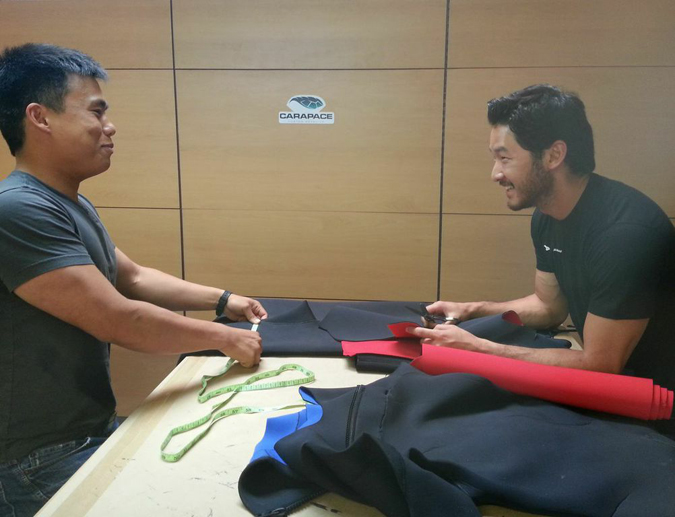
Alex Wang (L) and Andrew Park (R) of Carapace Wetsuits.

