
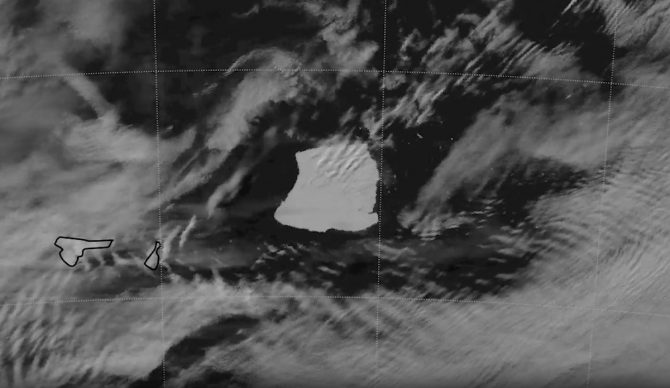
A23a, an iceberg currently trapped spinning in place in the Weddell Sea. Photo: NOAA

A23a is the world’s biggest iceberg, roughly the size of Rhode Island and weighing nearly a trillion tons. It’s also currently stuck spinning in place in the ocean just north of Antarctica, as the BBC reports.
The story of A23a began nearly four decades ago, when it first broke free from the Antarctic coastline in 1986. However, the ‘berg quickly stuck in the bottom muds of the Weddell Sea, where it remained stationary until 2020, when it floated again and began to move farther north. In April of this year, A23a entered the Antarctic Circumpolar Current, which should have sent the ice straight into the South Atlantic to melt. However, instead, it just went nowhere, trapped in place just north of the South Orkey islands, slowly rotating counter-clockwise.
The reason is that A23a became trapped on top of a rotating cylinder of water called a Taylor Column. Taylor Columns in the ocean arise when, under certain conditions, topographical features of the ocean floor redirect ocean currents into a vortex. In this case, the column is caused by a 100km-wide rise known as the Pirie Bank.
“Taylor Columns can also form in the air; you see them in the movement of clouds above mountains,” Prof Mike Meredith from the British Antarctic Survey told the BBC. “They can be just a few centimetres across in an experimental laboratory tank or absolutely enormous, as in this case where the column has a giant iceberg slap-bang in the middle of it.”
It’s hard to say how long A23a will be trapped in its spinning purgatory. However, a buoy placed in another Taylor Column in the Southern Ocean remained in place for four years, so the iceberg could be stuck there for a while.
“Usually you think of icebergs as being transient things; they fragment and melt away. But not this one,” polar expert Prof Mark Brandon told the BBC. “A23a is the iceberg that just refuses to die.”

