
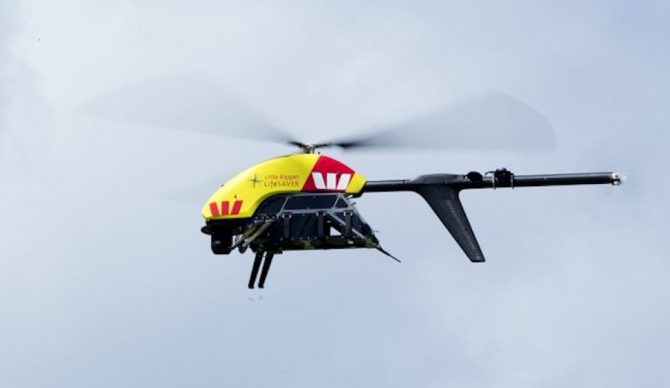
A drone equipped with an algorithm that promises to spot sharks with 90 percent accuracy may be the solution to increases in shark/human run ins. Photo: Westpac

Amid heightened fears of shark encounters throughout the United States and Australia, a drone company plans to harness the power of unmanned aircraft to monitor sharks in lineups.
Professor Michael Blumenstein, the Head of the School of Software in the Faculty of Engineering and Information Technology at the University of Technology Sydney (UTS) worked with Australian drone company Little Ripper Group in cooperation with Australian Bank Westpac to develop an algorithm for their drones that can spot sharks in the lineup with upwards of 90 percent accuracy. Compare that to humans in boats or helicopters that identify sharks with 20 to 30 percent accuracy, according to Nabin Sharma, a research associate at UTS’ School of Software.
Last year, Australian authorities together with Little Ripper Group launched an $180,000 pilot program to demonstrate the program’s viability. According to reports additional trial patrols are due to begin next month at beaches in Queensland and New South Wales.
In addition to being capable of spotting sharks in the water and relaying information to computers on the ground, the drones are equipped with a siren and pre-recorded voice messages in different languages to alert people in the water below. They can also deploy rescue tubes capable of supporting four people.
Public pressure to act in the face of a perceived increase in global shark/human encounters has resulted in controversial shark nets, and calls for culls wherein public safety advocates are often pitted against environmentalists. This new technology if as successful at spotting sharks as it claims, may bridge the gap between the groups that have been hard pressed to find middle ground in this debate.

