
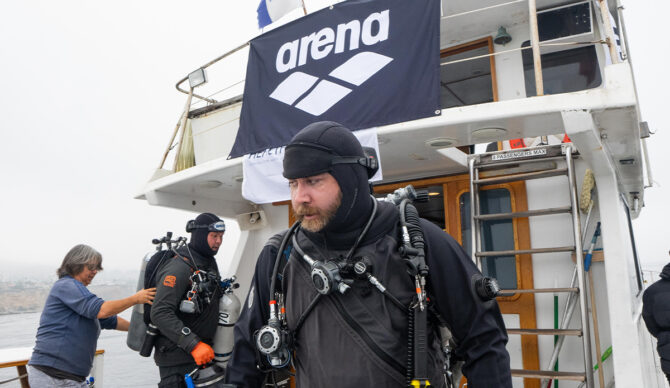
Divers prepare for the difficult work of retrieving abandoned fishing gear. Photo: Jack Spitser//Arena

The horn shark hardly moved. Caught in a web of nets, its spotted belly was marred by rope burns. But the animal was still breathing when diver Shane McWilliams began the delicate work of cutting it free. The shark was a victim of ghost fishing: the unintended capture of wildlife by lost or abandoned fishing gear (or ghost gear). The nets draped across the sunken San Vito tuna clipper, which went down in 1985, likely lured the shark as it pursued other trapped fish and invertebrates. It was August 2023, and McWilliams was 170 feet down off the coast of Catalina Island, volunteering for Ghost Diving USA (GDUSA), a nonprofit dedicated to removing ghost gear from the ocean.
“Part of our procedure is to scan the wreck totally to see if animals are stuck, where we can,” McWilliams explained when I spoke to him. “In our initial scan, we saw [the shark] but we didn’t think he was alive.” But on a second pass, a teammate saw the shark’s gills moving, so Shane freed it.
“I actually swam him around in my hand for almost 15 minutes, just getting water to pass over his gills,” McWilliams recalled. “Horn sharks can do that manually. They don’t need to be in motion. But he was so tired, and we didn’t know when he had eaten last. He had no energy left.”
Shane stayed with the shark until he physically couldn’t. Deep dives like the ones conducted for ghost gear retrieval are physically taxing, deplete tanks quickly, and require calculated ascents with timed safety stops for off-gassing. That’s one of the many reasons why the cleanup missions GDUSA performs require repeat visits; most divers can’t stay down too long.
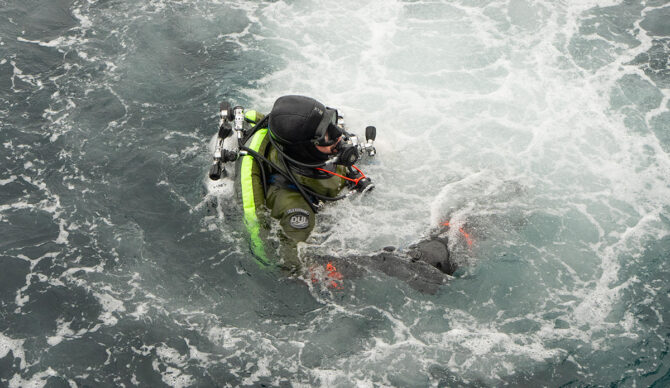
Diving for ghost gear is exhausting work, often requiring multiple trips. Photo: Jack Spitser//Arena
On November 1, I joined Shane and the GDUSA team on a cleanup mission to the Jenny Lynne, a shipwreck that sits 145 feet down off Long Point, Rancho Palos Verdes.
The mission was funded by Healthy Seas (a nonprofit dedicated to marine cleanup and education) and its partner, Arena (an Italian swimwear manufacturer that recycles recovered ghost gear). According to Arena’s Steve Ozmai, “Healthy Seas has grown to the point where, through partnerships like Arena’s, they’re able to actually pay for all of the supplies for the ghost divers. But their time is fully volunteered. There’s no compensation. So, they’re just out there because they’re passionate about what they do.”
The team had chartered the Sundiver, its crew, and a smaller rigid-hulled inflatable boat (or RHIB) to chase down ghost gear as it surfaced.
When we left the harbor in Long Beach, it was about 7 a.m. The world was still, and the sky was white with fog. Shane was the first diver I spoke with, but the GDUSA team likewise included Michael Gasbarro, newly-appointed chapter President & CEO Curtis Wolfslau, and a handful of others. Shane had been to the Jenny Lynne before. He spoke to his teammates in jargon I did my best to understand, explaining that the wreck lay on its side, and that the bulk of the day’s cleanup concerned the nets draping its mast.
It took two hours to get to the site of the wreck, which looked like any other stretch of blue-green ocean. That’s part of what makes education essential for GDUSA and Healthy Seas. “When people don’t see a problem, they don’t consider it a problem,” Shane remarked. Above the surface, you would never know a wreck sat on the ocean floor, collecting nets.
The divers broke into separate teams. Shane and his team planned a 30-minute dive, while Curtis and Michael planned for an hour. After the anchor dropped, the divers jumped into the water and sank out of sight. Their 145-foot descent took only two minutes.
I moved across the bow, somewhere above Shane, as inflated orange lift bags popped up to the surface, carrying bundles of nets cut free from the wreck. Crew members chased down the bags in the RHIB, as the Sundiver’s captain, Kyaa Heller, joked they’d float “halfway to Malibu” if they weren’t retrieved in time.
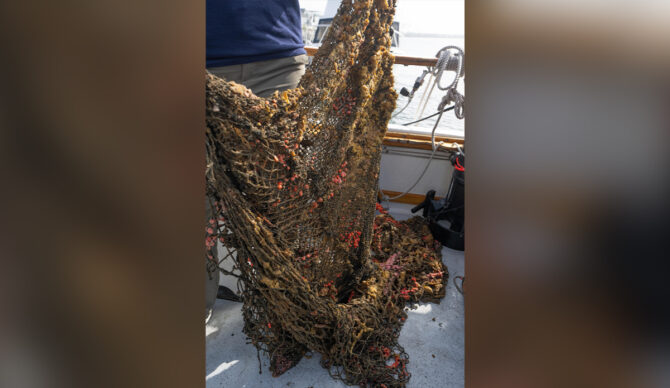
Ghost nets, after being retrieved off the bottom. Photo: Jack Spitser // Arena
When the nets came on board, they were teeming with life. Tiny crabs and brittle stars crawled among them, and what looked like pieces of pink coral covered silty strands of rope. The small world of life in the net prompted Captain Kyaa to explain why she was on the fence about net retrieval. She questioned whether or not the benefits of the cleanup made uprooting these bits of sea life worthwhile.
We broached the topic of returning the small creatures to the ocean, but the vessel’s captain asserted they would just become “fish food on the way down.”
When Shane and his faction resurfaced, I was eager to ask about the pros and cons of net retrieval, and what kind of wildlife they’d seen. But Shane hadn’t made it to the wreck at all.
“You drop and then it’s this 360 degree spherical world of nothing.” Shane explained, still coming out of his gear. “It’s dark, on top of (that), it’s silty,” he gestured to his left, “I couldn’t have seen that railing underwater.”
When the divers dropped, they kicked up silt and sand. And without a current, Shane explained, “you just sit in it.” Reaching a wreck in poor visibility comes down to chance. “It could be three feet this way,” Shane pointed in opposite directions, “and I make the choice to go that way.” But Curtis and Michael had reached the wreck, and cut nets free. They were still underwater.
All parties hoped to complete cleanup work on the wreck that day, though Shane now doubted they would. “I don’t think they’ll finish the wreck,” Shane said as he motioned to the nets on the deck, “that doesn’t look like what was left on the mast.” I asked about the creatures in the net. Shane identified the bulk of the biomass as strawberry anemones, or Corynactis Californica, a marine animal closely related to stony corals.
“There’s trillions of ‘em” Shane explained, “we’ve weighed the pros and cons. And even a few thousand strawberry anemones isn’t worth the risk of a mammal or a larger animal getting stuck.”
Shane described a kind of trolley problem that prioritizes life at the top of the food chain, save for circumstantial exceptions, like Farnsworth Bank, a series of underwater sea-mounts about 1-2 miles off the shore of Catalina Island. The site is famous for its imperiled purple hydrocorals. They grow slowly, and are less abundant than strawberry anemones. Because parts of the site are open to fishing, purple hydrocorals grow on ghost gear that GDUSA is hesitant to remove.
But, whenever possible, GDUSA prioritizes the long-term health of a site, and removes as many nets as it can. Beyond trapping wildlife, ghost gear leaches microplastic into the water. The divers want to eliminate hazards.
That’s why, in addition to the nets Curtis and Michael were able to remove, they also floated up a stainless steel anchor they found. The anchor wasn’t from the Jenny Lynne, and had probably been lost or snagged on the wreck by another boat.
When they finally resurfaced, Curtis and Michael detailed their dive. “Visibility was not great” Michael said, “so we basically crash landed on the bottom.” Curtis decided to head east, and the pair found the wreck. “At first we checked [the wreck’s] anchor,” but Michael noted that such a small amount of gear was tangled in it that it wouldn’t be worth “ripping off certain invertebrates and shells if we pulled that off.”
The pair found a net hanging on the wreck’s mast. “It was just tied with one rope,” Michael explained, “we put two lift bags on that, cut it, and up it went.” Before their ascent, they attached an inflated lift bag to a stubborn piece of net they didn’t have time to free, and left the wreck. “Hopefully that bag stays inflated,” Michael said, “but we’re going to have to go back.”
In terms of not completing the cleanup on the Jenny Lynne, the team didn’t seem too defeated, as GDUSA’s work is never really done. Shane presented a paradigm. Structures like shipwrecks attract fish, and fish attract fishermen. Thus a wreck is always a major draw for both fish and ghost gear. “We never pull a site from our working list,” he explained, “because we could have finished this wreck today, and tomorrow somebody could’ve deposited more fishing gear.” That’s why informing mariners and fishermen about ghost fishing is so important.
“We certainly do not want to vilify the fishermen,” Shane asserted, “all we want to do is, say ‘Hey, did you lose your gear? We could go get it for you and potentially salvage it and give it back.’ I just don’t want it in the water all the time.”
And though the wrecks GDUSA visits always remain on their working list, the organization considers a wreck complete when it’s no longer covered in nets capable of catching larger fish or mammals. Even after a wreck is considered finished, Shane explained it still might have gear attached, “but if it’s not actively fishing, it becomes hard to justify the cost [of another cleanup mission].”
In fact, the bulk of the disappointment Shane expressed that day was almost entirely related to the use of chapter funds. In reference to the gear, gas, and charter, Shane lamented, “It’s not an inexpensive day for the chapter.”
But the team was confident they’d complete the wreck soon. As we spoke on our return trip, Curtis detailed initiatives like training more volunteers on closed circuit rebreathers, for longer deep dives in order to lessen the need for repeat visits. And despite the low-visibility, Shane insisted this old adage holds true: “A bad day underwater is always better than a good day at work.”

