
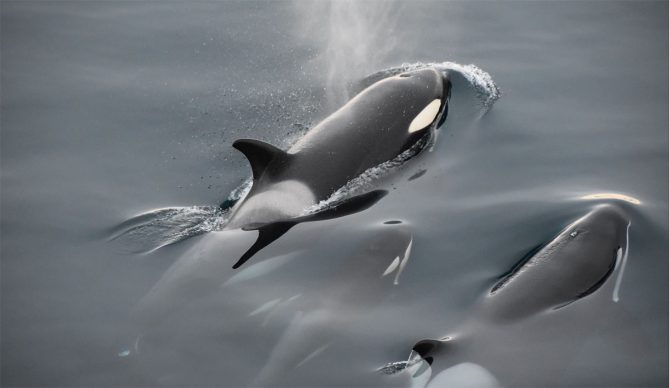
Photo: Unsplash

A new use for an old technology may give us a novel method of studying orcas. A team of scientists at the University of Washington are currently attempting to use fiber optic cables to study orcas in the Salish Sea.
The technology, called Distributed Acoustic Sensing (DAS), uses fiber optic cables, like the kind used to transmit internet signals, as continuous underwater microphones. DAS was first developed to monitor pipelines, but now it’s being used to listen to the ocean.
“We can imagine that we have thousands of hydrophones along the cable recording data continuously,” Shima Abadi, professor at the University of Washington Bothell School of STEM and the University of Washington School of Oceanography, told the Associated Press. “We can know where the animals are and learn about their migration patterns much better than hydrophones.”
The fiber optic cables used in DAS are already in place on the ocean floor, and could therefore be turned into a massive network that would be able to pinpoint the exact location of animals and the direction they’re heading in. The technology has already been successfully used to record fin whales and blue whales, but the more recent efforts to track orcas will be a much more difficult task, owing to the higher frequency of their calls.
However, if it does work, the technology could prove instrumental in aiding conservation efforts. “It will for sure help with dynamic management and long-term policy that will have real benefits for the whales,” said Scott Veirs, president of Beam Reach Marine Science and Sustainability.
“One of the most important challenges for managing wildlife, conserving biodiversity and combating climate change is that there’s just a lack of data overall,” added Yuta Masuda, director of science at Allen Family Philanthropies, which helped fund the project, adding that, “We think this has a lot of promise to fill in those key data gaps.”

