
While overcoming fear, gender disparity, racial divides and age barriers, many South African women have embraced surfing — particularly longboarding. They perform that seemingly effortless dance with style and grace as they cross step their way to what Californian philosopher and surfer, Aaron James calls “the ultimate freedom in aquatic sports.”
“The surfer’s spray flies off the surfboard, into the air, and then rains into the ocean medium, being reabsorbed completely. In…[a] snap in the wave pocket, the spray will erupt in a fanning plume, with an existence as evanescent as a passing fancy. There’s “no trace left behind,” says James.
While this might be true of surfers riding waves, if beachside coffee behaviors are anything to go by, it seems some of us ocean users are leaving a trace. We’re leaving a plastic one.
At the South African Longboard Champs in Durban last year, one of our talented South African women longboard surfers, Diony Lalieu, was struck by the irony that contestants were being given plastic water bottles. Those who live and breathe the stoke of the ocean should surely not make a mass contribution to the wave of plastic that is choking it?
Diony’s eco-epiphany inspired her to create Ocean Pledge, a movement to encourage surfers, stand up paddlers, divers, and even the bucket and spade brigade on South African shores to pledge a change in their plastic habits. As a woman empowered by the ocean in many ways, Diony wanted to use that energy to pay it back.
She has appealed to many surfers, male and female, to rethink their habits and refuse and reuse. “If each person makes one small change, we can turn the tide on plastic,” she says.
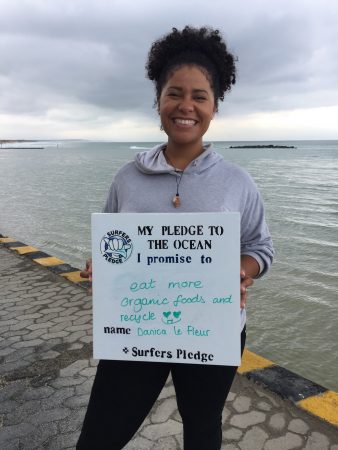
Danica le Fleur 9 Miles Project
Diony hasn’t stopped there. She believes that surf contests should lead from the front in reducing and refusing single-use plastics. The WSL sets the bar high in South Africa at the JBay Open, making the contest area a plastic-free zone, and facilitating a beach cleanup after the event. But other surf events on South African shores are not plastic free and the cogs of local legislation turn slowly. So Ocean Pledge stepped up with a mission to make South African surf contests sustainable and single-use plastic free. Their flagship plastic-free Blue Ocean Event was this year’s South African Longboard Champs, which took place last month in the chilly West Coast waters of Lamberts Bay.
The Southern African coastline is blessed with one beautiful surf break after another. From Donkey Bay down to Elands, from Kommetjie to JBay, from the Wild Coast to New Pier, from Ballito to Ponta do Ouro, and so many in between, our ocean deserves our attention. We all need to step up and take responsibility for every single piece of plastic we use, because when we throw it away, in reality there is no “away.” Our waste either goes to recycling (but despite best efforts this is unlikely), to landfill or directly and indirectly into our rivers and oceans.
Surfing is the muse that inspired a wave of women to be empowered and uplifted by the ocean. Let it also be the muse to inspire change.
I think Aaron James is right. Surfing is the true “ideal limit of aquatic sports.” In his view, “surfing ….. is a full, maybe the fullest, expression of the free human’s natural state of being.”
As beneficiaries of this ultimate freedom, male and female, should we not bear responsibility toward the medium of our playground, this ocean that inspires and empowers us?
James asks this question of us: “What should we do in a world in which ecological resources are a lot scarcer than they have been? Just party on?”
Sure. If it’s a sustainable one. So, when you’re in Cape Town, hit up Ocean Pledge, and make a promise to change your plastic habits. And if you’re not this far south, make your own resolve to be part of the change. Refusing plastic is not that tricky. Just say no.
Because there really is no excuse for single use.
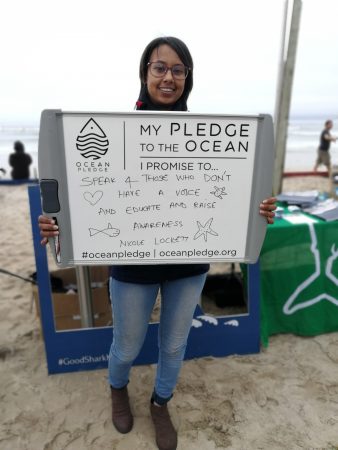
Nicole Lockett – Shark Spotters

