
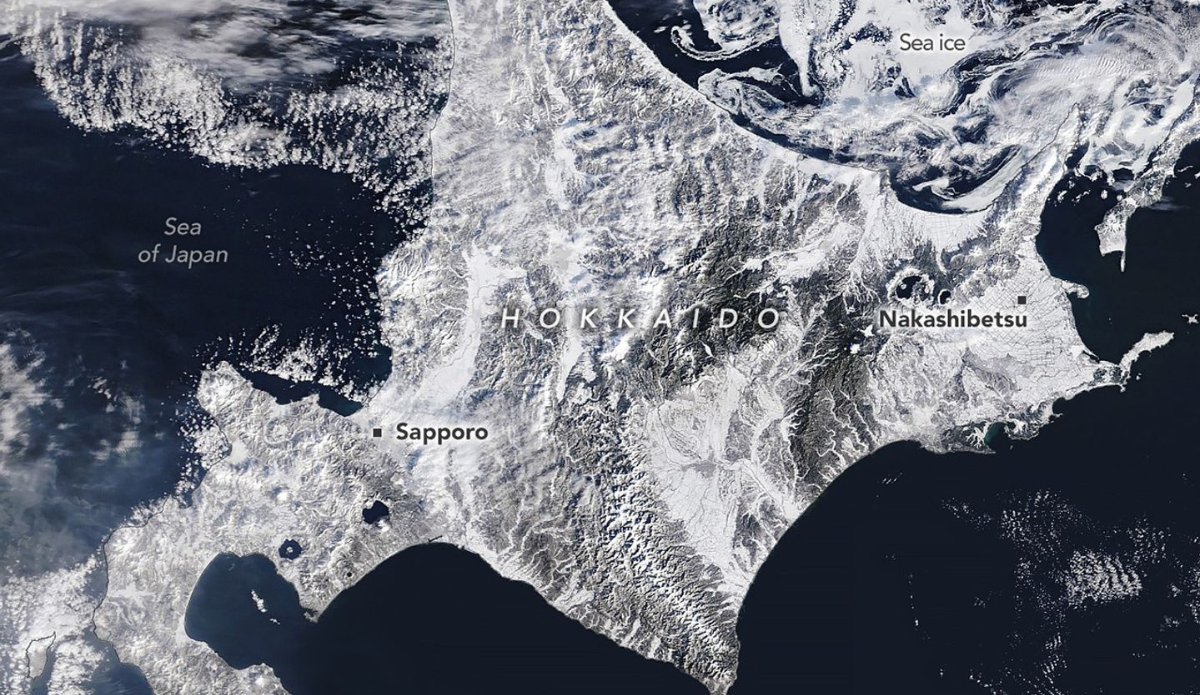
Japan’s Northern Island, Hokkaido, is completely covered in snow on February 5, 2026. Photo: NASA

Just how much does climate change influence major headline-making weather events around the world? Can it be quantified? An analysis released by the Japan Meteorological Agency this month has just offered an answer to both of those questions.
Heavy snowstorms over parts of Japan made international headlines earlier this winter. Powder hounds were in heaven, but the storms were wildly disruptive to everyday people in some regions. In Aomori, for example, more than 1,700 homes were left without electricity and troops were called in to clear roads, tracks, and more. Dozens of citizens died during the late-January stretch of storms, mostly as a result of falls that occurred while clearing snow from rooftops.
The recent analysis from the nation’s science institute involved simulations of conditions attributed to “human-caused” climate change compared to conditions of a hypothetical climate without the impacts of human-caused climate change. The colder regions around Japan (northern Japan, particularly) were found to have experienced a seven-percent increase in snowfall. The reason for this is because warmer air (the long-term rise in the Earth’s average atmospheric and ocean temperatures, and the logic behind the original term “global warming”) delivers more intense precipitation. In colder regions, that precipitation will obviously be delivered as snowfall. Meanwhile, the study determined that the same weather event in western Japan resulted in more rainfall rather than snow.
“For the time being, the impact of global warming may increase the amount of water vapor, raising the risk of greater snowfall,” said Hisashi Nakamura, a professor emeritus at the University of Tokyo, and chair of the Japan Meteorological Agency’s abnormal weather analysis committee. “Although the link between global warming and increased snowfall may be contrary to our intuition, we still need to stay prepared for snow.”

