
Alesia Kazantceva//Unsplash

The National Oceanic and Atmospheric Administration (NOAA) has released its latest 2025-2026 winter forecast. The outlook for the upcoming La Niña winter remains similar to October’s roundup, with the November report pinpointing U.S. regions the Climate Prediction Center (CPC) expects to get the most snow.
“The December-January-February (DJF) 2025-2026 Temperature Outlook favors above-normal temperatures across much of the East Coast, Southeast, Gulf Coast, Texas, the Southwest, and California. The DJF Temperature Outlook leans towards below-normal temperatures from the Upper Mississippi Valley and Northern to Central Great Plains west to parts of the Pacific Northwest. An increased chance of below (above)-normal temperatures is forecast for southeastern (northwestern) Alaska,” wrote the CPC.
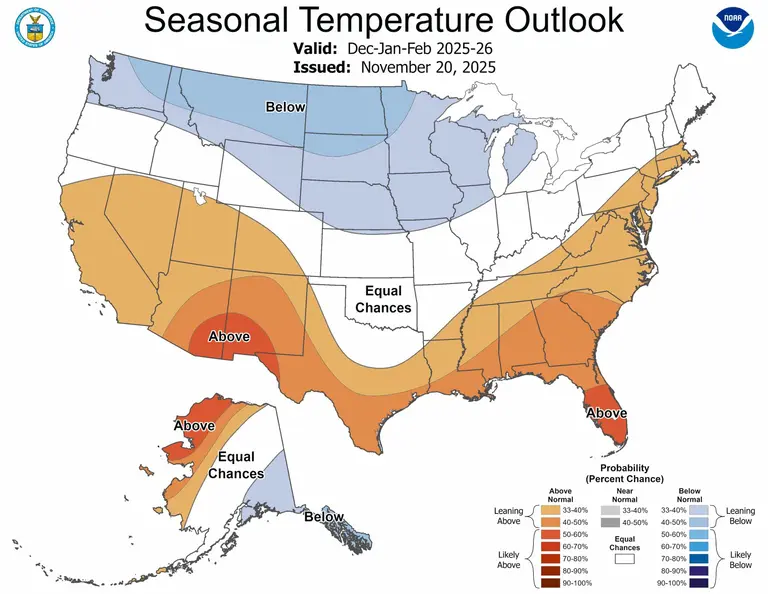
Photo: NOAA
Forecasters then added that the “DJF Precipitation Outlook depicts elevated below-normal precipitation probabilities for portions of the Mid-Atlantic, Southeast, Gulf Coast, Texas, the Southwest, and California. Above-normal precipitation is favored from the Upper Mississippi Valley and Great Lakes south to the Ohio Valley along with the Northern Great Plains, Northern Rockies, and parts of the Pacific Northwest. An increased chance of below (above)-normal precipitation is forecast for southeastern (northwestern) Alaska.”
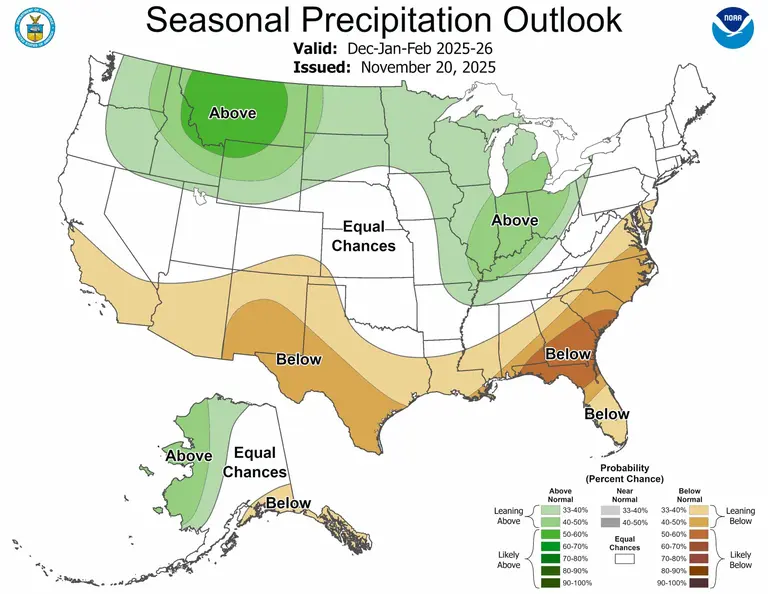
Photo: NOAA
The temperature-precipitation combo adds up to predictions for resorts in the Northern Rockies and Northern High Plains having above average snowfall while the snowfall predictions for the Pacific Northwest are still a coin flip. As is typical with La Niña winters, ski resorts in the Southwest, including the southern parts of Utah and Southern Rockies, may expect a drier winter with less snow than usual. A notable (slight) change from the NOAA’s October outlook has that Southwestern region seeing a winter that’s somewhat warmer than previously expected.
“Although a transition to ENSO-neutral conditions is likely to occur during January-February-March 2026, a La Niña influence on the mid-latitude circulation pattern and anomalous precipitation is expected to linger through the late winter or even early spring,” according to the CPC.

