
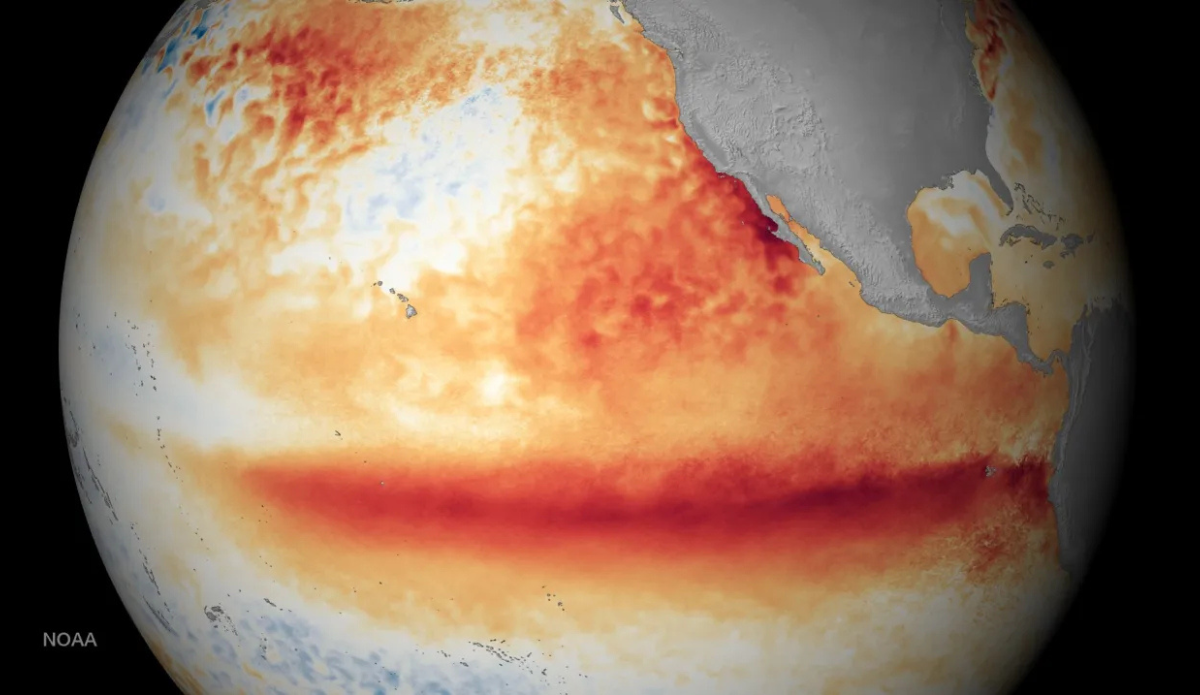
Satellite sea surface temperature departure in the Pacific Ocean for the month of October 2015, where darker orange-red colors are above normal temperatures and are indicative of El Niño. Photo: NOAA

Anticipation of a strong El Niño later this year has brought on a wave of superlatives. The “Super El Niño” has been escalated to “Godzilla El Niño” by many forecasters around the globe and opened discussion for what a climate event of that magnitude could bring. California ski resorts are already marketing it to sell season passes for next winter, for example, where warmer winter temps can raise snowfall levels but total snowfall typically increases at higher elevations in the Sierra Nevada.
One organization that we haven’t seen throw out the term “Godzilla El Niño,” at least, is the National Oceanic and Atmospheric Administration (NOAA), which prefers to refer to the upcoming event as “strong” or “significant” in its monthly analyses. The administration laid out its latest observations on April 9, announcing that the recent La Niña has officially faded and we are currently in a ENSO-Neutral phase. It’s worth noting that while many other experts have said La Niña was over, NOAA makes the declaration when sea surface temperatures in the tropical Pacific reach neutral levels for three consecutive, overlapping months. This means they’ve been observing a shift to neutral conditions since February.
The Climate Prediction Center doesn’t expect the current neutral conditions to last long, with the initial shift from neutral to that potential strong El Niño starting as soon as next month. Another noteworthy piece of its forecast involves just how long this upcoming El Niño may stick around and impact weather patterns.
“El Niño is likely because of increasing subsurface temperature anomalies and recent westerly wind anomalies over the western Pacific Ocean,” wrote the CPC. “However, the possible outcomes range from ENSO-neutral to a very strong El Niño during the upcoming Northern Hemisphere winter. The possibility of a very strong El Niño (1 in 4 chance) largely depends on the continuation of westerly wind anomalies across the equatorial Pacific throughout the Northern Hemisphere summer months, which is not assured. In summary, ENSO-neutral conditions are present and are favored through April-June 2026 (80 percent chance). In May-July 2026, El Niño is likely to emerge (61 percent chance) and persist through at least the end of 2026.”
That’s a long haul.

