
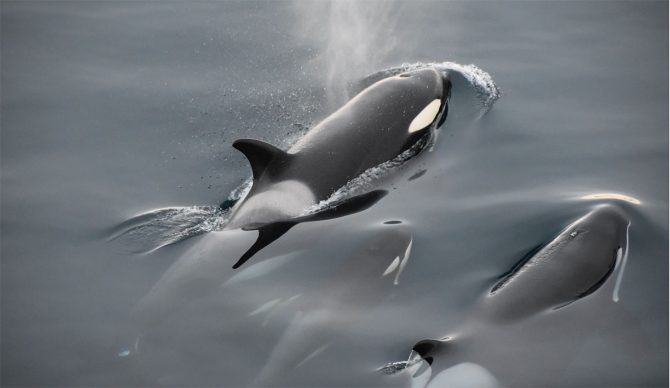
“Can you get that for me?” Photo: Unsplash

No matter how much we think we know about killer whales, they find new ways to surprise us. At times they do it in a way that is actively frightening, like when they started attacking boats in the Strait of Gibraltar. On the other hand, sometimes it just means they can be found using bits of kelp to clean each other, as scientists recently discovered.
Tool use is widespread in terrestrial animals, but less frequently seen in aquatic creatures, making the find even more incredible. According to a study newly published in the journal Current Biology, in July of 2024, southern resident killer whales in the Salish Sea were observed fashioning short lengths of bull kelp from complete stalks, positioning the stems between themselves and another whale, and then repeatedly rolling it along their bodies – a practice that has been named “allokelping.”
“We started keeping an eye out for the behavior and realized this was a common, frequent behavior, which was a very exciting moment,” Michael Weiss, research director at the Center for Whale Research and the study’s lead author, told The Guardian.
The discovery was even more remarkable for the fact that this is the first time it has been observed, despite how closely studied killer whales are. “We realized we had stumbled across a newly described behavior, which is remarkable,” he continued. “You don’t even think it is a possibility to find something new like this when you’re observing whales.”
As to what the animals are actually doing: the researchers hypothesize that allokelping is a means of social skin maintenance – a practice that would remove dead skin and parasites, as well as create social bonds in the group. Social skin maintenance has been observed in orcas before, but this is the first time they have been documented using tools to do it. The researchers believe this to be a cultural behavior unique to the southern resident killer whales.
“It really shows that these whales have so much to teach us and that we are still just scratching the surface of their lives and behavior,” said Weiss to The Guardian. “There is probably a lot of other such behavior we are just waiting to stumble upon, in this and other marine species.”

