
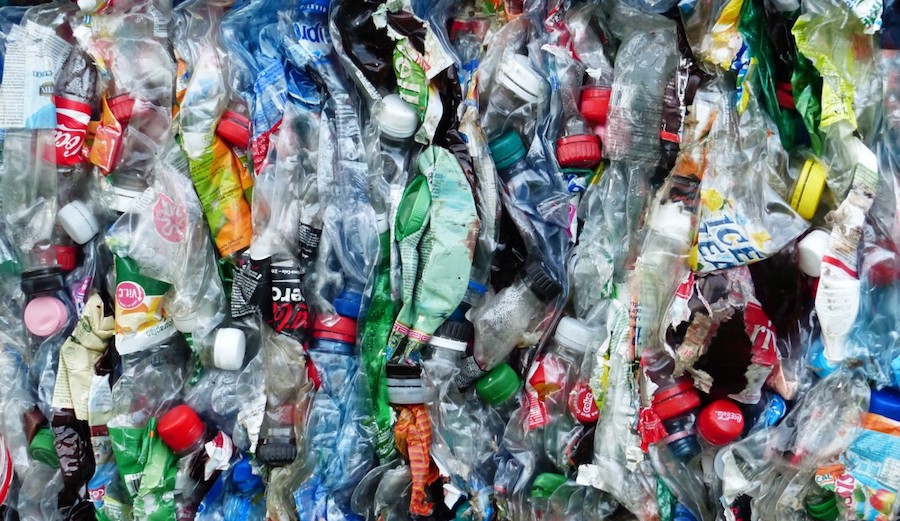
The mutated enzyme could be used to break down plastic bottles to their original materials. Photo: pxhere

Imagine if the solution to the global plastic epidemic was created in a laboratory by complete and utter happenstance. It sounds crazy, but a recent inadvertent scientific breakthrough may have monumental implications. In a study published in the Proceedings of the National Academy of Sciences (PNAS), a group of researchers outlined the structure of a mutant enzyme they created that breaks down plastic bottles. The discovery could be used to recycle plastic bottles down to their original materials, which would be a total game changer in fighting the plastic epidemic that’s plaguing our oceans and environment.
Back in 2016, scientists discovered a naturally occurring bacterium that evolved to eat plastic at a dump in Japan. The international team involved in researching how the bacterium developed, exactly, did so by messing with the enzyme it uses to break down PET (the polymer used in plastic bottles) and in so doing created a mutated version that breaks down plastic even more efficiently.
“What actually turned out was we improved the enzyme, which was a bit of a shock,” Professor John McGeehan, at the University of Portsmouth, UK, who led the research, told the Guardian. “It’s great and a real finding.”
Statistics associated with the globe’s plastic addiction and its impact on nature – particularly the ocean – are startling. Humans purchase a million plastic bottles every minute worldwide, according to the Guardian, the lion’s share of which do not get recycled.
Potential solutions abound ranging from educating consumers to change their behavior to reprocessing PET into carpets and clothing to cleaning up the oceans with a giant floating “boom.” Together, such solutions deal with the consumer demand for plastic, and the outcome of plastic ending up in the ocean, but all fail to actually recycle a plastic bottle into a new plastic bottle, thereby reducing the consumer demand for oil.
According to McGeehan, this mutated enzyme may have just unlocked that ability. “What we are hoping to do is use this enzyme to turn this plastic back into its original components, so we can literally recycle it back to plastic,” he said. “It means we won’t need to dig up any more oil and, fundamentally, it should reduce the amount of plastic in the environment.”
The mutated enzyme breaks down plastic about 20 percent faster than that of the naturally occurring bacterium discovered in 2016 in Japan. McGeehan says that’s not the point. “It’s incredible because it tells us that the enzyme is not yet optimized. It gives us scope to use all the technology used in other enzyme development for years and years and make a super-fast enzyme.”

