
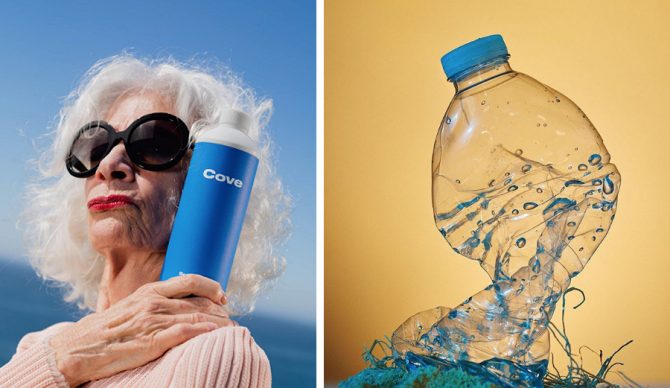
Photo: Cove / Instagram

According to a 2016 report by National Geographic, Americans consume the equivalent of 1.7 billion half-liter bottles of water every week, which averages out to just over five bottles of water being consumed by every person in the nation in a seven-day span. It’s now the most-consumed bottled beverage in the U.S., overtaking carbonated drinks, coffee, beer, and sports drinks.
Less than 30 percent of those water bottles are ever recycled while the other 70 percent will end up in landfills or in the ocean. Over the course of thousands of years, those plastics disintegrate through a process called photodegradation, but they never fully biodegrade. Left behind are microplastics, which we’ll all have to wait a long time to fully understand the consequences of. Personal reusable canteens and insulated bottles and greater recycling efforts are the most obvious solutions, but if we’re talking about a massive, universal change of daily habits, plastic water bottles are probably here to stay. Plenty of businesses have researched alternative materials that could ultimately replace the injection-molded plastic bottles but to this point, those still require some kind of recycling effort on the consumer, introducing a catalyst for the degrading process, or are made partly of metals or plastics that don’t fully biodegrade.
“For so long the big brands producing all these products just said ‘It’s the consumer’s fault. It’s on the consumers to recycle their bottles,'” Alex Totterman, a London-born entrepreneur told me. “I disagree with that. I think that brands, governments, and companies should be providing solutions so that it’s as easy as possible for people to do the right thing.”
Totterman’s solution to the problem is about to become the world’s first 100-percent biodegradable, single-use bottled water company, Cove. When the company officially launches on February 28th, cases of 12 will sell for $24 and ship throughout California in May. Their plan is to bring that cost down to compete with brands like Dasani and Smart Water in 18 to 24 months. For now, it seems, Cove’s biggest opportunity is setting an example that the status quo can be changed for the better.
“We are all for people not drinking bottled water, it’s just that despite the growing awareness of plastic pollution, plastic bottled water use is at an all-time high,” he adds. “It’s the biggest beverage category and it’s never been bigger, so there’s never been a better opportunity to transform that.”
The Cove bottle will be made of a natural biopolymer called PHA. Polyhydroxyalkanoate (PHA) is made by bacteria that feed on sugars, vegetable oils, starches, or greenhouse gases, and scientists and entrepreneurs have been devising ways to use it for packaging that would replace regular plastic because of its potential as a zero-waste product. You could conceivably throw it into your standard trash bin at home without a second thought where it’d, unfortunately, end up in a landfill (or eventually the ocean), and over time it would naturally break down without creating any toxic waste. There’s no exact timeframe for how long a Cove water bottle would take to biodegrade because the process is impacted by a handful of variables, like temperature, humidity, and microbial load. The company says a conservative estimate right now would be that a Cove bottle would take five years to biodegrade in soil.
“But of all the possible environments to consider, 100 percent soil is one of the least conducive environments for biodegradation,” a company media kit reads. “In compost, landfills, and the ocean, biodegradation will likely happen much sooner than five years.”
“We have roughly 30 years before it’s a reality that we have more plastic in our ocean than we do fish, which is just nuts,” Totterman explains. “So we need to turn off the amount of single-use plastics that are going into our environment.”
It’s kind of shameful to realize the most exciting and maybe the most viable long-term solution to one plastic pollution problem still ends with waste landing in the ocean, but accepting that likely reality seems to be something that helped Totterman get this far over the two years he’s spent creating Cove.
“Something you used for maybe 30 seconds out of a day, like a bottle of water or a snack — it’s nuts that we throw that material into our environment and it ends up in all kinds of places we don’t want it to be,” he says. “Our infrastructure to deal with it is broken, so we then leave it to our last barrier which is nature, and nature is not made to accept plastic. That’s just the truth of it.”
Ultimately, Totterman says the solution is a “multi-pronged approach,” with more people using refillable bottles as a direct reduction of single-use plastics, a greater infrastructure for recycling the single-use plastics we do consume, and greater favor for biodegradable products. Obviously, Cove tackles the latter. The entrepreneur says he didn’t set out to start a beverage company but it seemed to become a viable solution to the problem he wanted to solve. Now he describes the brand as something that leads the way in encouraging larger companies, governments, and consumers to adopt more environmentally-conscious options.
“The communities which seem to connect with this most were ocean-centric communities and artistic communities,” he points out. “There’s got to be a deeper philosophical reason for that and I think that people who are connected to the ocean and people that are connected to their own emotions more are aware of this issue and more in touch with it. People do care and want to do the right thing, there just isn’t an option.”
Now, thankfully, there is.

