
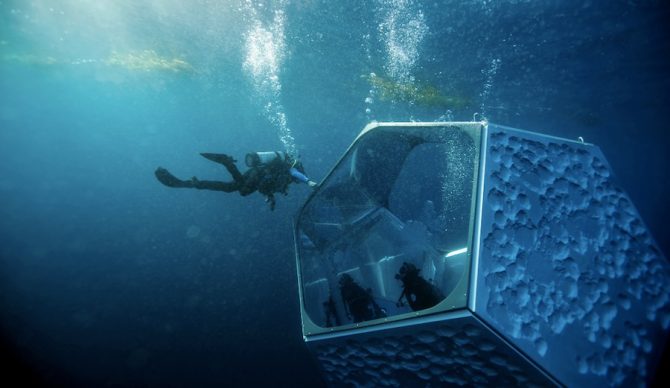
Divers swim up to Doug Aitken’s art installation, made up of three pavilions, off the coast of Catalina. Photo: Patrick T. Fallon/NY Times

Artistic expression is a funny thing. Sometimes, it can feel inaccessible, pompous even – expensive works of art lining the walls of museums, linoleum floors, title, oil or acrylic on canvas. But, other times, certain pieces transcend those barriers and touch something deeper in us. They’re pieces that surround, entice, and evoke an emotional experience without words.
The last time I felt something like that was when I saw Pablo Picasso’s ‘Guernica‘ in Madrid. At more than 11-feet tall and 25-feet wide, the thing was massive. I stared at it for more than 10 minutes.
I imagine a recent art installation by Doug Aitken off the coast of Catalina would stir in me a similar emotional reaction, albeit for different reasons.
The three ‘pavilions’, as Aitken calls them, are 12-sided structures with mirrors on the inside that capture and reflect sunlight as they float back and forth, 15 feet beneath the waves. The exterior is made of a composite to foster marine growth, meaning as time passes the installation will slowly become a part of the natural environment, with barnacles and algae latching on to the walls.
Divers and swimmers can swim through the pavilions, seeing themselves, the sun, the depths and passing fish reflected in kaleidoscopic fashion.
The project was produced with support from Parley for the Oceans, a nonprofit environmental group that focuses on raising awareness and advocating for our oceans.
The pavilions are planned to remain off of Catalina for several months, and will likely become a permanent installation in the Maldives.
For those who won’t be able to visit the pavilions in person, both Parley and the Museum of Contemporary Art websites will host a live feed beginning December 4.
You can also check out the New York Times video below for a 360-degree look at the pavilions:


