
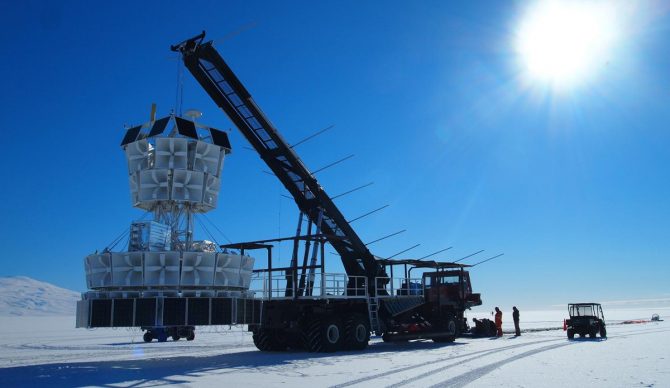
Photo: Stephanie Wissel // Penn State

Something strange is going on in the Antarctic. There, a cosmic particle detector recently found unexplained radio waves emanating from below the Earth’s surface. Not only was the finding unexpected, but it seemed to defy the very laws of physics.
The radio waves were picked up by the Antarctic Impulsive Transient Antenna (ANITA) experiment, which was designed to detect neutrinos – elusive subatomic particles that may hold the key to understanding the origin of matter. “We have these radio antennas on a balloon that flies 40 kilometers above the ice in Antarctica,” explained Stephanie Wissel, an associate professor of physics, astronomy and astrophysics who worked on the ANITA team, in a press release. “We point our antennas down at the ice and look for neutrinos that interact in the ice, producing radio emissions that we can then sense on our detectors.”
According to findings published in the journal Physical Review Letters, the equipment detected two anomalous radio pulses that “appear inconsistent with the standard model of particle physics. “The radio waves that we detected were at really steep angles, like 30 degrees below the surface of the ice,” explained Wissel. She elaborated that, by their calculations, the waves would have had to pass through and interact with thousands of kilometers of rock to reach the antenna – which should be impossible.
“My guess is that some interesting radio propagation effect occurs near ice and also near the horizon that I don’t fully understand, but we certainly explored several of those, and we haven’t been able to find any of those yet either,” said Wissel. “So, right now, it’s one of these long-standing mysteries, and I’m excited that when we fly PUEO, we’ll have better sensitivity. In principle, we should pick up more anomalies, and maybe we’ll actually understand what they are. We also might detect neutrinos, which would in some ways be a lot more exciting.”

