
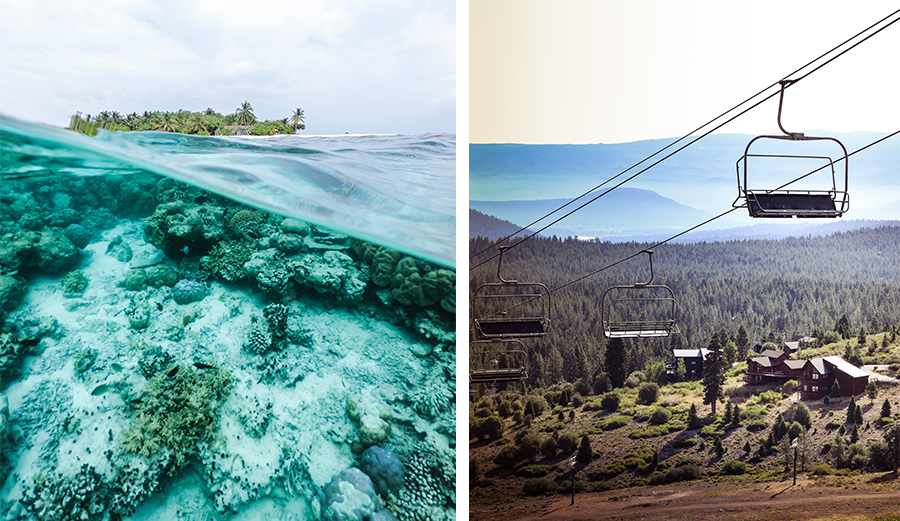
Unless we act swiftly, the future is bleak for our oceans and mountains, a new U.N. climate report says. Photo: Ishan/Unsplash (L)/ Allie Smith/Unsplash (R)

As if we didn’t already know, climate change poses a major threat to the oceans and snowy peaks where we recreate. Today, though, the United Nations Intergovernmental Panel on Climate Change released a blistering report that proves the situation is especially dire.
Acidification, sea-level rise, and increased frequency in major storms are just a few of the impacts global climate change is having on the world’s oceans – issues that will only be exacerbated barring swift and dramatic global action. And glaciers, snow, ice, and permafrost in high mountain areas are currently in decline.
The special report, titled The Ocean and Cryosphere in a Changing Climate, paints a bleak picture of a warming planet and the impact that has on the cryosphere – the part of the planet that’s frozen water – and the oceans.
For one, the report acknowledges that melting ice sheets and glaciers in areas like Greenland and Antarctica are contributing to an increasing rate of sea-level rise. The result is an increase in the frequency of “extreme sea-level events” that often occur during high tides or major storms. According to the report, events that happened once every hundred years will likely occur every year by 2050. And if low-lying coastal areas and islands don’t adapt, they’re likely to be at higher risk of flooding. Some island nations may even become uninhabitable.
Up in the mountains, the IPCC report explains snow, ice, and permafrost will continue to decline under current conditions, impacting the availability of water downstream and “adversely [affecting] recreational activities, tourism, and cultural assets.” In other words, shorter ski and snowboard seasons around the globe.
“Smaller glaciers found for example in Europe, eastern Africa, the tropical Andes, and Indonesia are projected to lose more than 80% of their current ice mass by 2100 under high emission scenarios,” a summary of the report explains.
The report also details how the world’s oceans have absorbed more than 90 percent of the excess heat in the climate system to date, and that’s impacting ocean chemistry, oxygen supply, nutrient supplies and biodiversity.
“By 2100, [the ocean] will take up two-to-four times more heat than between 1970 and the present if global warming is limited to 2°C, and up to five-to-seven times more at higher emissions,” the report says.
At this point, the authors warn that government intervention may not be able to reverse the course of a warming planet, but that action is urgently needed to slow its effects to make the situation more bearable in the immediate term.
“If we reduce emissions sharply, consequences for people and their livelihoods will still be challenging, but potentially more manageable for those who are most vulnerable,” said IPCC chair Hoesung Lee in a statement.”We increase our ability to build resilience and there will be more benefits for sustainable development.”
The more than 100 authors from 36 countries are calling for countries to put forth ambitious climate action policies pursuant to the landmark Paris Agreement. They say it may be the only way to keep warming below 2°C above pre-industrial levels, an amount of warming that will already have a sizable impact on human life.
“We will only be able to keep global warming to well below 2°C above pre-industrial levels if we effect unprecedented transitions in all aspects of society, including energy, land and ecosystems, urban and infrastructure as well as industry,” said IPCC co-chair Debra Roberts. “The ambitious climate policies and emissions reductions required to deliver the Paris Agreement will also protect the ocean and cryosphere.”
The release of the IPCC’s most recent report comes just days after the conclusion of the U.N. Climate Action Summit and in tandem with the 74th session of the U.N. General Assembly in New York City, that’s still ongoing.
At the Climate Action Summit, youth activist Greta Thunberg blasted world leaders for their inaction saying that it’ll be her generation left to deal with the consequences.
Authors of the IPCC report explain they hope the text will be a resource for world leaders as they head into key upcoming climate policy negotiations like the U.N. Framework Convention on Climate Change Conference (COP25) in Chile this December.

