
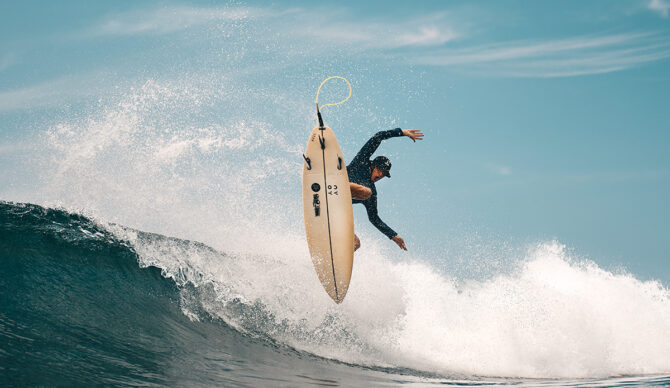
In IYYE Barnaby Cox went on a journey over land, sea and through the air. Photo: Eugene Tan

As joyful as surfing can be, it can also be a source of pain. Of course, there’s physical pain – reef rash, fin cuts, bruised ribs – but there’s also a mental toll. For competition surfers, the constant need to perform can turn life’s passion into a grind. And not everyone gets to come out the other end with a spot on the Championship Tour.
It’s a position that English surfer Barnaby Cox found himself in. Hailing from a little town in North Cornwall called Bude, he fought his way onto the competitive circuit, only to find that his dreams laid elsewhere. Eventually, he found his place, now splitting his time between England and the Maldives, where he works as a surf coach, but it was a journey to get there.
IYYE, filmed by Rob Blackett and starring Barnaby, chronicles that journey – along with a helluva lot of fantastic surfing across South Africa, Indonesia, and the Maldives. The term “iyye” means “yesterday” in Maldivian and pretty much sums up Baranaby’s experience over the last few years, he says. I sat down with him to learn how his new film came to fruition.
What’s your surfing background? What was the arc that took you to the beginning of the film.
I started competing when I was 12. I decided it was my dream to surf and travel, so I thought “I’ll compete and do it that way.” I competed for team England for a few contests around Europe and the World Junior Championships a few times. Then I did the European QS and I just got super burnt out from competing.
Me and my partner at the time were just like, “How else can we live this dream and surf and travel?” We thought, “Well, we can surf coach.” So we both made some CVs, searched for luxury surf resorts on Google, and just applied to the top 30. We got lucky, we got a few interviews, and we landed on a pretty sick job in the Maldives. So we got that job confirmation in the middle of 2023 and just decided to spend all our savings on an Indo trip, because I’d never been. We spent three months there and just had the sickest time. Then went from there to the Maldives and started that job. It was so cool, surf coaching and living my dream out there.
How did it feel to leave competition? That can be a difficult transition.
Yeah, it was. It felt like kind of the only option I had. I felt like every contest I was just doing worse and worse, surfing worse and worse. I just felt like it wasn’t going to change unless I changed something. I couldn’t just keep grinding forever. So I decided to have a break and actually try and get back to enjoying surfing again. I got so serious when I was competing that there was no joy left, and I think when it got to that point, that’s when I started to perform worse and worse.
It was funny. After I stopped competing, I had this little blue twinny and it was the only board I could surf that felt like I wasn’t trying to perform or get a score on. I only surfed that for the first three of four months after I stopped competing. Even then, it was so hard for me just not to be so stressed when I was surfing, like, “Am I going on the right wave on this set,” or, “What would that score have been if I’d gone on a different wave?” I just couldn’t enjoy the moment. Throughout, this film was kind of just getting back to that enjoyment and surfing my best, really.
Did you did you find that joy again? And then did that change the way you surfed?
A hundred percent. There was no pressure or needing to surf well – I didn’t depend on it anymore, I didn’t have sponsors. It being fun again made me surf so much better.
It’s funny how surfing is supposed to be such a freeing thing, but then it can also be so confining in a competition context, and in other ways.
Oh, definitely. I mean, that’s why everyone has this dream, because they love surfing. Then it gets to a point of, “Why are you doing this, if you’re not really enjoying it? Why are you out there?”
What was your experience like with Surfers Not Street Children, and also just spending time in Durban?
I’ve never really encountered danger like that. Where I live, people don’t really lock their doors, but out there, you can’t walk with your phone in your hand or go out after dark. I was really blown away by that.
I was also blown away by Surfers Not Street Children. It’s not just taking kids surfing. They pay for every kid’s education, so all these kids get put into school, and then after school they get straight to the beach, go surfing, and then after that they go back to the surf house, and they get cooked food. A lot of them have problems at home, so Surfers Not Street Children pays for social care and gets their families back together and buys them food boxes so they can eat healthy food. They really attack the problems from all angles. It was amazing how they built up these kids’ lives. I’m such a fan of that charity. I think they’re amazing what they do.
What’s next for you?
My sponsor, Seaskins, took me this January to Scotland. They’re cooking up something pretty sick, I think. They want to do a Celtic Nations surf trip, and you’ve got crazy waves up in Scotland. I was so happy with my surfing, so I can’t wait for them to release that. I also had some of the scariest surfs of my life up there. Horrible, scary slabs I would not have surfed unless my friends and other team riders, were like, “Yeah, we gotta go.”

