
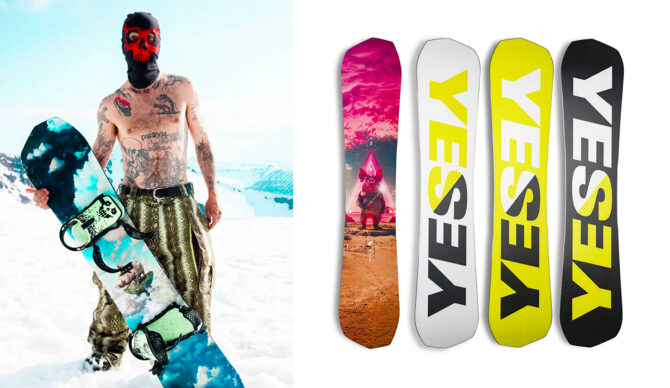
YES mixed AI with human design and a reference to conspiracy theories. Photos: YES

There is a lot of heat around snowboard graphics this season. In comment sections around the internet, riders grapple with a new reality: AI-art in snowboarding. In a moment when it feels like everything is charged with some level of political or cultural ideology, the snowboard world is not immune, and riders are tasked with discerning what counts as “real art.”
Board graphics have always been more than just a decorative afterthought. Over the years, top sheets and base graphics have defined a rider’s style and ethos. Brands have used graphics to make political statements, and some have ushered in a cultural shift, catching the attention of the mainstream press and reaffirming the anti-establishment roots of the sport. With the recent proliferation of affordable, and highly capable, AI tools it’s no wonder that an industry that has seen significant consolidation over the past two decades may turn to a tool that seemingly cuts costs. And while a handful of brands have admitted to using AI in the creation of some board graphics, a questions remain about how these generative AI tools are being utilized and whether they’re resulting in the elimination of the human element in the design process. Perhaps an even bigger question is, do riders want to stand on top of something that was designed with a prompt rather than a human’s artistic vision?
Complex indeed. The storied brands YES and Ride both confirmed the use of AI in specific graphics, and artists like Lucas Beaufort are watching the shift and choosing their own lanes. Taken together, the picture is less about replacement and more about how the tool is used, who is credited, and how the work is presented to riders.
#YES: A satirical AI experiment with a human counterpart
#YES explained to me via email that its Greats series this season took on the world’s greatest conspiracy theories, from aliens at the pyramids to the moon landing debates. As a satirical twist, the team intentionally incorporated AI into the design process and leaned into the AI aesthetic. Two in-house artists created five graphics featuring the UNINC pig in these scenarios. The goal was not to sneak AI into a line but to spark conversation about design and marketing today.
YES made two points that riders will care about. One, the brand is not replacing human creatives. Their line is still designed by the in-house team or in collaboration with designers like Mark Kowalchuk, Michiel Walrave, and Dagsson. Two, for anyone who’s not into the AI experiment, the Greats XTRM was released as a fully human-designed counterpart.
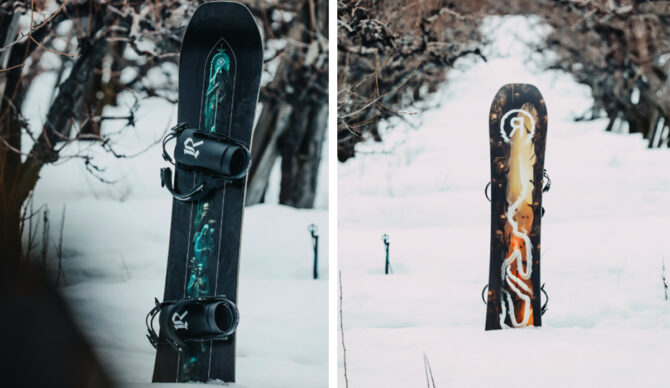
The Shadowban has created some controversy this year. Photo: Ride
Ride: AI on the Shadowban with a heavy lift by human designers
Ride addressed what has been discussed online about the Shadowban (also via email). The in-house art department utilized an AI program to create a graphic that would not have been possible otherwise. It was not a one-and-done prompt. Ride’s designers developed a concept, learned the tool, produced more than 80 variations, and layered the result inside standard design programs. The team says this took no less bandwidth, people, or time than a traditional topsheet. They also note that no AI programs were used for other graphics or for marketing materials.
Ride frames the approach as creative autonomy. Snowboarders design the product. They pick the tools and stand behind the outcome, six-finger easter egg included. The message is simple. The board is still the work of human designers who ride, and the process is still hands-on.
An artist’s take
French artist Lucas Beaufort is a familiar name on topsheets. He told me he was initially skeptical of AI and doesn’t currently use it to design boards. His inspiration comes from real life. Books, travel, and the people he meets. At the same time, he’s not drawing a hard line for everyone else. He sees technology as something that evolves. You can adapt and take an interest in what is happening, or you can get left behind. For him, the right move is to listen, pay attention, observe, then decide. He does use AI in practical ways, such as building pitches for brands. Image creation may come one day, but for now, he has enough inspiration elsewhere.
That stance captures what many artists are working through. A tool can exist without owning the work. Process matters. So does the clarity around how the tool was used.
A minimalist counterpoint
On the flipside, some brands forgo board graphics altogether. Korua Shapes occupies a distinct space, featuring a minimalist aesthetic approach that is both a creative decision and a pragmatic one. Creative Director Aaron Schwartz told me he has little direct experience with AI and doesn’t see a significant role for it in his process. Admittedly old school in his approach to photography and design, Aaron embodies what many riders feel is a key ingredient to snowboard culture — the human element. For him, creativity should carry a personal touch, not feel like it was generated from a template or automated system.
Aaron traced his own interest in art back to album covers and film photography from his youth, all of which were created by human hands. That legacy is why he is skeptical of AI-generated snowboard graphics. As he put it, “people become skilled artists for a reason.” Designing a board graphic is not just checking a seasonal box before moving on to the next cycle; it’s about creating something meaningful that embodies the human element.
At the same time, Aaron admitted he is in a unique position to comment. Korua doesn’t rely on topsheet graphics at all; instead, it embraces a minimalist design philosophy. That approach sets the brand apart from the traditional seasonal cycles that dominate snowboarding. By avoiding constant graphics updates, Korua avoids the end-of-season fire sales and waste that often force bigger brands to discount or even dispose of unsold product.
This gives Korua a sustainability edge, and it also means the brand is unlikely to experiment with AI-generated graphics anytime soon. For Aaron, AI not only conflicts with his personal view of creativity, but it also raises questions about environmental impact. Generating images at scale requires computing power and energy. From Aaron’s POV at Korua, paired with already wasteful seasonal cycles, AI-driven design could amplify snowboarding’s footprint rather than shrink it.
Where AI is already infiltrating the business
Even if some brands never use AI for final topsheets, the tools are already showing up around the edges of the business. Artists and brand teams are using AI to draft pitches, summarize briefs, generate internal mockups for retailer decks, test copy variations for social and email, and produce rough background plates for photography layouts. None of this decides the culture. It is office work. But it does shape timelines, budgets, and the number of options a creative team can review in a day. That has ripple effects. More options can be good, but they can also create noise. In this scenario, strong art direction becomes increasingly important, not less so.
View this post on Instagram
Ethics
Two questions sit under every AI conversation. What was the model trained on, and who gets credit if a style is mimicked? Many artists object to models that were trained on copyrighted work without consent. Style theft is not a new debate, but AI seems to be accelerating it. If a brand wants to use AI responsibly, the basic guardrails are clear. Prefer tools with opt-in training data. Do not ask for outputs that imitate living artists without permission. When a human artist polishes or finishes a piece that began with AI, credit and compensation should reflect the real work, not the myth that a prompt did the job.
Environment
AI image generation runs on computer and data centers that draw real power. A single image costs far less energy than running a lift at the local resort, but the scale matters. When a team spins hundreds of iterations, the compute adds up. The comparison is not simple. Human workflows also consume energy and materials. The practical question for a brand is the whole lifecycle. How many iterations do you need? How will you store and serve those files? How can you cut waste in sampling and proofing? The greenest approach remains a focused process with fewer, better drafts, regardless of the tool.
The Current Landscape
This season marked the first significant emergence of AI in snowboard design in targeted, public ways. While snowboarding has always been a mix of culture and product, the next few seasons will be shaped by riders who vote with their wallets, artists who choose their process, and brands that explain their choices. At the time of writing, debate over AI graphics has spilled out of the Subreddits and into customer reviews on major retail sites. Perhaps a level of controversy not seen since Burton’s release of the infamous Love series that featured Playboy centerfolds.
It’s still early days, and it’s unclear where this will all lead. If the use of AI tools made the cost of products dramatically less expensive, you may see a shift in consumer sentiment. On the other hand, it is not difficult to imagine a resurgence, and reverence for, products that employ a more analog, homemade approach. For the time being, however, riders seem to be clear about what they want from brands: honesty about how a board is made and a significant human presence at the center of the work.
Editor’s Note: JP Schlick is a writer, cinematographer, and editor that has worked in the snowboarding industry for nearly two decades. He’s a longtime contributor to The Inertia.

